

 Edu_Admin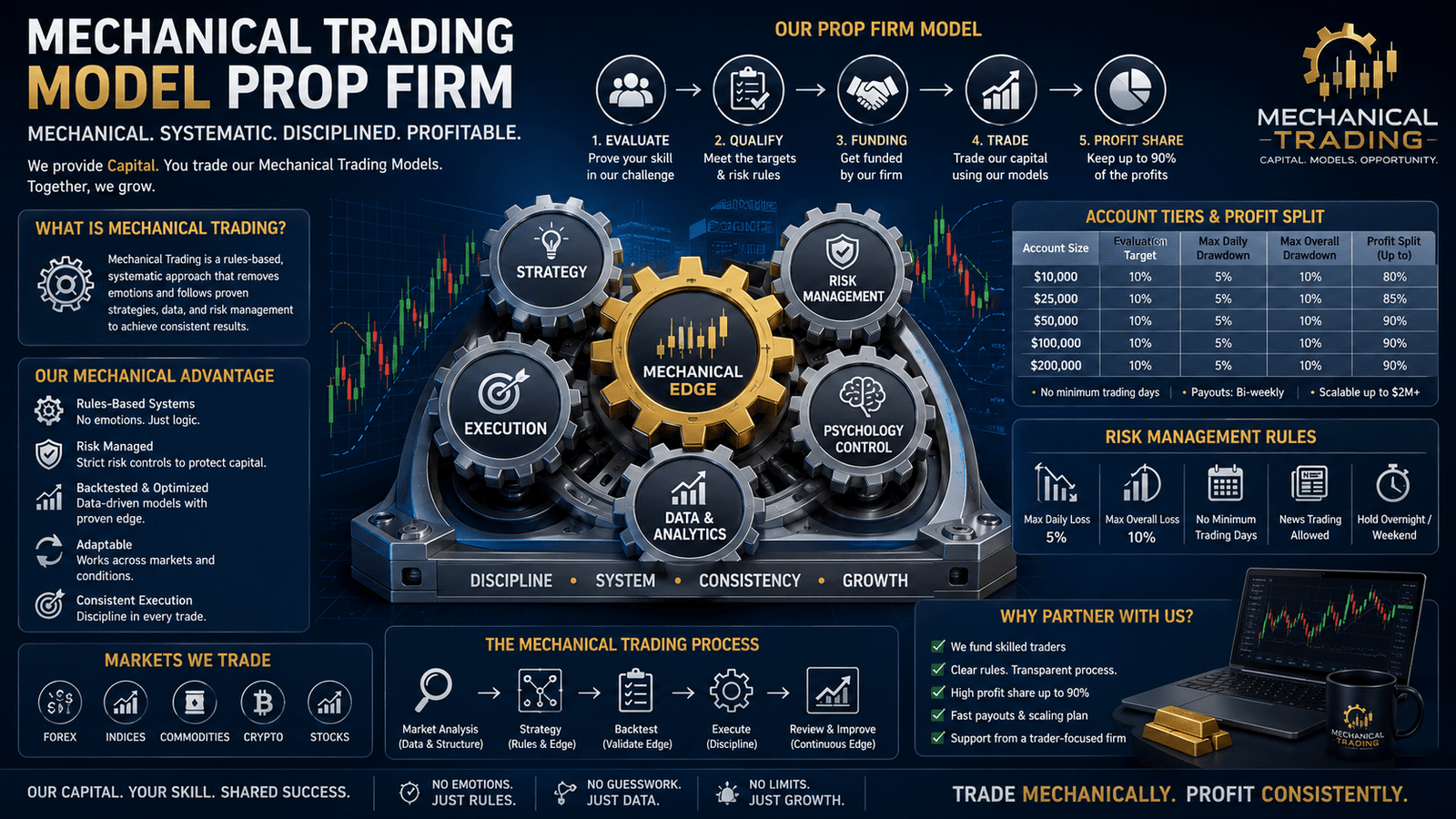
Introduction
The path to becoming a funded trader is littered with failure. Most traders who attempt proprietary trading firm challenges fail. Not because they lack intelligence or work ethic, but because they rely on discretion, gut feelings, and emotional decision-making in markets that reward discipline and punish impulsivity. The problem is not a lack of information. It is having too much information and no systematic way to act on it.
Proprietary trading firms, or prop firms, provide traders with access to significant capital—typically $25,000 to $250,000 in buying power—without requiring the trader to risk their own money. In exchange, the firm takes a percentage of the profits, usually between 10 and 20 percent. The arrangement is attractive: trade with substantial capital, keep the majority of the profits, and limit personal downside. But the evaluation process to qualify for such funding is notoriously difficult, with most candidates failing to meet the drawdown and profit targets.
This is where the concept of a mechanical trading model becomes essential. A mechanical trading model removes the psychological burden of trading by providing a strict, if-this-then-that set of rules. It eliminates hesitation, eliminates gut feelings, and eliminates the emotional rollercoaster that destroys most traders’ accounts. It transforms trading from an art into a repeatable, testable process.
The The 10-Day Prop Firm Blueprint: A Mechanical Trading Model course introduces the A+ Mechanical Trading Model, a system refined over 10 years of professional Forex trading and multiple successful prop firm allocations. It is not a broad theory course; it is a specialised blueprint designed to help traders pass prop firm evaluations efficiently.
This guide provides a comprehensive overview of mechanical trading models, why they matter for prop firm challenges, what the course covers, and how you can begin your journey toward becoming a funded trader.
What Is a Mechanical Trading Model?
A mechanical trading model is a trading system with clearly defined, unambiguous rules for entering and exiting trades. Every decision is governed by a predetermined set of conditions. There is no discretion. There are no gut feelings. If the rules are met, you take the trade. If they are not met, you do not.
The Core Characteristics
Zero Discretion
The defining feature of a mechanical trading model is the complete absence of discretion. As the course description states, this setup is completely mechanical and has been designed to trade with logic and simplicity, thus removing emotional decision-making. If the rules are not met, there is no trade.
Rule-Based Decision Making
Every aspect of the trade is governed by rules: entry conditions, stop loss placement, profit target placement, position sizing, and trade management. The rules are specific, objective, and testable.
Psychological Relief
One of the greatest benefits of a mechanical trading model is the removal of psychological burden. Most traders struggle not with strategy but with the psychological issues that arise from discretionary trading: fear of loss, fear of execution, FOMO (fear of missing out), overtrading, and overleveraging. A mechanical model addresses these issues directly by replacing emotional decisions with rule-based execution.
Backtestable and Verifiable
Because the rules are specific and objective, a mechanical trading model can be backtested. You can verify the performance of the model on historical data before risking a single dollar of real capital.
Why Most Traders Fail Without a Mechanical Model
The course makes a compelling observation: most traders fail not because they lack information, but because they have too much of it. Information overload leads to analysis paralysis. When every trade setup requires interpretation and judgment, inconsistency is inevitable. A mechanical model solves this problem by providing clear, actionable rules that eliminate the need for interpretation.
What Is a Prop Firm and Why Does It Matter?
A proprietary trading firm, or prop firm, is a company that provides traders with capital to trade in financial markets. In return, the firm takes a share of the profits.
The Prop Firm Model
| Feature | Description |
|---|---|
| Capital Access | Traders get access to $25,000 to $250,000 in buying power |
| Risk Profile | The trader does not risk their own capital |
| Profit Split | The firm takes typically 10-20% of profits |
| Evaluation | Traders must pass a challenge to prove their profitability |
Why Prop Firms Are Attractive
Limited Personal Risk
Trading with a prop firm means you are not risking your own capital. The firm absorbs the downside risk in exchange for a share of the profits.
Access to Significant Capital
Retail traders with limited capital often struggle to generate meaningful returns. Prop firm funding provides access to capital that would otherwise be unavailable.
Professional Environment
Prop firms provide a professional trading environment with access to sophisticated tools, data, and often a community of traders.
Career Path
For successful traders, prop firms can provide a legitimate career path with the potential for substantial income.
The Challenge of Passing Prop Firm Evaluations
Prop firms do not give away capital freely. Traders must pass an evaluation that typically requires meeting specific profit targets while staying within drawdown limits. The difficulty of these evaluations is the reason most traders fail. A mechanical trading model designed specifically for prop firm challenges addresses this difficulty directly by providing a systematic approach that meets the drawdown and profit targets of modern prop challenges.
The A+ Mechanical Trading Model
The A+ Mechanical Trading Model is the centrepiece of the course. It is a system refined over 10 years of professional Forex trading and multiple successful prop firm allocations.
Key Features of the Model
Pure Price Action
The model is based on pure price action. It does not rely on complex or lagging indicators that can obscure the true market picture. This makes the model applicable across multiple markets including Forex, Futures, Metals, and Indices.
Exact Entry Conditions
The model identifies the exact candle for entry. Unlike discretionary strategies that leave you wondering where the “exact” entry is, this setup is completely mechanical.
Mathematical Stop Loss and Target Placement
Stop loss and profit target placement are based on mathematical calculations, not subjective judgment. This ensures consistency and removes the emotional component of trade management.
Session and Pair Specificity
The model identifies which specific sessions and Forex pairs provide the highest probability for this trading model. This focus on optimal conditions improves the probability of success.
Prop Firm Optimised Position Sizing
Position sizing is specifically designed for prop firm evaluations. This ensures that the model meets the drawdown requirements of modern prop challenges.
Process-Based Trading
The model emphasises consistency through process-based trading. The focus is on executing the process correctly, not on individual trade outcomes.
The 10-Day Blueprint
The course provides a step-by-step schedule to pass prop firm evaluations efficiently. The 10-day timeframe is not arbitrary—it is designed to be achievable while maintaining the discipline required for consistent profitability.
What the Course Covers
The The 10-Day Prop Firm Blueprint: A Mechanical Trading Model course provides a complete training program for traders who want to pass prop firm challenges using a mechanical trading model.
Course Overview
| Feature | Detail |
|---|---|
| Total Duration | 7 hours 40 minutes |
| Number of Lectures | 21 lectures |
| Number of Chapters | 6 chapters |
| Language | English |
| Last Updated | April 2026 |
| Student Enrollment | 24+ students |
What You Will Learn
Master the A+ Mechanical Trading Model
- Trade a completely mechanical trading model for Forex, Futures, Metals, and Indices
- Execute the A+ trading model with zero hesitation or gut feelings
- Identify the exact candle for entry and the mathematical placement for stop loss and target
- Know which specific sessions and Forex pairs provide the highest probability
Protect Your Capital
- Use position sizing designed specifically for prop firm evaluations
- Protect your capital through disciplined risk management
Pass Prop Firm Challenges Efficiently
- Follow a step-by-step schedule to pass prop firm evaluations
- Build your own blueprint to pass prop firms in 10 trading days
Improve Trading Psychology
- Solve psychological issues including fear of loss, fear of execution, FOMO, overtrading, and overleveraging
- Build consistency through process-based trading
Verify Your Trading Model
Enrol in The 10-Day Prop Firm Blueprint: A Mechanical Trading Model Now
Who Should Take This Course
Traders Who Want to Pass Prop Firm Challenges
The course is specifically designed for traders who want to pass prop firm challenges in about 10 trading days. If you have attempted prop firm evaluations and failed, this course provides a systematic alternative.
Traders Seeking Funded Accounts
Anyone looking to secure 5 or 6-figure funding and needing a reliable system to pass the evaluation will benefit from this structured approach.
Traders Lacking Consistency
Traders who have knowledge but lack a consistent, repeatable execution plan are the ideal audience for this course. The mechanical model provides the consistency that discretionary trading cannot.
Traders Struggling with Psychology
Traders who struggle with psychological issues including fear of loss, fear of execution, FOMO, overtrading, and overleveraging will find that a mechanical model addresses these issues directly.
Beginners Seeking a Structured Starting Point
Beginners who want a structured starting point will benefit from a course that provides clear, actionable rules rather than vague theories.
Why This Course Is Different
Zero Discretion
Unlike traditional strategies that leave you wondering where the exact entry is, this setup is completely mechanical and has been designed to trade with logic and simplicity. If the rules are not met, there is no trade.
Prop Firm Focused
The course is specifically designed to meet the drawdown and profit targets of modern prop challenges. This is not a general trading course—it is a specialised blueprint for passing prop firm evaluations.
Professional Grade
The model is built on 10 years of institutional-level market experience. You are not learning from a retail trader with limited experience; you are learning from a professional who has navigated the challenges of institutional trading.
Back-Testing Framework
The course includes a back-testing guide to help you verify the data for yourself before risking a single dollar. This ensures that you have confidence in the model before applying it with real capital.
Frequently Asked Questions
What is a mechanical trading model?
A mechanical trading model is a trading system with clearly defined, unambiguous rules for entering and exiting trades. There is no discretion and no gut feelings. If the rules are met, you take the trade. If they are not, you do not.
What is a prop firm?
A prop firm, or proprietary trading firm, is a company that provides traders with capital to trade in financial markets. In return, the firm takes a share of the profits. Traders do not risk their own capital.
What markets can I trade with this model?
The model is applicable to Forex, Futures, Metals, and Indices. It is a pure price action model that works across multiple markets.
Do I need prior trading experience?
A basic understanding of Forex trading terminology and candlestick charts is helpful. The course requires a willingness to follow rules with patience and discipline.
How long does it take to pass a prop firm challenge with this model?
The course provides a blueprint to pass prop firms in 10 trading days. Individual results may vary based on market conditions and execution.
What is the A+ Mechanical Trading Model?
The A+ Mechanical Trading Model is a system refined over 10 years of professional Forex trading and multiple successful prop firm allocations. It is a zero-discretion, rule-based trading model designed specifically for prop firm challenges.
Which course should I choose for learning mechanical trading?
A course that provides a complete, rule-based trading model with clear entry and exit rules, back-testing guidance, and prop firm focus is ideal. The The 10-Day Prop Firm Blueprint: A Mechanical Trading Model course provides exactly this comprehensive training.
Mastering Mechanical Trading: Your Next Step
Passing a prop firm challenge is one of the most difficult achievements in retail trading. Most traders fail. Not because they lack intelligence or dedication, but because they rely on discretionary decision-making in markets that demand discipline and consistency.
A mechanical trading model provides the solution. By removing discretion, eliminating emotional decision-making, and providing clear, testable rules, a mechanical model transforms trading from an art into a repeatable process. It is the difference between guessing and executing with confidence.
The The 10-Day Prop Firm Blueprint: A Mechanical Trading Model course provides the complete blueprint you need. With 7 hours 40 minutes of expert instruction across 21 lectures and 6 chapters, you will develop the skills to:
- Trade a completely mechanical trading model for Forex, Futures, Metals, and Indices
- Execute trades with zero hesitation or gut feelings
- Identify exact entry candles and mathematical stop loss and target placement
- Protect your capital with prop firm-optimised position sizing
- Pass prop firm challenges in 10 trading days
- Solve psychological issues including fear, FOMO, and overtrading
- Back-test and verify the model before risking real capital
The course starts from a practical foundation and builds your skills systematically.
Enrol in The 10-Day Prop Firm Blueprint: A Mechanical Trading Model Now
Recommended Related Courses
To build a comprehensive trading and mechanical systems skillset, consider these additional courses:
Build Your First Mechanical Trading System in 15 Minutes – Learn to build a mechanical trading system quickly using TradingView with no coding required.
Mechanical Trading Systems Using Technical Analysis – Develop mechanical trading systems using technical analysis and Pine Script.
Forex Day Trading Strategy – Simple, Mechanical and Profitable – A simple, mechanical, and profitable Forex day trading strategy.
Institutional & Mechanical Market Structure Trading Strategy – Understand institutional and mechanical market structure trading strategies.
Mechanical Engineering-Machine Designing-1 – For those interested in the engineering side of mechanical systems.
Python for Mechanical Engineers – Develop programming skills applicable to algorithmic trading and mechanical systems.
Final Thoughts
Passing a prop firm challenge is one of the most significant achievements a retail trader can accomplish. It provides access to substantial capital, limits personal risk, and opens the door to a legitimate career in trading. But the path to funding is difficult, and most who attempt it fail.
The difference between success and failure often comes down to a single factor: having a mechanical, rule-based trading model that removes discretion and emotional decision-making. A mechanical model provides the consistency that discretionary trading cannot deliver. It transforms trading from an art into a repeatable, testable process.
The The 10-Day Prop Firm Blueprint: A Mechanical Trading Model course provides the complete blueprint you need to develop such a model and use it to pass prop firm challenges efficiently.
Start your journey to becoming a funded trader today.
Enrol in The 10-Day Prop Firm Blueprint: A Mechanical Trading Model
About the Author