



 Edu_Admin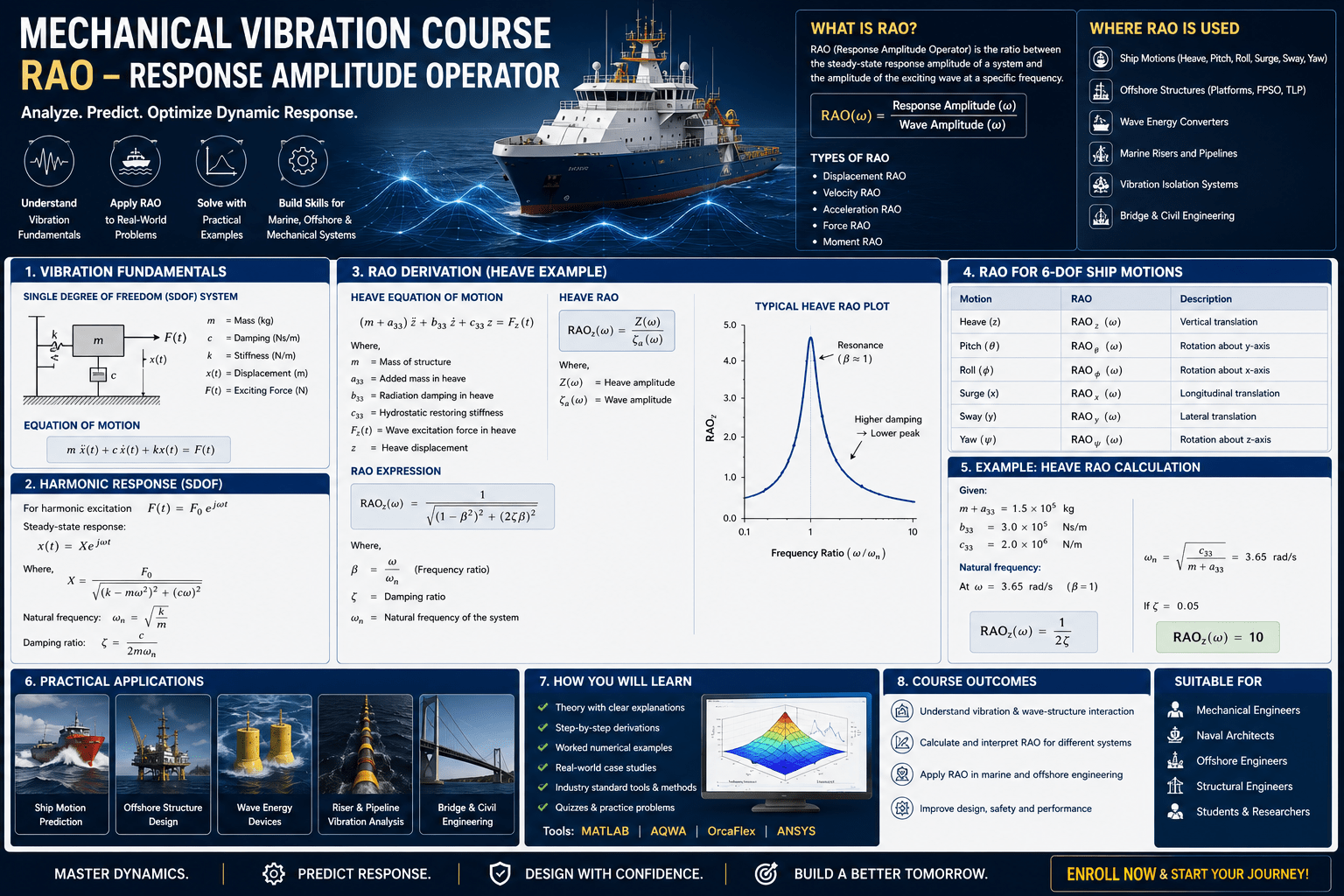
Introduction
Every machine vibrates. From the gentle hum of a household fan to the powerful rumble of a jet engine, vibration is an inherent part of mechanical systems. While some vibration is harmless, excessive or uncontrolled vibration can lead to catastrophic failure. It is the silent enemy of machinery, causing wear, fatigue, noise, and ultimately, breakdown.
Consider the consequences. A vibrating component can fail prematurely, leading to costly downtime, expensive repairs, and even safety hazards. In industrial settings, uncontrolled vibration can reduce the lifespan of equipment, compromise product quality, and create unsafe working conditions. In extreme cases, vibration-induced resonance can cause structures to collapse.
The science of mechanical vibrations is the study of oscillatory motion in physical systems. It is the discipline that enables engineers to predict, control, and mitigate vibration. Understanding vibrations is essential for designing reliable machines, structures, and systems that can withstand dynamic loads.
Mechanical vibration is one of the most important sciences for engineers. It is the foundation for understanding how machines behave, how to prevent failures, and how to design systems that operate smoothly and reliably. Yet for many engineering students and professionals, vibration analysis can seem abstract and mathematically intensive. The equations appear complex. The concepts are unfamiliar. Where does one even begin?
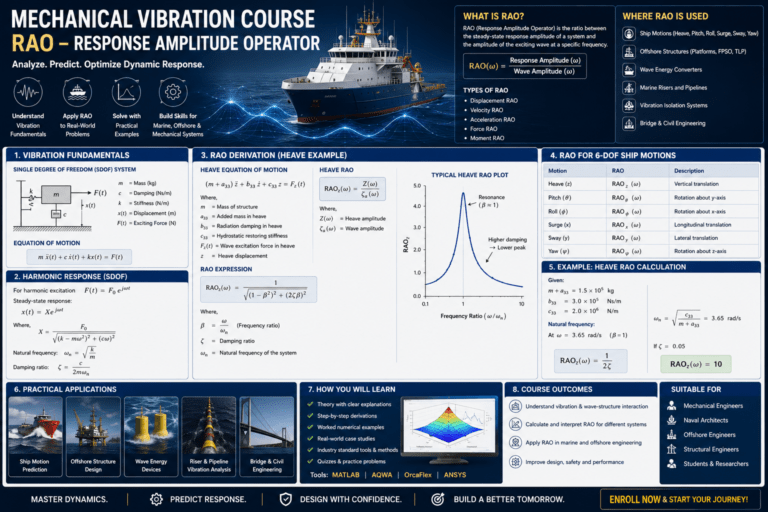
The Mechanical Vibration Course RAO is designed precisely for this purpose. It draws upon the renowned textbook “Mechanical Vibrations” by Singiresu S. Rao, a comprehensive guide to vibration theory, computations, and applications. With 27 hours 59 minutes of comprehensive instruction across 121 lectures and 14 chapters, this course takes you from the basic concepts of vibration to advanced topics including multi-degree-of-freedom systems.
This guide provides a comprehensive overview of what mechanical vibrations are, why they matter, what the course covers, and how you can begin your journey toward mastering vibration analysis.
What Is Mechanical Vibration?
Mechanical vibration is the oscillatory motion of a mechanical system about its equilibrium position. It is the repetitive back-and-forth movement of a body or system in response to an applied force or disturbance.
The Nature of Vibration
Vibration can be characterised by several key parameters:
- Amplitude: The maximum displacement from the equilibrium position
- Frequency: The number of complete oscillations per unit time
- Period: The time required for one complete oscillation
- Phase: The relative position of the oscillation at a given time
Types of Vibration
Mechanical vibrations can be classified in several ways:
Free Vibration
Free vibration occurs when a system is set into motion and then allowed to vibrate without any external force. The system vibrates at its natural frequency. Examples include a pendulum swinging or a plucked guitar string.
Forced Vibration
Forced vibration occurs when a system is subjected to a periodic external force. The system vibrates at the frequency of the applied force, not necessarily its natural frequency. Examples include a washing machine vibrating during the spin cycle or a building vibrating during an earthquake.
Damped Vibration
Damped vibration occurs when energy is dissipated from the system, causing the amplitude of vibration to decrease over time. Damping can be caused by friction, air resistance, or internal material damping. The course covers three types: over-damped vibration, critical-damped vibration, and under-damped vibration.
Undamped Vibration
Undamped vibration occurs when there is no energy dissipation. In theory, the vibration continues indefinitely. In practice, all real systems have some damping.
Why Vibration Matters
Vibration is not just an academic subject. It has real-world consequences:
Machine Wear and Fatigue
Excessive vibration accelerates wear on bearings, gears, and other components. Over time, this leads to premature failure and costly downtime.
Structural Damage
Vibration can cause structural damage to buildings, bridges, and other infrastructure. Resonance—when the frequency of excitation matches the natural frequency of the structure—can be particularly destructive.
Human Comfort
Vibration can cause discomfort, fatigue, and even health problems for people working near vibrating machinery.
Noise
Vibration generates noise, which can be a nuisance or a health hazard.
Product Quality
In manufacturing, vibration can affect product quality, causing defects in machined parts or inconsistent processes.
The RAO Textbook: The Gold Standard in Vibration Education
The course is based on the textbook “Mechanical Vibrations” by Singiresu S. Rao. This book is widely regarded as the gold standard for vibration education, used in undergraduate courses in vibration engineering. It presents the theory, computational aspects, and applications of vibration in as simple a manner as possible.
What Makes the RAO Textbook Exceptional
Comprehensive Coverage
The book covers all aspects of vibration analysis, from fundamental concepts to advanced topics.
Clear Explanations
Rao explains complex concepts in a straightforward manner, making them accessible to students.
Practical Applications
The book emphasises computer techniques of analysis and includes numerous examples and problems.
Widely Adopted
The textbook is used in universities worldwide and is considered the definitive reference for vibration engineering.
What the Course Covers
The Mechanical Vibration Course RAO provides comprehensive, in-depth training in mechanical vibration analysis.
Course Overview
| Feature | Detail |
|---|---|
| Total Duration | 27 hours 59 minutes |
| Number of Lectures | 121 lectures |
| Number of Chapters | 14 chapters |
| Language | English, with Arabic subtitle |
| Student Enrollment | 1,279+ students |
| Prerequisites | Calculus |
What You Will Learn
Introduction to Mechanical Vibration
You will be introduced to the basic concepts of mechanical vibration, including:
- Types of mechanical vibration
- Modelling of mechanical systems
- Calculating the equivalent stiffness and mass of systems
Free Undamped Vibration
You will learn to derive equations of motion and determine the natural frequency of vibrating systems. The course covers:
- Free undamped vibration (Linear, Rotational, and Torsional motions)
- Solving numerous examples
Damped Vibration
You will learn the basic concepts of dampers and understand:
- Over-damped vibration
- Critical-damped vibration
- Under-damped vibration
Forced Vibration
You will understand forced vibration due to:
- Rotating unbalance
- Base excitation
Multi-Degree-of-Freedom Systems
You will learn about systems with two or more degrees of freedom.
Practical Applications
You will learn how to:
- Reduce the amplitude of vibration
- Design vibration absorbers or shock absorbers for machines and structures to avoid resonance
Geophysical Applications
The course sheds light on the application of vibration theory in geophysics, including the physical basis of vibration measuring instruments and the decay and amplification of propagating vibratory motion.
Enrol in Mechanical Vibration Course RAO Now
Why Mechanical Vibration Matters for Engineers
Foundation of Machine Design
Understanding vibration is essential for designing reliable machines. Engineers must predict how machines will behave under dynamic loads and ensure that they operate within acceptable vibration limits. As one source notes, mechanical vibration is one of the most important sciences for engineers.
Failure Prevention
Many mechanical failures are caused by excessive vibration. Understanding vibration enables engineers to identify potential problems early and design solutions to prevent failure.
Performance Optimisation
By understanding vibration, engineers can optimise the performance of machines and structures. This includes reducing noise, improving comfort, and extending equipment life.
Career Opportunities
Vibration analysis skills open doors to roles including:
- Vibration Analyst
- Condition Monitoring Engineer
- Design Engineer
- Reliability Engineer
- Acoustic Engineer
Industry Applications
Vibration analysis is used across industries:
- Automotive: Engine vibration, suspension systems, NVH (Noise, Vibration, Harshness)
- Aerospace: Aircraft flutter, rotor dynamics
- Manufacturing: Machine tool vibration, quality control
- Energy: Turbine vibration, wind turbine dynamics
- Civil Engineering: Building response to earthquakes, bridge vibration
Who Should Take This Course
Mechanical Engineering Students
Students who want to build a strong foundation in vibration analysis will find this course invaluable. It covers both theory and practical applications.
Practicing Engineers
Engineers who need to understand vibration for their work—whether in design, maintenance, or reliability—will benefit from the comprehensive coverage.
Technicians
Technicians who work with vibrating machinery will gain a deeper understanding of the underlying principles.
Business Managers
Managers who need to understand the technical aspects of vibration for decision-making will find the course accessible and practical.
Requirements
The course has one primary requirement:
- Calculus
No prior vibration experience is required. The course starts from the basics and builds systematically.
Frequently Asked Questions
What is mechanical vibration?
Mechanical vibration is the oscillatory motion of a mechanical system about its equilibrium position. It is the repetitive back-and-forth movement of a body or system in response to an applied force or disturbance.
Why is vibration analysis important?
Vibration analysis enables engineers to predict, control, and mitigate vibration. It is essential for designing reliable machines, preventing failures, and optimising performance.
What is the difference between free and forced vibration?
Free vibration occurs when a system is set into motion and then allowed to vibrate without any external force. Forced vibration occurs when a system is subjected to a periodic external force.
What is damping?
Damping is the dissipation of energy from a vibrating system, causing the amplitude of vibration to decrease over time. Damping can be caused by friction, air resistance, or internal material damping.
What is resonance?
Resonance occurs when the frequency of an external force matches the natural frequency of a system, causing the amplitude of vibration to become very large. Resonance can cause catastrophic failure if not controlled.
What is the RAO textbook?
“Mechanical Vibrations” by Singiresu S. Rao is a comprehensive guide to vibration theory, computations, and applications. It is widely used in undergraduate courses in vibration engineering.
Do I need prior experience to take this course?
Calculus is required. No prior vibration experience is necessary.
Which course should I choose for learning mechanical vibrations?
A comprehensive course covering free and forced vibration, damping, and multi-degree-of-freedom systems is ideal. The Mechanical Vibration Course RAO provides exactly this comprehensive training with 27 hours of expert instruction.
Recommended Related Courses
To build a comprehensive mechanical engineering and vibration analysis skillset, consider these additional courses:
Mechanical Vibration – Graham Kelly – Another comprehensive mechanical vibration course covering equation of motion derivation for different vibratory systems.
Mechanical Vibrations’ Fundamentals – A focused introduction to the fundamentals of mechanical vibrations, including single degree of freedom lumped parameter modelling.
Complete Mechanical Vibration Online Course RAHME301 Rahsoft – A comprehensive course providing a depth understanding of vibration, modeling different vibratory systems, and deriving equations of motion.
Python For Mechanical Vibrations and Dynamics + 17 Examples – Apply Python programming to analyse dynamic motions and vibrations.
Mechanics / Statics – Introduction to Mechanical Engineering – Build foundational mechanics knowledge essential for understanding vibrations.
Mechanical Engineering-Machine Designing-1 – Apply vibration principles to machine component design.
Mastering Mechanical Vibrations: Your Next Step
Mechanical vibration is one of the most important sciences for engineers. It is essential for designing reliable machines, preventing failures, and optimising performance. But like any engineering discipline, it requires structured learning and practical application.
The Mechanical Vibration Course RAO provides the comprehensive training you need to master vibration analysis. With 27 hours 59 minutes of expert instruction across 121 lectures and 14 chapters, you will develop the skills to:
- Gain a deep understanding of mechanical vibration
- Derive equations of motion for different vibratory systems
- Model different vibratory systems
- Reduce the amplitude of vibration
- Design vibration absorbers or shock absorbers to avoid resonance
- Solve mechanical vibration examples
- Apply vibration theory to geophysics and other fields
The course starts from the fundamentals and builds your knowledge systematically. Calculus is the only prerequisite.
Enrol in Mechanical Vibration Course RAO Now
Final Thoughts
Mechanical vibration is not a subject to be feared. It is the science of oscillatory motion—the science that explains why machines vibrate, how to control vibration, and how to prevent failures. Once you understand vibration, you see the world differently. You understand why certain machines are noisy, why certain structures are prone to failure, and how to design systems that operate smoothly and reliably.
For mechanical engineers, vibration analysis is not optional. It is essential. It is the foundation upon which reliable machines are designed and maintained.
The Mechanical Vibration Course RAO provides the comprehensive, structured training you need to master this essential engineering discipline.
Start your vibration analysis journey today.
Enrol in Mechanical Vibration Course RAO
About the Author