
 Edu_Admin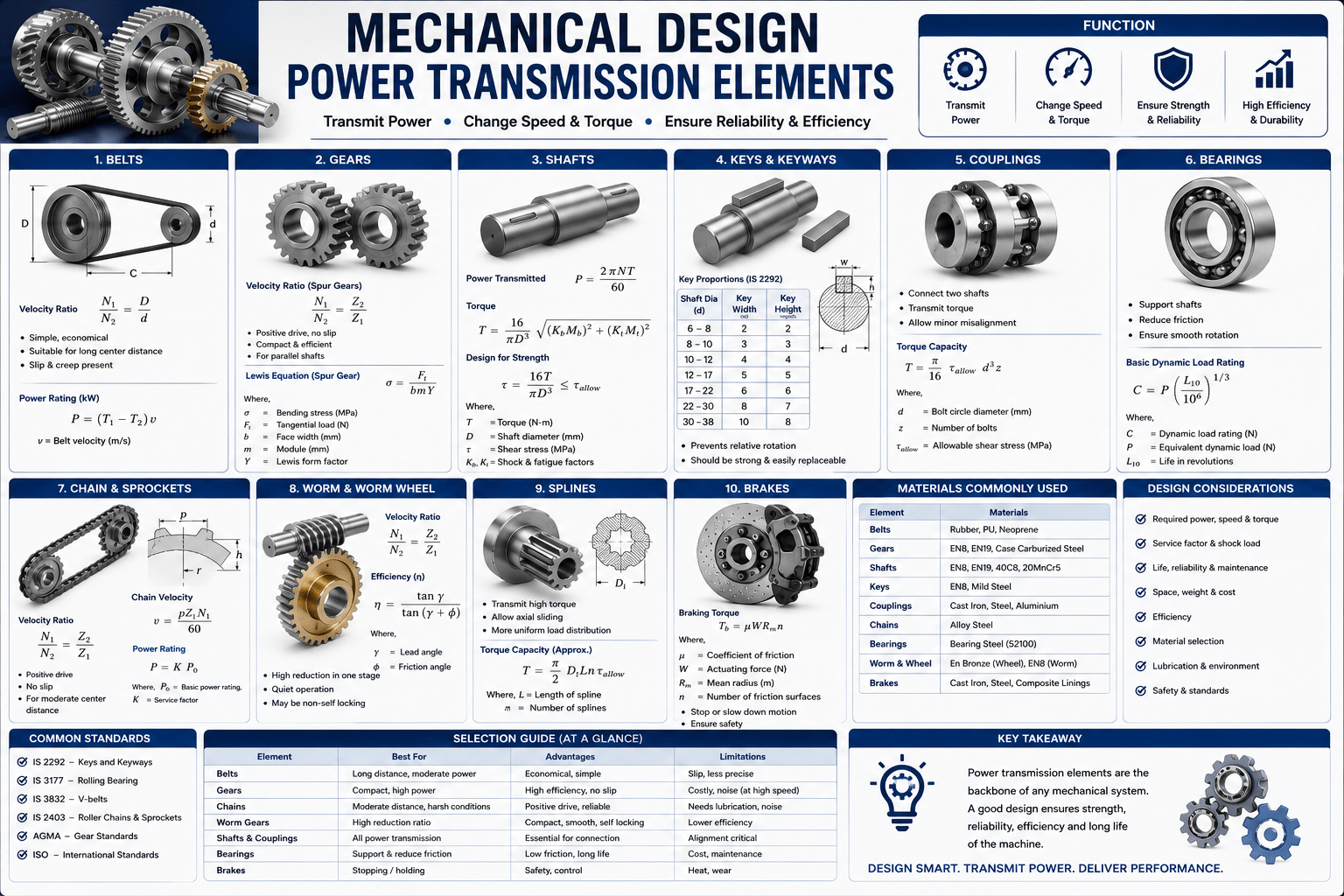
Introduction
Every machine that moves relies on power transmission. From the gears in a car’s transmission to the belts driving industrial machinery, from the springs absorbing shock to the clutches engaging and disengaging power—these elements are the lifeblood of mechanical systems. Without them, motion cannot be controlled, power cannot be delivered, and machines cannot function.
Mechanical design is the discipline that enables engineers to create these essential components. It is the application of engineering science to design elements that transmit power efficiently, reliably, and safely. Understanding how to design gears, shafts, belts, springs, clutches, and gearboxes is fundamental to becoming a competent mechanical design engineer.
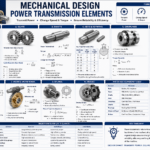
Building on the foundations of mechanical design, this second part delves deeper into the specific elements that make power transmission possible. While the first part introduces the basic concepts and principles, the second part applies these principles to the design of real, functional components that engineers use every day. The focus is on the study of the main mechanical elements of power transmission such as gears, springs, belts, and drive shafts.
The Mechanical Design-Part(2) course is designed precisely for this purpose. It is one of the releases of Design Online Academy, consisting of 11 lectures with a total duration of 8 hours. The course is the second part in the field of mechanical design, with the first part considered a fundamental prerequisite. Notably, both courses are free.
This guide provides a comprehensive overview of what power transmission design entails, why it matters, what the course covers, and how you can begin your journey toward mastering mechanical design.
What Is Power Transmission Design?
Power transmission design is the discipline of designing mechanical elements that transfer power from a source to a load. It involves the selection, sizing, and analysis of components that convert, modify, and transmit motion and force.
The Core Concept
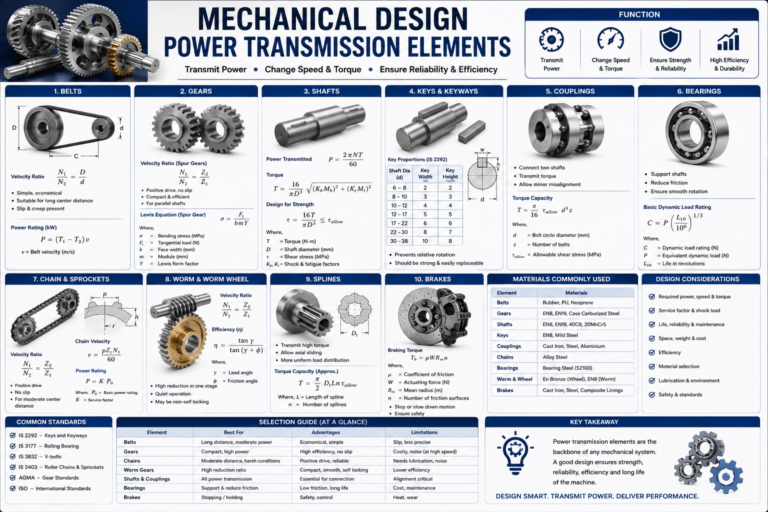
At its heart, power transmission is about getting energy from where it is generated to where it is needed. A motor produces rotational power. That power must be transmitted to a driven machine—a conveyor belt, a pump, a vehicle’s wheels. The elements that accomplish this transmission—gears, shafts, belts, couplings, clutches, and brakes—must be designed to handle the loads, speeds, and operating conditions they will encounter.
Why Power Transmission Design Matters
Foundation of Machine Design
Power transmission elements are found in virtually every machine. Understanding how to design them is essential for any mechanical design engineer. The course focuses on the study of the main mechanical elements of power transmission such as gears, springs, belts, and drive shafts.
Reliability and Safety
Poorly designed power transmission components can fail catastrophically. A shaft that is undersized can fracture. A gear with incorrect tooth geometry can strip. A spring that is improperly designed can break. Proper design ensures safety and reliability.
Efficiency
Well-designed power transmission systems minimise energy losses. This reduces operating costs and improves machine performance.
Career Advancement
Proficiency in power transmission design is a core competency for mechanical design engineers. It is a skill that employers value and seek.
What the Course Covers
The Mechanical Design-Part(2) course provides focused, practical training in power transmission element design.
Course Overview
| Feature | Detail |
|---|---|
| Total Duration | 8 hours |
| Number of Lectures | 11 lectures |
| Number of Chapters | 1 chapter |
| Language | Arabic |
| Instructor | Amr Shaaban – Assistant Professor, Ain Shams University |
| Student Enrollment | 895+ students |
| Prerequisite | Mechanical Design-Part(1) (also free) |
| Price | Free |
| Last Updated | January 2019 |
Course Content
Chapter 1: Power Transmission Design (11 lectures, 8 hours)
- Gear Design – Part 1: Geometry & Standards (28:30) – Introduction to power transmission, types of gears, geometry and standards
- Gear Design – Part 2: Gear Kinetics (40:48) – Gear kinetics and motion analysis
- Gear Design – Part 3: Design of Bevel Gears (28:08) – Design of bevel gears for intersecting shafts
- Gear Design – Part 4: Gear Tooth Design (43:59) – Detailed gear tooth design and calculations
- Design of a Clutch Brake Unit – Part 1: Theory (37:27) – Theoretical foundations of clutch and brake design
- Design of a Clutch Brake Unit – Part 2: Gears & V-belts (44:40) – Integration of gears and V-belts in clutch brake units
- Design of a Clutch Brake Unit – Part 3: Design of Springs (31:39) – Spring design for clutch brake applications
- Design of a Circular Saw Attachment (49:42) – Practical application of power transmission design
- Design of a Conveyor Unit (57:27) – Complete conveyor system design
- Design of an Internal Gear Unit (54:07) – Internal gear design and applications
- Applications on Power Transmission Units (1:06:11) – Comprehensive applications and case studies
What You Will Learn
- Design of Gears: You will learn to design different types of gears, including geometry, standards, kinetics, bevel gears, and gear tooth design. Gears are fundamental to power transmission, enabling the transfer of motion and torque between shafts.
- Design of Belt Drives: You will learn to design belts and understand their standard specifications and loads. Belt drives are used in countless applications, from automotive engines to industrial machinery.
- Design of Springs: You will learn to design springs and study their applications. Springs are used for shock absorption, energy storage, and force generation.
- Shaft Stress Analysis: You will learn to analyse the stresses on drive shafts under different loading forms. Shafts must withstand bending, torsion, and combined loads.
- Clutch Design: You will learn to design clutches. Clutches enable the engagement and disengagement of power transmission.
- Gearbox Design: You will learn to design gearboxes. Gearboxes are integrated assemblies of gears, shafts, and bearings that provide speed reduction and torque multiplication.
- Manufacturing and Assembly Considerations: You will study the manufacturing, assembly, and performance considerations when designing power transmission units.
Enrol in Mechanical Design-Part(2) Now
Instructor Profile: Amr Shaaban
The course is taught by Amr Shaaban, an assistant professor at the Mechanical Engineering Department, Faculty of Engineering, Ain Shams University, Egypt. He is the founder and main instructor of Design Online Academy.
Academic Credentials
- PhD: Applying virtual prototyping and simulation approaches on machine tools performance evaluation
- Research: Various research papers published in national and international journals
- Teaching Experience: Instructor for courses on basic FEA, dynamic FEA, composites, structure optimisation, and CAD/CAM/CNC
Teaching Philosophy
Most of his courses are code-independent, yet for the purpose of application Autodesk Inventor is selected for CAD courses, and ANSYS/LS-Dyna for FE courses. The primary goal of this course and the previous one is to qualify everyone to deal with various engineering software such as Inventor and ANSYS professionally. The motto of Design Online Academy is to bridge the gap between academic science and engineering software to reach professionalism.
Why This Course Is Different
Building on Fundamentals
The course is the second part in a two-part series. The first part provides the foundational knowledge required for understanding mechanical design principles. The second part applies these principles to the specific elements of power transmission. As the course description emphasises, the first part is considered a fundamental prerequisite for this course.
Free and Accessible
Both courses are free. This makes high-quality mechanical design education accessible to everyone, regardless of financial constraints. It is a significant contribution to engineering education.
Academic Rigor
The instructor, Amr Shaaban, brings academic expertise from Ain Shams University, one of Egypt’s premier engineering institutions. His PhD and research background ensure that the course content is rigorous and grounded in sound engineering principles.
Practical Application Focus
The course aims to qualify everyone to deal with various engineering software such as Inventor and ANSYS professionally. The stated goal is to bridge the gap between academic science and engineering software to reach professionalism.
Comprehensive Coverage
With 8 hours of content across 11 lectures, the course covers gear design (geometry, kinetics, bevel gears, tooth design), clutch brake units, spring design, and complete applications including circular saw attachments, conveyor units, and internal gear units.
Who Should Take This Course
Mechanical Engineering Students
Mechanical engineering students at all levels will benefit from this course. It provides the practical design knowledge that complements academic coursework.
Graduates
Graduates who want to refresh their academic fundamentals will find this course valuable. It serves as a reminder of the essential principles of mechanical design.
CAD Software Users
Users of engineering software who want to connect academic knowledge with practical execution will benefit from this course. The course aims to bridge the gap between theory and software application.
Aspiring Design Engineers
Anyone interested in the field of mechanical design, whether a student or a graduate, is the target audience for this course.
Professionals Seeking to Strengthen Fundamentals
Working engineers who want to reinforce their understanding of power transmission design will find this course a valuable resource.
Requirements
The course has one primary requirement:
No other prerequisites are specified. The course is designed to be accessible to those who have completed the foundational first part.
Frequently Asked Questions
What is the difference between Mechanical Design-Part(1) and Part(2)?
Part(1) covers the foundational concepts and principles of mechanical design. Part(2) applies these principles to the specific design of power transmission elements including gears, shafts, belts, springs, clutches, and gearboxes.
Do I need to complete Part(1) before taking Part(2)?
Yes. The first part is considered a fundamental prerequisite for this course. Both courses are free.
Is this course free?
Yes. Both Mechanical Design-Part(1) and Part(2) are free.
What language is the course taught in?
The course is taught in Arabic.
Who is the instructor?
The course is taught by Amr Shaaban, an assistant professor at Ain Shams University, Egypt, and the founder of Design Online Academy.
What topics are covered in this course?
The course covers gear design (geometry, kinetics, bevel gears, gear tooth design), clutch brake units, V-belt design, spring design, shaft stress analysis, and complete applications including circular saw attachments, conveyor units, and internal gear units.
What software will I be able to use after this course?
The course aims to qualify participants to deal with engineering software such as Autodesk Inventor and ANSYS professionally.
Is this course suitable for beginners?
The course builds on Part(1), which covers foundational concepts. Students who have completed Part(1) will be well-prepared for Part(2).
Mastering Power Transmission Design: Your Next Step
Power transmission design is a core competency for mechanical engineers. The ability to design gears, shafts, belts, springs, clutches, and gearboxes is essential for creating reliable, efficient machines. But like any engineering discipline, it requires structured learning and practical application.
The Mechanical Design-Part(2) course provides the focused training you need to master power transmission design. With 8 hours of expert instruction across 11 lectures, you will develop the skills to:
- Design different types of gears including geometry, kinetics, bevel gears, and gear tooth design
- Design belts and understand their standard specifications and loads
- Design springs and understand their applications
- Analyse shaft stresses under different loading conditions
- Design clutches for engagement and disengagement
- Design gearboxes for speed and torque conversion
- Consider manufacturing and assembly in your designs
- Bridge the gap between academic theory and software application
The course builds on the foundational knowledge from Part(1) and is completely free. It is the ideal resource for mechanical engineering students, graduates, and anyone interested in the field of mechanical design.
Enrol in Mechanical Design-Part(2) Now
Recommended Related Courses
To build a comprehensive mechanical design and engineering skillset, consider these additional courses:
Mechanical Design-Part(1) – The foundational first part of the mechanical design series, covering the basic concepts and principles.
Mechanical Engineering-Machine Designing-1 – Build foundational machine design knowledge covering gears, shafts, and bearings.
Mechanical Engineering Design – The Ultimate Course – Comprehensive coverage of mechanical engineering design theory and practice.
Mechanical Design Fundamentals – Build a strong foundation in mechanical design principles.
Basics of Mechanical Design Engineering (2022) – Understand the fundamentals of mechanical design engineering and industry-required skills.
Learn the Fundamentals of Mechanical Engineering – Broaden your understanding of mechanical engineering fundamentals.
Mechanical concept design : Stress simulation in Fusion 360 – Learn stress simulation to validate your mechanical designs.
Final Thoughts
Mechanical design is the discipline that turns engineering principles into functional machines. Power transmission design—the design of gears, shafts, belts, springs, clutches, and gearboxes—is at the heart of this discipline. Without these elements, machines cannot transmit power, control motion, or perform work.
The Mechanical Design-Part(2) course provides the focused, practical training you need to master these essential components. Taught by a university professor with a PhD and research background, and delivered in a free, accessible format, it is the ideal resource for anyone serious about building a career in mechanical design.
Start your power transmission design journey today.
About the Author