



 Edu_Admin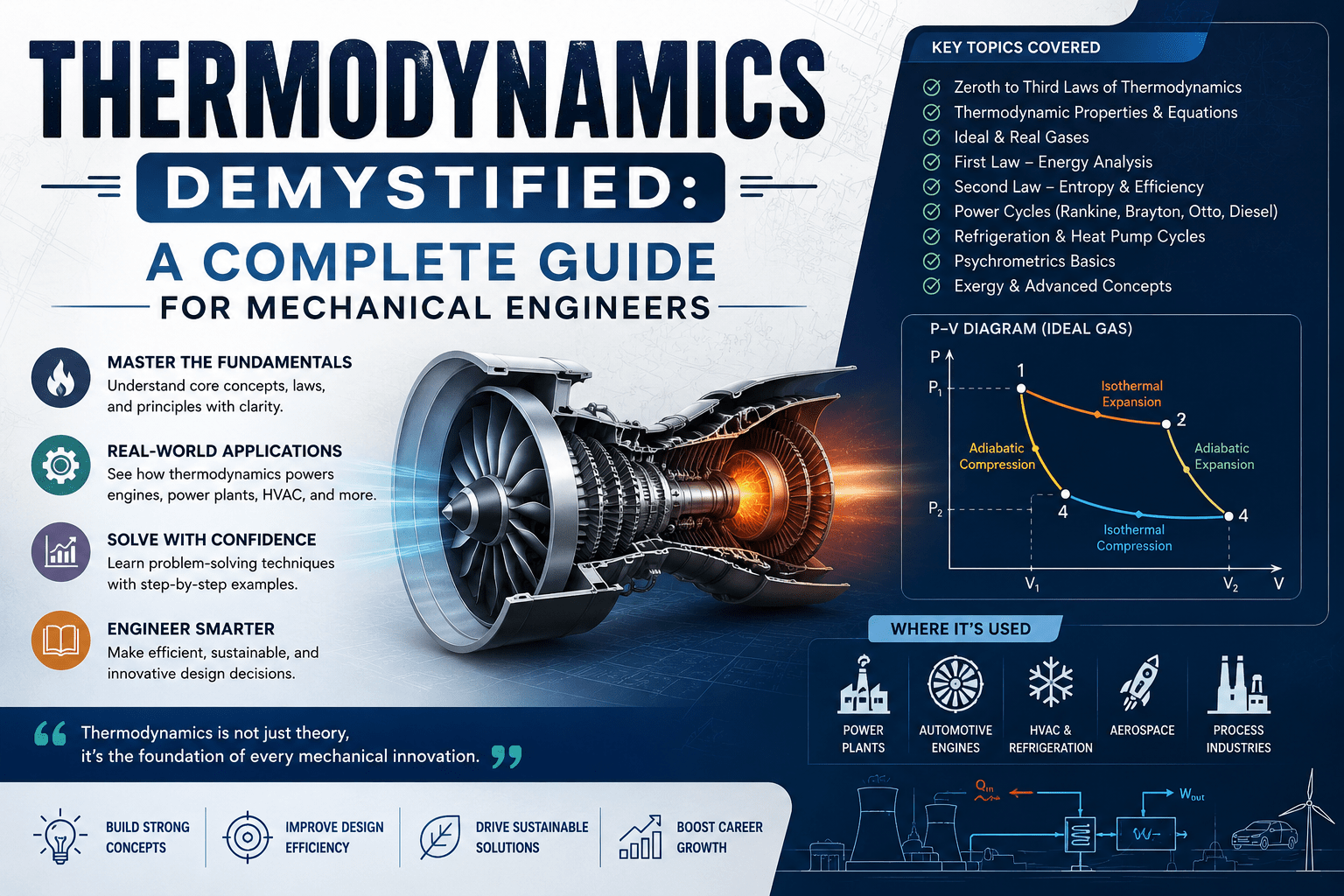
Introduction
Thermodynamics has a reputation. Walk into any mechanical engineering department, and you will hear students whispering about it like it is some kind of academic monster. “Thermo is brutal.” “Everyone fails it at least once.” “Just memorise the equations and pray.”
These statements are common, but they reflect a deeper problem. Thermodynamics is not inherently difficult. It is often poorly taught.
Most educational approaches throw equations at students without explaining why they matter. They skip the intuition and jump straight to the mathematics. The result is that students memorise formulas without understanding the underlying principles.
Thermodynamics for Mechanical Engineering is actually elegant. It is the science of everything that moves, burns, heats, or cools. It explains why car engines work, why air conditioners function, why rockets fly, and why power plants generate electricity. Thermodynamics is the backbone of mechanical engineering.
Once understood correctly, thermodynamics clicks. Fast.
This guide provides a clear, practical breakdown of thermodynamics that actually makes sense. No fluff. No confusing jargon. Just fundamental understanding.
What Exactly Is Thermodynamics?
At its core, thermodynamics is the science of energy—how it moves, how it transforms, and how it affects matter.
Think of thermodynamics as the accounting system of the universe. It tracks every single unit of energy, recording where it comes from, where it goes, and what it does along the way.
Every time you start your car, turn on an air conditioner, brew a cup of coffee, or charge your phone, you are experiencing thermodynamics in action.
Mechanical engineers use thermodynamics to design:
- Engines that convert heat into motion
- Turbines that generate electricity
- Refrigeration systems that preserve food
- Heat exchangers that transfer energy efficiently
- Power plants that supply energy to cities
- HVAC systems that maintain comfortable environments
Without thermodynamics, modern civilisation would not exist. This is not an exaggeration but a statement of fact.
The Three Pillars of Thermodynamics: Energy, Entropy and Equilibrium
Before examining the laws, it is essential to understand the three fundamental concepts that underpin thermodynamics.
Energy
Energy is the capacity to do work. It exists in many forms including heat, mechanical work, chemical energy, and electrical energy. The key insight is that energy cannot be created or destroyed, only transformed from one form to another.
Entropy
Entropy is frequently misunderstood. It is not merely chaos or disorder. Entropy is a measure of how energy spreads out. Consider a hot cup of coffee containing concentrated energy. Over time, that energy disperses to the surrounding air. That dispersal is entropy in action.
Equilibrium
Equilibrium is the state where nothing changes anymore. When a hot object and a cold object reach the same temperature, they are in thermal equilibrium. No further heat flows. No more energy moves.
These three concepts—Energy, Entropy, and Equilibrium—are interdependent. Understanding one requires understanding the others. Once all three are grasped, thermodynamics begins to make sense.
The Four Laws of Thermodynamics Made Simple
Thermodynamics laws are essentially common sense expressed through mathematical equations. Here is a straightforward breakdown.
Zeroth Law: Temperature Exists
If two systems are in thermal equilibrium with a third system, they are in thermal equilibrium with each other.
In simpler terms, if object A is the same temperature as object C, and object B is the same temperature as object C, then object A and object B are the same temperature. This law provides a method for measuring temperature.
First Law: Energy Is Conserved
Energy cannot be created or destroyed, only transformed.
You cannot obtain something from nothing. Every unit of energy used came from somewhere else. This is the most important law for engineers and forms the foundation of every energy system.
Second Law: Entropy Always Increases
In any spontaneous process, the entropy of the universe increases.
Things naturally move from ordered to disordered states. Hot objects cool down. Energy spreads out. This process cannot be reversed without expending additional energy. This is why perpetual motion machines do not exist.
Third Law: Absolute Zero Is Impossible
The entropy of a perfect crystal at absolute zero is exactly zero.
Absolute zero, equivalent to -273 degrees Celsius, can never be reached. As temperatures approach absolute zero, physical behaviour becomes unusual.
The Secret to Mastering Thermodynamics
Most thermodynamics courses teach students to memorise equations instead of understand concepts. This approach is fundamentally flawed.
If you understand the concepts, the equations follow naturally.
The Steady Flow Energy Equation (SFEE)
This is one of the most important equations in mechanical engineering. At first glance, it appears complex:
h₁ + (V₁²/2) + gz₁ + Q = h₂ + (V₂²/2) + gz₂ + W
However, the equation simply states that what goes in must come out, plus or minus whatever work or heat is added. It is essentially an energy balance.
- h represents internal energy (the energy stored in the fluid)
- V²/2 represents kinetic energy (energy of motion)
- gz represents potential energy (energy of height)
- Q represents heat added
- W represents work done
Understanding the concept makes the equation a simple tracking mechanism.
What a Comprehensive Thermodynamics Course Should Cover
A well-structured thermodynamics course should include the following topics:
- Thermodynamic systems and processes, including open and closed systems and their behaviour
- Work and heat transfer, examining how energy moves in different processes
- Laws of thermodynamics with numerical applications
- Steady Flow Energy Equation (SFEE), including derivation, application and practice
- Practical devices including nozzles, diffusers, turbines, compressors, and heat exchangers
- Throttling process, Enthalpy and Entropy concepts
- Carnot cycle and Reverse Carnot cycle, forming the foundation of heat engines and refrigeration
The best part is that advanced mathematical knowledge is not required to understand these concepts. Clear explanation is sufficient.
Who Needs to Learn Thermodynamics
Thermodynamics is not only for academics. It is relevant for:
- Mechanical Engineering Students – Thermodynamics forms the foundation of the degree
- Practicing Engineers – Working in power plants, process industries, and manufacturing
- Aerospace Engineers – Designing rockets, jets, and propulsion systems
- Civil Engineers – Working on HVAC systems and building energy efficiency
- Anyone who wants to understand how the world works – Thermodynamics explains fundamental physical processes
Frequently Asked Questions
Is thermodynamics really that difficult?
No. The difficulty arises from poor teaching methods in many universities. When explained clearly with practical examples, thermodynamics makes sense.
Do I need advanced mathematics?
Basic algebra and calculus are helpful, but concepts are more important than mathematics. Once concepts are understood, the mathematics follows naturally.
How long does it take to learn thermodynamics?
Fundamentals can be grasped in a few hours with appropriate instruction. Mastery requires practice, but the foundation can be built quickly.
Is thermodynamics relevant in the age of AI and renewable energy?
Absolutely. Thermodynamics is the science of energy. Artificial intelligence cannot change physics. Renewable energy systems including solar, wind, and geothermal are all governed by thermodynamic principles.
Which course should I choose for learning thermodynamics?
A concise, focused course that explains concepts clearly with practical examples is ideal. The Thermodynamics for Mechanical Engineering course on Udemy provides exactly this approach with 4 hours of content and 39 lectures.
Mastering Thermodynamics: Your Next Step
Learning thermodynamics presents a choice. You can struggle through alone, reading confusing textbooks and watching inconsistent video content. Alternatively, you can take a structured course that explains everything clearly with practical examples and real-world applications.
The Thermodynamics for Mechanical Engineering course is designed for people who want to actually understand thermodynamics, not merely memorise equations. The course includes:
- 4 hours of concise, focused video content with no unnecessary filler
- 39 lectures broken into digestible lessons
- Clear explanations of thermodynamic systems, processes, and laws
- Practical applications including nozzles, turbines, compressors, and heat exchangers
- Numerical problems and problem-solving to build confidence
- Certificate of completion to add to your professional portfolio
The course starts from the very basics. No prior knowledge is required.
Enrol in Thermodynamics for Mechanical Engineering Now
Recommended Related Courses
To build a comprehensive mechanical engineering foundation, consider these additional courses:
Thermodynamics – Introduction to Mechanical Engineering – An introductory course covering the basics of thermodynamics for mechanical engineering.
Thermodynamics & Python for Process and Mechanical Engineers – Combine thermodynamics principles with Python programming for modern engineering analysis.
Mechanical Aspects of Shell and Tube Heat Exchangers – A specialised course focusing on heat exchanger mechanical design.
Heat and Mass Transfer HMT for Mechanical Engineering – Expand your knowledge into heat and mass transfer principles.
Pressure Vessel Fabrication – Mechanical Engineering, Oil & Gas – Practical knowledge for oil and gas industry applications.
The Complete Mechanical Engineering Course – 12 Courses in 1 – An all-in-one course covering multiple mechanical engineering disciplines.
Final Thoughts
Thermodynamics is not a monster to be feared. It is the science of how things work, explaining why you can drive to work, cool your home, and power your devices. It is the foundation of mechanical engineering.
Once you understand thermodynamics, you will see the world differently. You will see energy everywhere and understand exactly how to use it.
Start your thermodynamics journey today with the right course and approach.
Enrol in Thermodynamics for Mechanical Engineering
About the Author