
 Edu_Admin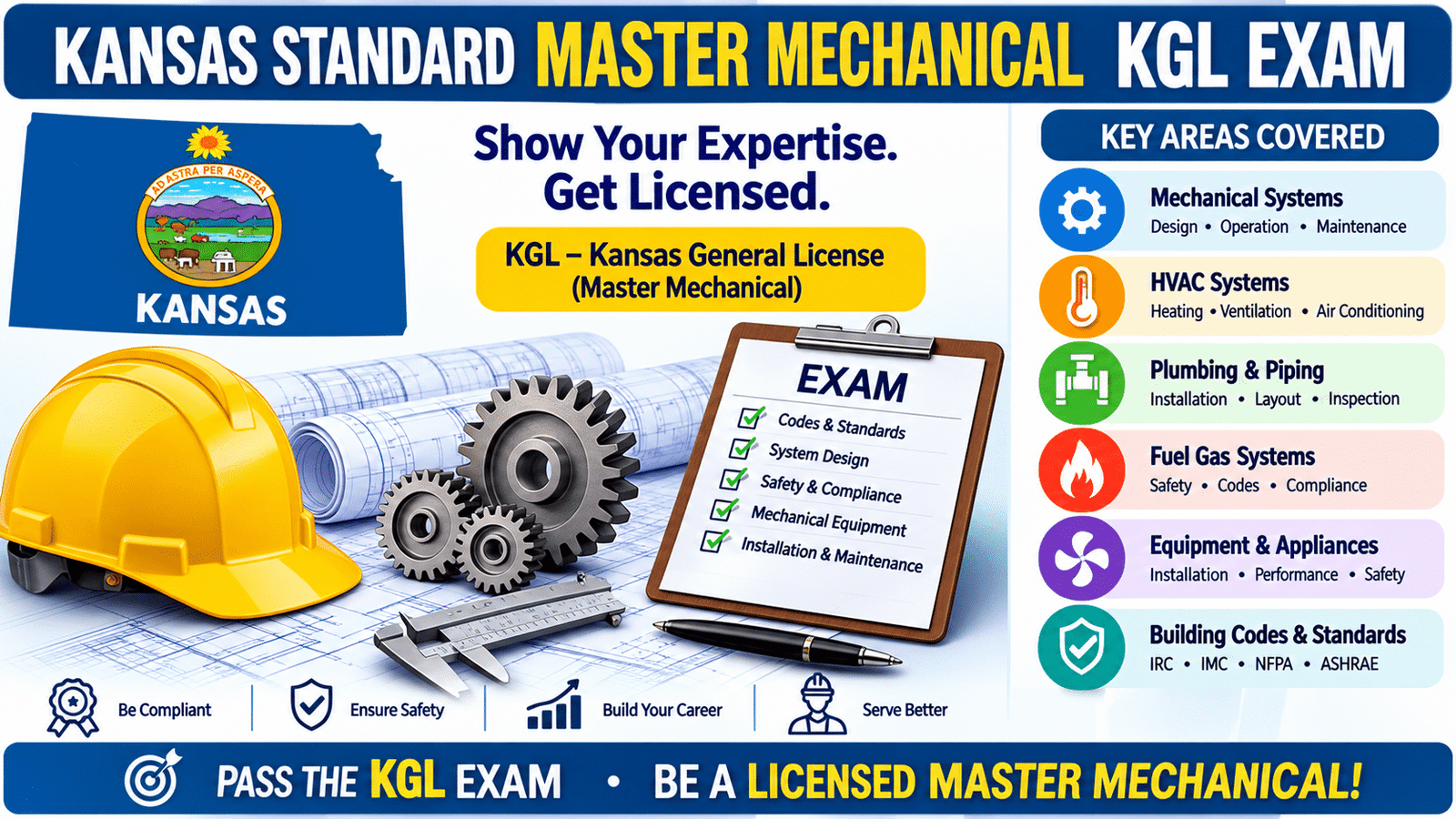
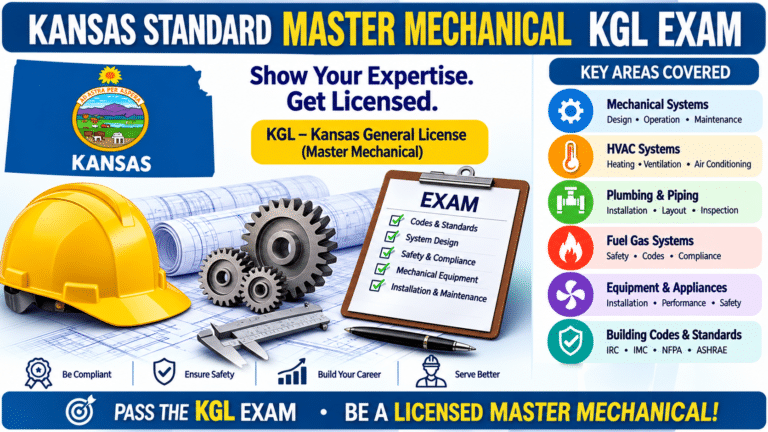
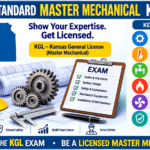
In Kansas, mechanical contractors operate under a unique licensing framework. Unlike many states where licensing is administered at the state level, Kansas licenses are administered at the county level—such as Johnson County, Sedgwick County, or Ellis County. However, despite this local administration, the Kansas Standard Master Mechanical (KGL) exam serves as the universal testing standard for many of these jurisdictions. It is the credential that demonstrates your competence to oversee large-scale HVAC, refrigeration, and fuel gas piping projects.
The KGL exam is a nationally recognized standard developed by the International Code Council (ICC). It is designed to certify individuals as Master Mechanical contractors who can supervise mechanical installations, ensure code compliance, and lead projects from planning through completion. Passing this exam is a significant milestone in a mechanical professional’s career—it unlocks the ability to pull permits, bid on projects, and operate as a licensed mechanical contractor in participating jurisdictions.
Yet for many professionals, the KGL exam can seem daunting. The International Mechanical Code (IMC) and International Fuel Gas Code (IFGC) are comprehensive documents. The range of topics—from duct systems to chimneys and vents to fuel gas piping—is broad. The exam is open-book, which means you must not only know the code but also be able to navigate it efficiently under time pressure.
This guide provides a comprehensive overview of the Kansas Standard Master Mechanical KGL exam, covering what it is, who it is for, the requirements, the exam content, preparation strategies, and how you can begin your journey toward earning this respected credential.
What Is the Kansas Standard Master Mechanical – KGL Exam?
The Kansas Standard Master Mechanical (KGL) exam is a professional certification examination administered through the International Code Council (ICC). It is recognized by Kansas counties as the standard for master mechanical licensure. The exam is designed to certify individuals as Master Mechanical contractors who can oversee large-scale HVAC, refrigeration, and fuel gas piping projects.
Who Should Take This Exam?
The KGL exam is intended for:
- Experienced Mechanical Professionals: Journeyman mechanical technicians who have accumulated the required field experience and are ready to advance to master level.
- Mechanical Contractors: Contractors who need to demonstrate their qualifications to obtain or maintain a mechanical contractor license in Kansas counties.
- HVAC and Refrigeration Specialists: Professionals seeking to expand their credentials and take on leadership roles in mechanical projects.
- Code Enforcement Professionals: Individuals who need to demonstrate comprehensive knowledge of mechanical codes.
Why This Certification Matters
Professional Recognition
The KGL certification validates your expertise in mechanical system design, installation, and code compliance. It demonstrates to employers, clients, and regulatory authorities that you have met rigorous standards of competence.
Career Advancement
Master mechanical licensure opens doors to higher-level positions, increased responsibility, and greater earning potential. It qualifies you to supervise projects, pull permits, and operate as a licensed contractor.
Code Compliance Knowledge
The exam ensures you understand the International Mechanical Code (IMC) and International Fuel Gas Code (IFGC) and can apply their requirements correctly. This knowledge is essential for safe and compliant installations.
Business Growth
For contractors, certification enables you to bid on larger projects, expand your service offerings, and operate legally in regulated jurisdictions.
Exam Overview
The Kansas Standard Master Mechanical KGL exam is a comprehensive assessment of your knowledge of mechanical codes and practices.
Exam Details
| Feature | Detail |
|---|---|
| Exam Code | KGL (also referred to as 556-KS) |
| Certification Type | Master Mechanical |
| Administering Body | International Code Council (ICC) |
| Exam Duration | 4 hours (240 minutes) |
| Number of Questions | 100 multiple-choice questions |
| Passing Score | 75% (75 correct answers) |
| Exam Format | Open-book |
| Primary References | 2018 International Mechanical Code (IMC), 2018 International Fuel Gas Code (IFGC), National Electrical Code (NFPA 70) |
The exam is an open-book, multiple-choice assessment based on the International Mechanical Code (IMC) and International Fuel Gas Code (IFGC).
Exam Content Areas
The KGL exam is divided into seven primary competency domains. The percentages indicate the approximate weight of each section on the 100-question exam.
1. General Installation Requirements (27%)
This is the largest section of the exam, focusing on the fundamental rules for mechanical equipment and specialized systems.
Key Topics:
- Heating Equipment: Installation of furnaces, wall heaters, and floor furnaces; clearances to combustibles and access requirements.
- Appliances & General Equipment: Mounting, support, and protection of mechanical units.
- Water Heaters & Boilers: Code requirements for pressure relief valves, expansion tanks, and low-water cutoffs.
- Cooling & Refrigeration: Refrigerant piping, safety relief systems, and equipment location.
- Hydronic Systems: Piping materials, installation, and testing of radiant heating or chilled water systems.
- Solar Systems & Specific Appliances: Requirements for solar thermal systems and miscellaneous mechanical appliances.
2. Duct Systems (12%)
This section focuses on the distribution of conditioned air and safety components within the ductwork.
Key Topics:
- Duct Construction: Materials, thickness, and sealing requirements for supply and return ducts.
- Installation & Plenums: Proper support, insulation (R-values), and use of under-floor or ceiling plenums.
- Smoke and Fire Dampers: Installation locations, access requirements, and actuation by smoke detectors.
3. Exhaust and Ventilation Systems (11%)
This domain covers the removal of air and contaminants from a structure.
Key Topics:
- Exhaust Fan Systems: Bathrooms, domestic kitchens, and general mechanical exhaust.
- Product Conveying Systems: Handling of dust, stock, or hazardous vapors.
- Commercial Hoods: Installation of Type I and Type II hoods, grease filters, and fire suppression integration.
- Kitchen Ventilation: Makeup air requirements for high-capacity exhaust systems.
4. Chimneys and Vents (8%)
This section covers regulations regarding the safe removal of combustion byproducts.
Key Topics:
- Venting Methods: Direct-vent, mechanical draft, and natural draft systems.
- Connectors: Proper sizing and pitch of vent connectors.
- Termination: Clearances from combustible materials and proper termination heights.
5. Fuel Gas Systems (Percentage Not Specified)
This domain covers the installation and safety requirements for fuel gas piping and appliances.
Key Topics:
- Gas Piping: Materials, sizing, and installation requirements.
- Combustion Air: Requirements for adequate combustion and dilution air.
- Appliance Connections: Proper connection methods and safety devices.
- Pressure Testing: Procedures for verifying gas-tight systems.
6. Refrigeration Systems (Percentage Not Specified)
This section covers the specialized requirements for refrigeration equipment and systems.
Key Topics:
- Refrigerant Piping: Materials and installation requirements.
- Safety Relief Systems: Pressure relief devices and venting.
- Equipment Location: Clearances and access requirements.
7. Electrical Requirements (Percentage Not Specified)
This domain covers the electrical aspects of mechanical installations.
Key Topics:
- Electrical Connections: Proper wiring methods for mechanical equipment.
- Disconnects: Requirements for disconnecting means.
- Overcurrent Protection: Circuit protection requirements.
- Grounding: Grounding and bonding requirements.
How to Prepare for the KGL Exam
Understand the Reference Codes
The KGL exam is open-book, and the International Mechanical Code (IMC) and International Fuel Gas Code (IFGC) are your primary references. Familiarise yourself thoroughly with these codes. Know how to navigate the code books efficiently during the exam. Tab key sections, highlight important passages, and practice finding information quickly.
Focus on High-Weight Content Areas
The General Installation Requirements section accounts for 27% of the exam—the largest portion. Duct Systems (12%) and Exhaust and Ventilation Systems (11%) are also significant. Allocate your study time proportionally, ensuring you master the highest-weighted topics while maintaining coverage of all areas.
Use Practice Questions
Working through practice questions is one of the most effective preparation strategies. Practice exams help you:
- Understand the exam format and question styles
- Identify areas where you need additional study
- Build confidence and reduce test anxiety
- Improve time management skills
The Kansas Standard Master Mechanical – KGL Exam course includes comprehensive mock tests with 166 questions covering all exam topics.
Master Code Navigation
Because the exam is open-book, your ability to navigate the code efficiently is critical. Practice finding answers to sample questions using the IMC and IFGC. Develop a system for quickly locating information, such as color-coded tabs or a detailed index.
Manage Your Time
With 100 questions in 240 minutes, you have approximately 2.4 minutes per question. Practice pacing yourself to ensure you can complete all questions within the time limit. If you are stuck on a question, mark it and move on—you can return to it later if time permits.
Consider Formal Training
Structured exam preparation courses provide the most efficient path to success. The Kansas Standard Master Mechanical – KGL Exam course is designed to help candidates pass the exam with comprehensive mock tests covering all key topics.
Mastering the KGL Exam: Your Next Step
Passing the Kansas Standard Master Mechanical KGL exam requires focused preparation and a solid understanding of the International Mechanical Code and International Fuel Gas Code. The right training makes the difference between struggling through the exam and passing with confidence.
The Kansas Standard Master Mechanical – KGL Exam course provides everything you need to succeed:
- 166 practice questions across 3 mock tests
- Comprehensive coverage of all seven content domains
- Code navigation and interpretation techniques
- Expert guidance from an experienced instructor
- Strategies for exam-day success
The course is designed for professionals at all stages of preparation, from those just beginning their study to those fine-tuning their skills before exam day.
Enrol in Kansas Standard Master Mechanical – KGL Exam Now
Recommended Related Courses
To build a comprehensive mechanical licensing and certification foundation, consider these additional courses:
National Standard Master Mechanical – F29-N Exam – Achieve master-level mechanical certification with this national standard exam preparation.
National Standard Journeyman Mechanical – F31-N Exam – Advance your career with journeyman-level mechanical certification.
Kansas Standard Journeyman Mechanical – KGG Exam – Build your Kansas-specific mechanical knowledge at the journeyman level.
Kansas Standard Master Mechanical – 556-KS Exam – Additional preparation for the Kansas master mechanical exam.
Mechanical Code Specialist – M8 – Progress to the Code Specialist level with comprehensive mechanical code knowledge.
Residential Mechanical Inspector – M1 Exam – Specialised preparation for residential mechanical inspector certification.
Commercial Mechanical Inspector – 2M Exam – Expand your certification to commercial mechanical inspection.
Mechanical Plans Examiner – M3 Exam – Develop plans examination skills for career advancement.
Thermodynamics for Mechanical Engineering – Build foundational knowledge in thermodynamics for mechanical systems.
Frequently Asked Questions
What is the Kansas Standard Master Mechanical KGL exam?
The KGL is an ICC certification exam for professionals seeking master mechanical licensure in Kansas. It tests knowledge of the International Mechanical Code (IMC) and International Fuel Gas Code (IFGC).
How many questions are on the KGL exam?
The exam consists of 100 multiple-choice questions.
How long is the exam?
The exam is 240 minutes (4 hours).
What is the passing score?
The passing score is 75%, which means you need to answer 75 questions correctly out of 100.
Is the exam open-book?
Yes. You may reference the International Mechanical Code (IMC), International Fuel Gas Code (IFGC), and National Electrical Code (NFPA 70) during the exam.
What are the primary reference codes for the KGL exam?
The primary references are the 2018 International Mechanical Code (IMC), 2018 International Fuel Gas Code (IFGC), and National Electrical Code (NFPA 70).
How do I prepare for the KGL exam?
Preparation should include studying the IMC and IFGC, using practice questions and mock tests, understanding the exam format, and managing your time effectively. The Kansas Standard Master Mechanical – KGL Exam course provides comprehensive mock tests.
What are the eligibility requirements for the KGL exam?
Eligibility requirements vary by county. Generally, candidates must have mechanical experience and may need to hold a journeyman certificate for a minimum period. Check with your local county licensing authority for specific requirements.
What career opportunities does the KGL certification prepare me for?
This certification prepares you for roles including Master Mechanical Contractor, Mechanical Project Supervisor, HVAC Contractor, and Code Compliance Specialist.
Final Thoughts
The Kansas Standard Master Mechanical KGL exam is your gateway to professional recognition and career advancement in the mechanical contracting industry. It demonstrates your competence, opens doors to new opportunities, and establishes your credibility as a master mechanical professional.
With proper preparation and the right resources, you can pass this exam with confidence. The Kansas Standard Master Mechanical – KGL Exam course provides the comprehensive mock tests and preparation you need to earn this respected credential.
Start your journey toward becoming a certified Master Mechanical professional today.
Enrol in Kansas Standard Master Mechanical – KGL Exam
About the Author