 Edu_Admin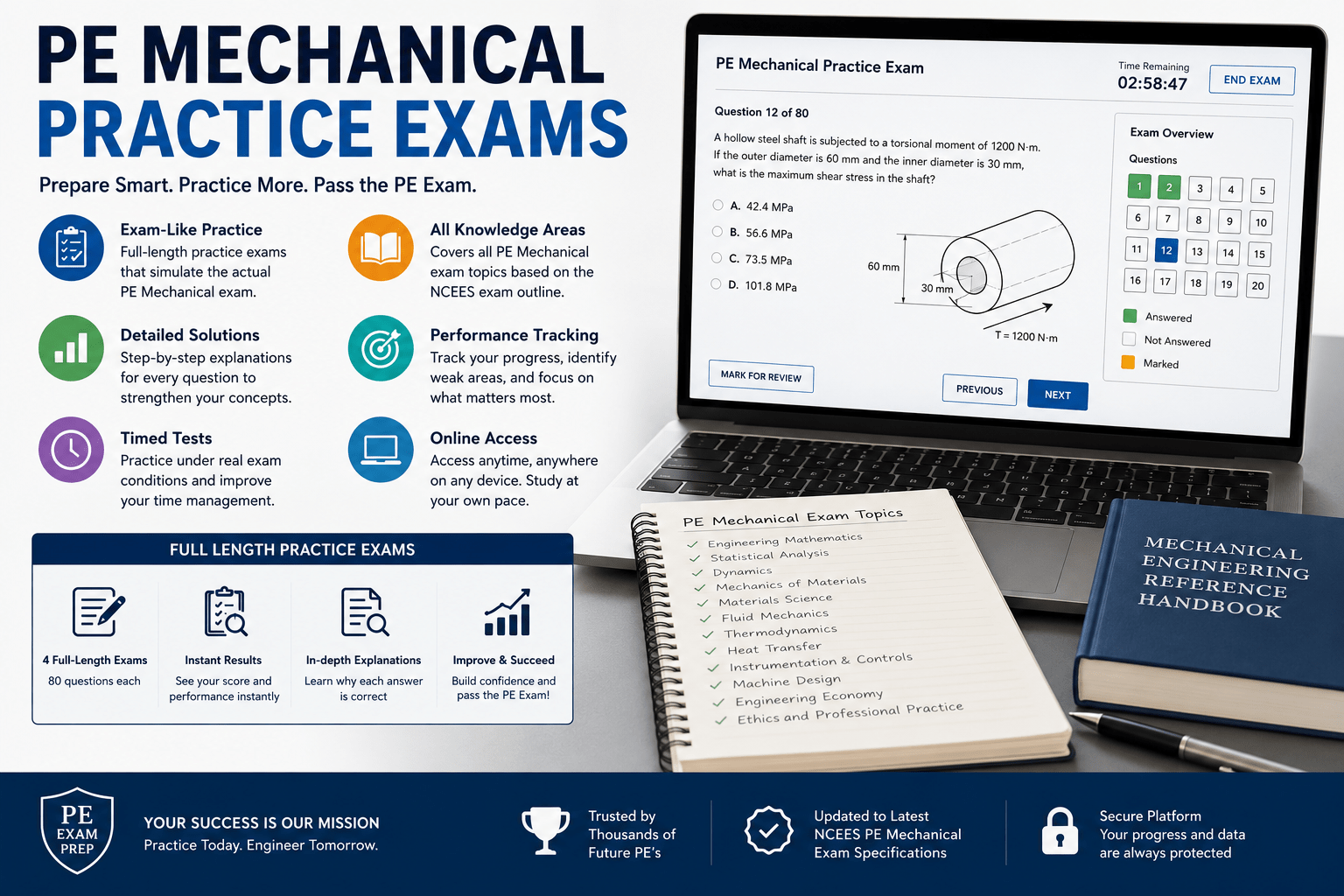
Introduction
The Professional Engineer license is the pinnacle of achievement in the engineering profession. It represents not just technical competence, but a commitment to public safety, ethical practice, and professional excellence. For mechanical engineers, the PE Mechanical exam is the final gateway to this prestigious credential.
Consider the significance. A licensed Professional Engineer can sign and seal engineering documents, take legal responsibility for projects, and open doors to career advancement that are closed to unlicensed engineers. The PE license is recognised across all US states and territories, providing mobility and opportunity throughout your career.
Yet many engineers find the PE Mechanical exam daunting. The breadth of topics is extensive. The exam is rigorous. The stakes are high. Preparation requires discipline, strategy, and the right resources.
This is where practice exams become invaluable. They are not merely study aids but essential tools for building the knowledge, confidence, and test-taking skills needed to succeed.
This guide provides a comprehensive overview of the PE Mechanical exam, the value of practice exams, and the resources you need to pass on your first attempt.
What Is the PE Mechanical Exam?
The Principles and Practice of Engineering (PE) Mechanical exam is the final step in the professional engineering licensure process. Administered by the National Council of Examiners for Engineering and Surveying (NCEES), it assesses your competency in mechanical engineering practice.
Exam Format
The NCEES PE Mechanical exam is an 8-hour computer-based test (CBT). Examinees have a 9-hour appointment time, which includes a tutorial and breaks. The exam is closed book, with an electronic reference handbook provided.
The exam is divided into two sessions:
- Morning Session (Breadth): Covers general mechanical engineering topics
- Afternoon Session (Depth): Focuses on your chosen specialty
Specialty Areas
Candidates choose one of three depth modules:
- HVAC and Refrigeration
- Machine Design and Materials
- Thermal and Fluid Systems
Exam Administration
The PE Mechanical exam is computer-based and administered year-round at NCEES-approved Pearson VUE test centres. This flexibility allows candidates to schedule their exam when they are optimally prepared.
Prerequisites
To sit for the PE exam, candidates must typically:
- Graduate from an ABET-accredited engineering program
- Pass the Fundamentals of Engineering (FE) exam
- Gain at least four years of supervised work experience
Requirements vary by state, so it is essential to check with your state licensing board.
Why Practice Exams Are Essential
Build Exam Endurance
The PE Mechanical exam is an 8-hour marathon. Maintaining focus and performance over that duration requires conditioning. As one successful candidate noted, taking practice exams helped improve endurance because “an 8-hr exam is very long and drains all your energy”. Practice exams simulate this experience, training you to sustain concentration throughout the full test.
Develop Time Management
Time management is critical. With approximately 80 questions across 8 hours, you have roughly 6 minutes per question. Practice exams help you develop pacing strategies, teaching you when to push forward and when to move on. Taking each practice exam within the same four-hour time limit as the actual exam enhances time-management skills.
Identify Knowledge Gaps
Practice exams reveal areas where your understanding is weak. By analysing your performance, you can focus your study efforts on the topics that need the most attention. This targeted approach is far more efficient than general review.
Familiarise with Exam Format
Practice exams familiarise you with the exam scope, format, and question styles. They reduce surprises on exam day, allowing you to focus on solving problems rather than figuring out how the exam works.
Build Confidence
There is no substitute for the confidence that comes from successful practice. When you have completed multiple practice exams under realistic conditions, you approach the real exam with assurance and composure.
What a Comprehensive PE Mechanical Practice Exam Course Covers
A quality practice exam course provides more than just questions. It offers a complete preparation experience.
Exam-Like Questions
Practice questions should be exam-like, referencing the appropriate NCEES Handbook, matching the length of the real exam, and using multiple-choice questions. This ensures your practice accurately reflects the actual test.
Detailed Solutions
Comprehensive step-by-step solutions illustrate accurate and efficient problem-solving approaches. Understanding not just the correct answer but the reasoning behind it deepens your knowledge and prepares you for similar problems.
Performance Tracking
Effective practice exams provide performance analytics, showing your strengths and weaknesses across different topic areas. This data enables targeted study.
Time Management Training
Full-length practice exams under timed conditions build the pacing skills essential for success.
Coverage of All Topics
A comprehensive practice exam course covers the full range of PE Mechanical topics:
- Fluids
- Thermodynamics
- Power Cycles
- Heat Transfer
- HVAC
- Statics
- Materials
- Machine Design
- Dynamics and Vibrations
- Control Systems
- Plant Engineering
Who Should Take PE Mechanical Practice Exams
Recent Graduates
Engineering graduates who have passed the FE exam and are building work experience can begin preparing early. Practice exams help maintain and strengthen technical knowledge.
Engineers with Work Experience
For engineers who have been out of school for several years, practice exams are essential for refreshing knowledge and adapting to the exam format.
Career Changers
Engineers transitioning into new specialisations can use practice exams to assess and build competency in their chosen area.
Anyone Seeking PE Licensure
Whether you are taking the exam for the first time or retaking it, practice exams are an indispensable preparation tool.
Study Tips for PE Mechanical Success
Create a Structured Study Plan
Most successful candidates dedicate 3-6 months to systematic study. Experts recommend 200 to 300 hours of study time. For a full-time professional, this translates to five to seven months at 10-15 hours per week.
Master the NCEES Reference Handbook
The NCEES Reference Handbook is your only reference during the exam. Become as familiar as possible with its contents and how to find what you need. Practice locating equations and information quickly.
Practice Under Realistic Conditions
Take full-length practice exams under timed conditions. Simulate the exam environment as closely as possible. Time individual practice problems to get used to working quickly.
Analyse Your Performance
After each practice exam, review your mistakes thoroughly. Understand why you got each question wrong and how to avoid similar errors.
Focus on Weak Areas
Use practice exam results to identify your weaknesses and dedicate extra study time to those topics.
Write Out Your Study Plan
Be specific about your goals and your study schedule. A written plan provides structure and accountability.
Master the PE Mechanical Exam: Your Next Step
The PE Mechanical exam is a significant challenge, but with the right preparation, it is a challenge you can meet. Practice exams are the cornerstone of effective preparation.
The PE Mechanical | Practice Exams course provides the comprehensive practice you need to succeed. The course includes:
- Exam-like practice questions covering all PE Mechanical topics
- Detailed solutions with step-by-step explanations
- Full-length practice exams to build endurance
- Time management training for exam-day success
- Performance analytics to identify strengths and weaknesses
- Coverage of HVAC, Machine Design, and Thermal and Fluid Systems
The course is designed for engineers at all stages of preparation, from those just beginning their study to those fine-tuning their skills before exam day.
Enrol in PE Mechanical | Practice Exams Now
Recommended Related Courses
To build a comprehensive PE exam preparation strategy, consider these additional courses:
FE Mechanical Exam Prep: Pass the FE Exam (Step-by-Step) – Build a strong foundation before tackling the PE exam.
FE Mechanical Practice Tests – Practice exams for the Fundamentals of Engineering exam.
Thermodynamics for Mechanical Engineering – Strengthen your thermodynamics knowledge for the PE exam.
Mechanical Engineering-Machine Designing-1 – Deepen your machine design expertise.
Fundamentals of Mechanical Engineering: Learn with Animation – Visual learning for core mechanical engineering concepts.
The Complete Mechanical Engineering Course – 12 Courses in 1 – Comprehensive review of all mechanical engineering topics.
Frequently Asked Questions
What is the passing score for the PE Mechanical exam?
The passing score is typically around 70%, though this can vary. The focus should be on comprehensive preparation rather than a specific score.
What is the pass rate for the PE Mechanical exam?
Pass rates vary by discipline. For first-time takers, the HVAC and Refrigeration exam has an average pass rate of 77%, while the Machine Design and Materials exam has an average pass rate of 75%. First-time takers generally outperform repeat takers.
How many questions are on the PE Mechanical exam?
The exam typically consists of approximately 80 questions across two sessions.
Is the PE Mechanical exam open book?
No. The exam is closed book with an electronic reference handbook provided.
How long should I study for the PE Mechanical exam?
Experts recommend 200 to 300 hours of study time. For a full-time professional, this means five to seven months at 10-15 hours per week.
Can I take the PE Mechanical exam online?
No. The exam is administered in person at NCEES-approved Pearson VUE test centres.
How do I register for the PE Mechanical exam?
Registration is through the NCEES website. You must first meet your state licensing board’s eligibility requirements.
Final Thoughts
The PE Mechanical exam is a significant milestone in any mechanical engineer’s career. It represents the culmination of years of education, experience, and dedication. Passing this exam opens doors to professional advancement, increased responsibility, and greater impact on public safety and welfare.
Practice exams are not optional—they are essential. They build the knowledge, confidence, and test-taking skills needed to succeed. With the right preparation, you can join the ranks of licensed Professional Engineers.
Start your preparation today with comprehensive practice exams and take the next step in your professional journey.
Enrol in PE Mechanical | Practice Exams
About the Author