 Edu_Admin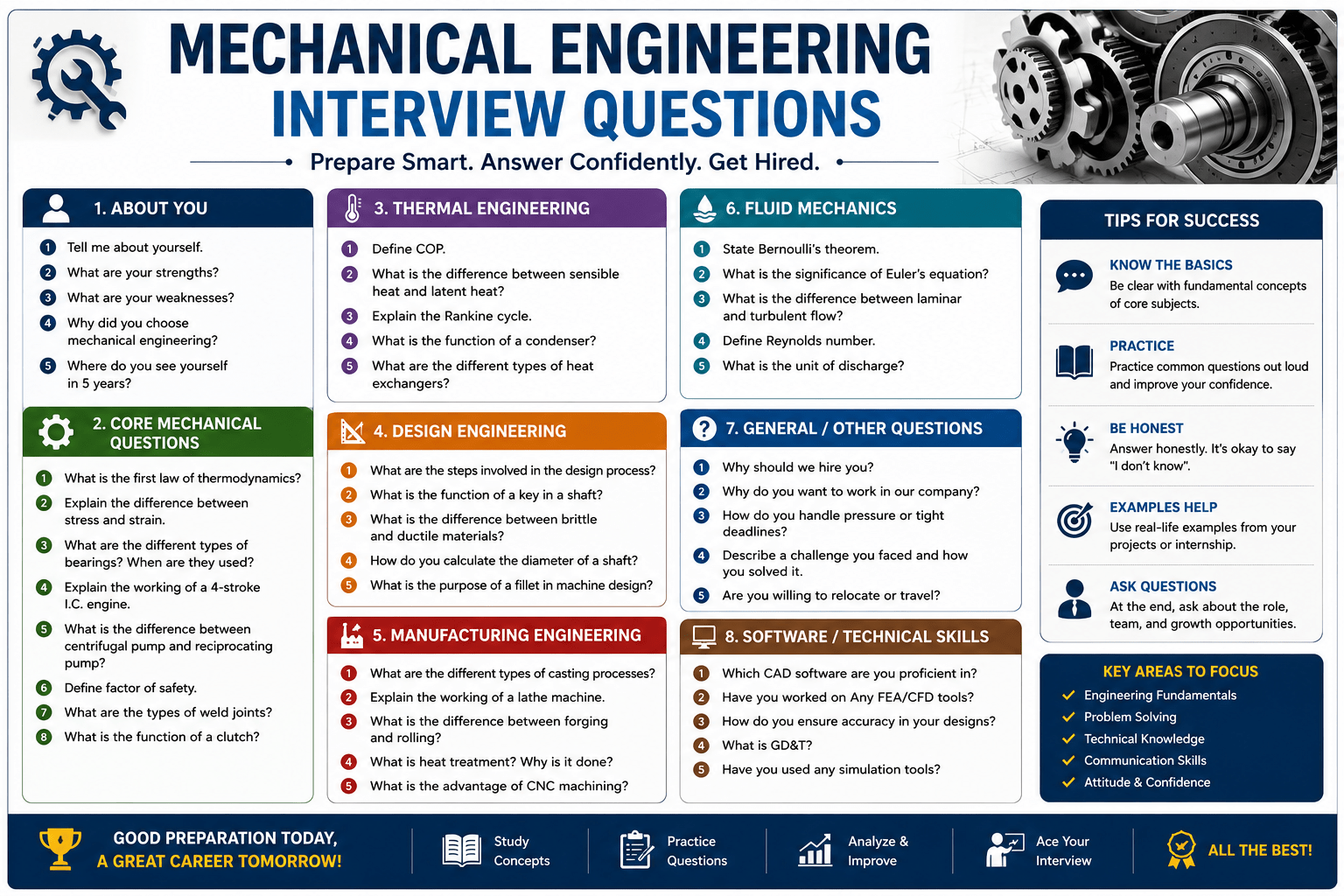
The mechanical engineering job market is competitive. Whether you are a fresh graduate entering the profession or an experienced engineer seeking new opportunities, the interview is the critical gateway to your next role. Employers are not merely looking for technical knowledge; they are assessing problem-solving ability, communication skills, and cultural fit.
Consider what interviewers are actually evaluating. They want to know if you can apply engineering principles to real-world problems. They want to understand how you think, how you approach challenges, and how you collaborate with others. They are testing whether you have the foundational knowledge to perform the job and the potential to grow within the organisation.
The challenge is that mechanical engineering interviews cover an exceptionally broad range of topics. Thermodynamics, fluid mechanics, strength of materials, machine design, manufacturing processes, CAD software, and project management are all fair game. Additionally, behavioural questions assess your soft skills and work history.
This is why structured preparation is essential. Knowing what questions to expect and how to answer them effectively dramatically improves your chances of success.
This guide provides a comprehensive overview of the top 50 mechanical engineering interview questions, organised by category. It covers technical fundamentals, design and software, manufacturing and materials, behavioural and HR questions, and advanced topics for experienced engineers.
Category 1: Foundational Technical Questions
These questions test your grasp of core mechanical engineering principles. They are the foundation of any mechanical engineering interview and are asked at all levels of experience.
Thermodynamics
- What are the four laws of thermodynamics?
- Answer: The Zeroth Law establishes temperature measurement. The First Law states that energy cannot be created or destroyed, only transformed. The Second Law states that entropy in any spontaneous process always increases. The Third Law states that absolute zero is unattainable.
- What is entropy?
- Answer: Entropy is a measure of the disorder or randomness in a system. It quantifies how energy spreads out. In any spontaneous process, the total entropy of the universe increases.
- Explain the difference between thermodynamics and fluid mechanics.
- Answer: Thermodynamics deals with energy transformations and the relationships between heat, work, and properties of systems. Fluid mechanics focuses on the behaviour of fluids (liquids and gases) in motion and at rest, including pressure, flow, and forces.
- What is Bernoulli’s principle?
- Answer: Bernoulli’s principle states that as the speed of a fluid increases, its pressure decreases. This principle is fundamental to understanding fluid flow in pipes, nozzles, and airfoils.
- State the Second Law of Thermodynamics.
- Answer: The Second Law states that heat cannot spontaneously flow from a colder body to a hotter body, and that the entropy of an isolated system always increases over time.
Strength of Materials
- What is the difference between stress and strain?
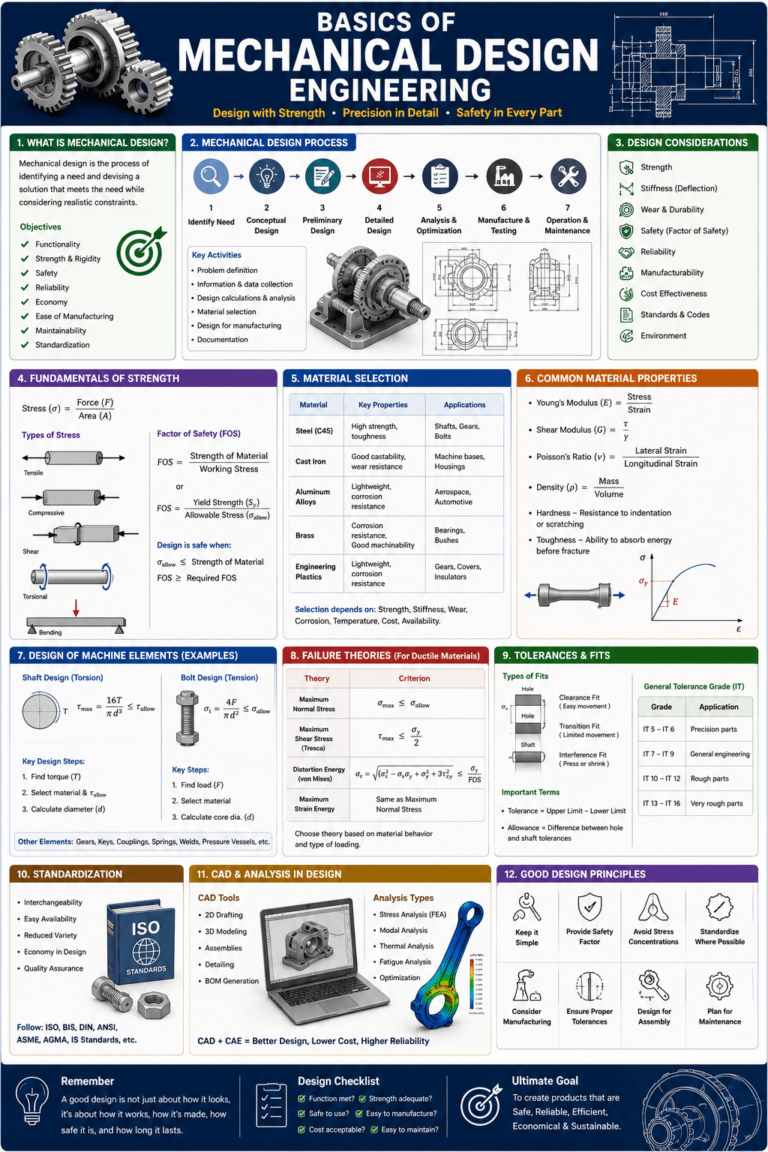
- Answer: Stress is the internal resistance offered by a material to an external force, measured as force per unit area. Strain is the deformation or change in shape of a material relative to its original dimensions.
- What is the difference between tensile strength and yield strength?
- Answer: Yield strength is the stress at which a material begins to deform plastically (permanently). Tensile strength is the maximum stress a material can withstand before failure.
- What is Poisson’s ratio?
- Answer: Poisson’s ratio is the ratio of lateral strain to longitudinal strain when a material is subjected to axial loading. It describes how a material deforms in directions perpendicular to the applied force.
- Explain the significance of the factor of safety.
- Answer: The factor of safety is the ratio of ultimate stress to allowable stress. It provides a margin of safety to account for uncertainties in material properties, loading conditions, manufacturing variations, and potential errors.
Fluid Mechanics
- What is Reynolds number and its significance?
- Answer: The Reynolds number is a dimensionless quantity that predicts flow patterns in fluid flow. It is the ratio of inertial forces to viscous forces. Low Reynolds numbers indicate laminar flow, while high Reynolds numbers indicate turbulent flow.
- What is cavitation and how can it be prevented?
- Answer: Cavitation is the formation of vapour cavities or bubbles in a fluid when the pressure drops below the vapour pressure. It can cause damage to pumps, turbines, and propellers. Prevention methods include reducing fluid velocity, increasing system pressure, and proper pump selection.
- What is the difference between a pump and a compressor?
- Answer: A pump moves incompressible fluids (liquids) and increases their pressure. A compressor moves compressible fluids (gases) and significantly increases their pressure while reducing volume.
- Explain the working principle of a centrifugal pump.
- Answer: A centrifugal pump uses an impeller to impart kinetic energy to the fluid. The fluid enters the impeller at the centre and is thrown outward by centrifugal force, converting kinetic energy to pressure energy in the volute casing.
Category 2: Design, CAD, and Manufacturing
These questions assess your practical design skills, software proficiency, and understanding of manufacturing processes.
Design and CAD
- What CAD software are you proficient in?
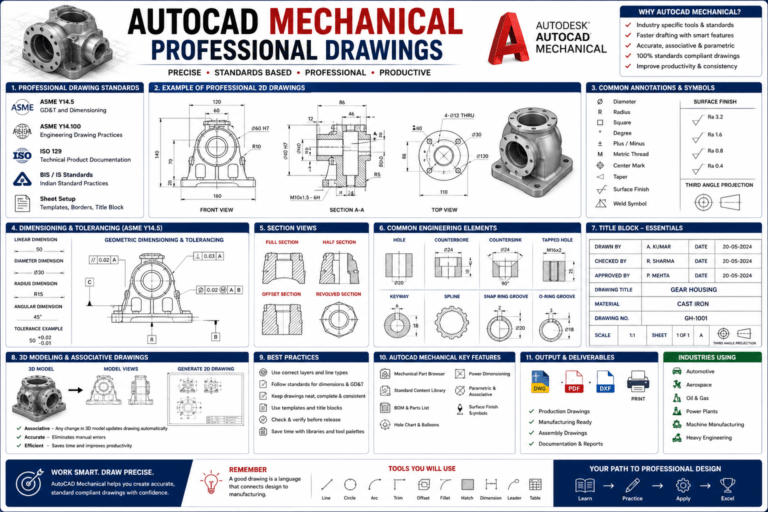
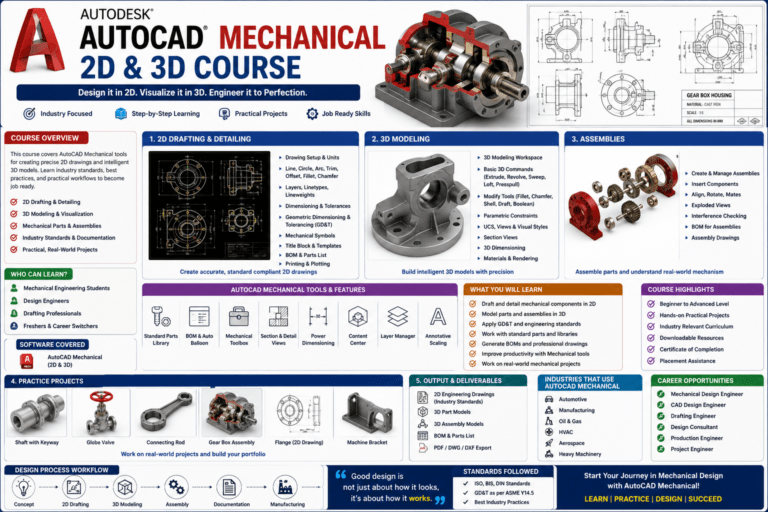
- Answer: Be prepared to discuss specific software such as AutoCAD, SolidWorks, CATIA, NX, or Creo. Mention your level of expertise and provide examples of projects completed using each tool.
- What is GD&T and why is it used?
- Answer: GD&T (Geometric Dimensioning and Tolerancing) is a system for defining and communicating engineering tolerances. It ensures that parts fit together properly and function as intended, even with manufacturing variations.
- Explain design for assembly (DFA).
- Answer: DFA is a design methodology that focuses on designing products that are easy to assemble. It aims to reduce assembly time, minimise part count, simplify assembly operations, and reduce overall manufacturing costs.
- What factors determine material selection for a load-bearing component?
- Answer: Key factors include mechanical properties (strength, stiffness, toughness), environmental conditions (temperature, corrosion), manufacturability, cost, weight, and availability.
- What is the purpose of a flywheel in an engine?
- Answer: A flywheel stores rotational energy and smooths out the power delivery from an engine. It absorbs energy during the power stroke and releases it during other strokes, reducing speed fluctuations.
Manufacturing Processes
- Describe the different types of manufacturing processes you are familiar with.
- Answer: Manufacturing processes include casting, forging, machining, welding, sheet metal forming, injection moulding, and additive manufacturing (3D printing).
- Explain the difference between welding, brazing, and soldering.
- Answer: Welding involves melting the base materials to form a joint. Brazing uses a filler metal with a melting point above 450°C without melting the base materials. Soldering uses a filler metal with a melting point below 450°C.
- What is knurling?
- Answer: Knurling is a manufacturing process that creates a patterned, textured surface on a workpiece. It is commonly used to improve grip on handles, knobs, and tools.
- What is the difference between CR and HR steel?
- Answer: Cold-rolled (CR) steel has better surface finish and tighter tolerances but is more expensive. Hot-rolled (HR) steel is cheaper and has a rougher surface finish.
- What is a process flow diagram (PFD)?
- Answer: A PFD is a diagram that shows the flow of materials and energy through a process. It is used to understand, analyse, and improve manufacturing or chemical processes.
Category 3: Mechanical Systems and Components
These questions test your knowledge of specific mechanical systems and components.
- Explain the working principle of a four-stroke engine.
- Answer: A four-stroke engine operates through four strokes: intake (air-fuel mixture enters), compression (mixture is compressed), power (combustion drives the piston), and exhaust (gases are expelled).
- What are the various types of brakes?
- Answer: Brakes include mechanical brakes (drum, disc), hydraulic brakes, pneumatic brakes, and electromagnetic brakes.
- What is the significance of tolerance in engineering?
- Answer: Tolerance is the allowable variation in a dimension. It ensures that parts fit and function correctly despite manufacturing variations. Tighter tolerances increase precision but also increase cost.
- Explain the difference between a belt drive and a chain drive.
- Answer: Belt drives use flexible belts to transmit power between pulleys. They are quieter and require less maintenance but can slip. Chain drives use chains and sprockets, providing positive drive without slip, but require lubrication and are noisier.
- What is a heat exchanger and what are its types?
- Answer: A heat exchanger transfers heat between two or more fluids without mixing them. Types include shell and tube, plate and frame, finned tube, and double pipe heat exchangers.
Category 4: Behavioural and HR Questions
Behavioural questions assess your soft skills, work history, and cultural fit. They are as important as technical questions.
- Tell me about yourself.
- Answer: Provide a concise summary of your professional background, key achievements, and career aspirations. Tailor your response to the specific role.
- Why did you choose mechanical engineering?
- Answer: Share your passion for the field. Mention specific experiences or interests that drew you to mechanical engineering.
- What are your strengths as a mechanical engineer?
- Answer: Be specific and provide examples. Mention technical strengths (e.g., CAD proficiency, problem-solving) and soft skills (e.g., communication, teamwork).
- What are your weaknesses?
- Answer: Be honest but strategic. Mention a genuine weakness and explain how you are working to overcome it.
- Describe a time you made a mistake on the job. How did you grow from the experience?
- Answer: Use the STAR method (Situation, Task, Action, Result). Be honest about the mistake and focus on what you learned and how you improved.
- Why do you want to work for this company?
- Answer: Research the company thoroughly. Mention specific projects, values, or aspects of the company culture that appeal to you.
- Where do you see yourself in five years?
- Answer: Demonstrate ambition and a clear career path. Align your goals with the opportunities the company can offer.
- What is your favourite part of being a mechanical engineer?
- Answer: Share what excites you about the profession. This could be problem-solving, design, innovation, or seeing your work come to life.
- Are you planning to pursue higher education?
- Answer: Be honest about your plans. If you are considering further study, explain how it aligns with your career goals and the role.
- What skills are most important for an engineer to have?
- Answer: Mention both technical skills (problem-solving, analytical thinking, technical knowledge) and soft skills (communication, teamwork, adaptability).
Category 5: Advanced and Specialised Questions
For experienced engineers, interviews often include more advanced or specialised questions.
- Explain the difference between fatigue failure and creep failure.
- Answer: Fatigue failure occurs under cyclic loading, even when the maximum stress is below the material’s yield strength. Creep failure is time-dependent deformation under constant stress at elevated temperatures.
- What is the role of a mechanical engineer in an EPC project?
- Answer: In Engineering, Procurement, and Construction (EPC) projects, mechanical engineers are involved in design, equipment selection, procurement support, construction supervision, and commissioning.
- Explain the concept of finite element analysis (FEA).
- Answer: FEA is a numerical method for solving complex engineering problems by dividing a structure into smaller, simpler elements and analysing their behaviour under loads.
- What is the difference between a closed-loop and open-loop control system?
- Answer: An open-loop system operates without feedback, while a closed-loop system uses feedback to adjust its output and maintain the desired setpoint.
- Explain the working principle of a refrigeration cycle.
- Answer: A refrigeration cycle uses a refrigerant to absorb heat from a cold space and reject it to a warm space through compression, condensation, expansion, and evaporation.
- What is the difference between a turbine and a compressor?
- Answer: A turbine extracts energy from a fluid and converts it to mechanical work. A compressor adds energy to a fluid to increase its pressure.
- Explain the concept of computational fluid dynamics (CFD).
- Answer: CFD is a branch of fluid mechanics that uses numerical analysis and algorithms to solve and analyse problems involving fluid flows.
Category 6: Problem-Solving and Analytical Questions
Interviewers often present hypothetical problems to assess your analytical and problem-solving approach.
- How would you approach designing a component that has conflicting requirements (e.g., lightweight but strong)?
- Answer: Discuss the trade-offs. Consider material selection, geometry optimisation, and the use of advanced manufacturing techniques. Mention the importance of iterative design and testing.
- How do you stay updated with new technologies in mechanical engineering?
- Answer: Mention professional journals, conferences, online courses, and professional organisations (e.g., ASME).
- Describe a challenging engineering problem you solved and how you solved it.
- Answer: Use the STAR method. Describe the problem, your approach, the solution, and the results.
- How would you explain a complex mechanical concept to a non-engineer?
- Answer: Use simple analogies and avoid jargon. Focus on the core idea and its practical implications.
- What was the first thing you designed on your own?
- Answer: Share a personal project or academic assignment. Explain the design process, challenges faced, and what you learned.
Preparation Tips for Mechanical Engineering Interviews
Master Your Core Subjects
Interviewers consistently test fundamentals in thermodynamics, fluid mechanics, strength of materials, machine design, and manufacturing processes. Ensure you have a solid understanding of these core areas.
Review Your Projects and Experience
Be prepared to discuss your academic projects, internships, and work experience in detail. Practice explaining your role, the challenges you faced, and the outcomes you achieved.
Prepare for Behavioural Questions
Behavioural questions assess your soft skills and work history. Use the STAR method (Situation, Task, Action, Result) to structure your answers.
Practice with Mock Interviews
Conduct mock interviews with friends, mentors, or career counsellors. This builds confidence and helps you refine your responses.
Research the Company
Thoroughly research the company’s products, services, culture, and recent developments. Tailor your answers to demonstrate your interest and fit.
Prepare Questions to Ask
Interviews are a two-way process. Prepare thoughtful questions about the role, team, projects, and company culture.
Use Practice Tests and Question Banks
Structured practice tests are among the most effective preparation tools. They familiarise you with question formats, help identify knowledge gaps, and build confidence.
Mastering Your Interview: Your Next Step
Preparing for a mechanical engineering interview can be overwhelming. The breadth of topics is vast, and the stakes are high. However, with the right preparation, you can approach your interview with confidence and poise.
The TOP 50 MECHANICAL ENGINEERING INTERVIEW QUESTIONS course provides the comprehensive preparation you need. The course covers:
- 50 essential interview questions with detailed answers
- Coverage of technical, behavioural, and HR questions
- Preparation strategies for freshers and experienced engineers
- Tips for answering effectively and confidently
- Practice questions to test your knowledge
Enrol in TOP 50 MECHANICAL ENGINEERING INTERVIEW QUESTIONS Now
Recommended Related Courses
To build a comprehensive career preparation strategy, consider these additional courses:
100+ MECHANICAL engineering INTERVIEW questions – More than 100 interesting questions and answers from various mechanical engineering subjects.
MECHANICAL ENGINEERING INTERVIEW QUESTION PRACTICE TEST 2025 – Comprehensive set of interview questions and answers with 100+ multiple-choice questions covering all critical areas.
Mechanical Engineer Interview – Specialised interview preparation for mechanical engineering roles.
Career Kickstart: Mechanical Engineers Job Ready – Complete career preparation for mechanical engineers entering the job market.
Mechanical Engineering 101: From Student to Professional – Transition from academic study to professional practice.
Thermodynamics for Mechanical Engineering – Strengthen your thermodynamics knowledge for interviews.
Frequently Asked Questions
What are the most common mechanical engineering interview questions?
The most common questions cover thermodynamics, fluid mechanics, strength of materials, machine design, and manufacturing processes. Behavioural questions about your experience, strengths, and career goals are also common.
How should I prepare for a mechanical engineering interview?
Review core subjects, practice answering common questions, prepare for behavioural questions, research the company, and conduct mock interviews.
What technical topics are most important for mechanical engineering interviews?
Thermodynamics, fluid mechanics, strength of materials, machine design, manufacturing processes, and CAD software are consistently tested.
How do I answer “Tell me about yourself”?
Provide a concise summary of your professional background, key achievements, and career aspirations. Tailor your response to the specific role.
What should I ask at the end of a mechanical engineering interview?
Ask about the team structure, typical projects, career development opportunities, and company culture.
How can I practice for a mechanical engineering interview?
Use practice tests, question banks, and mock interviews. The TOP 50 MECHANICAL ENGINEERING INTERVIEW QUESTIONS course provides comprehensive practice materials.
Final Thoughts
The mechanical engineering interview is your opportunity to demonstrate your knowledge, skills, and potential. Thorough preparation is essential for success. By mastering core technical concepts, practising common questions, and preparing for behavioural assessments, you can approach your interview with confidence.
Remember that interviews are not just about testing your knowledge. They are about assessing your problem-solving approach, communication skills, and cultural fit. Present yourself as a competent, collaborative, and motivated professional.
Start your preparation today with comprehensive interview training and take the next step in your career.
Enrol in TOP 50 MECHANICAL ENGINEERING INTERVIEW QUESTIONS
About the Author