 Edu_Admin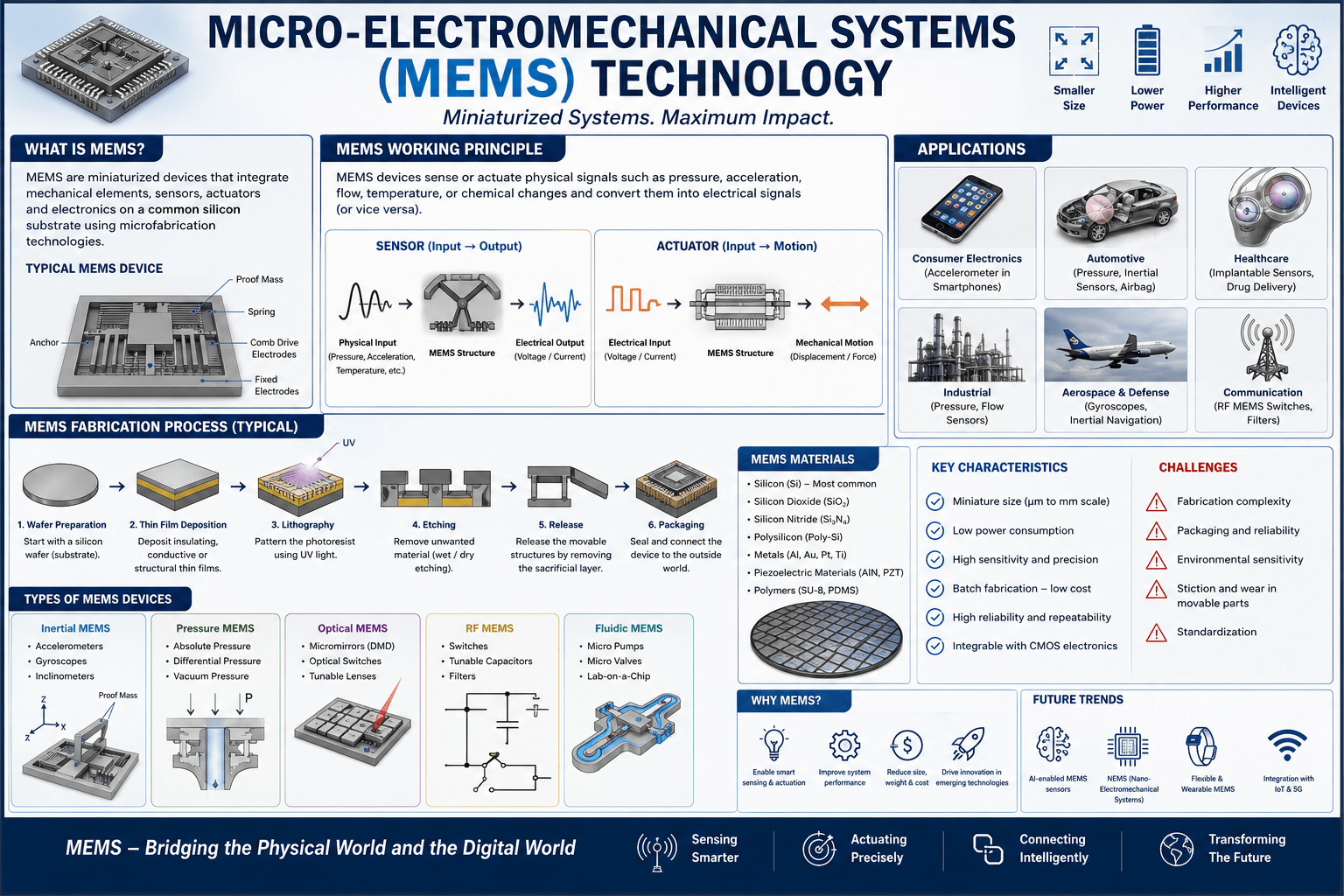
Introduction
Micro-Electromechanical Systems MEMS technology represent one of the most transformative technologies of the modern era. These miniaturised devices integrate mechanical and electrical components on a common substrate, typically silicon, at length scales ranging from one micrometer to several hundred micrometers. They are the invisible engines powering the smartphones in our pockets, the airbags in our cars, and the medical devices that save lives.
Consider the scale of the impact. The global MEMS market was valued at $17.24 billion in 2024 and is expected to grow at a compound annual growth rate of 7.74% to reach $36.34 billion by 2034. MEMS devices are celebrated for their small size, biocompatibility, low cost, low power consumption, ultra-high sensitivity, fast detection speed, high accuracy, and real-time analysis capabilities. They are the fundamental building blocks of intelligent objects, providing information about our environment and enabling responsive action.
Yet despite their ubiquity, MEMS technology remains poorly understood by many engineers. The fabrication processes are complex. The design principles are multidisciplinary. The terminology can be overwhelming.
This guide changes that. It provides a comprehensive introduction to Micro-Electromechanical Systems technology, covering what MEMS are, how they work, how they are fabricated, where they are used, and how you can build expertise in this critical field.
What Are Micro-Electromechanical Systems (MEMS)?
Micro-Electromechanical Systems, or MEMS, are microscopic devices that combine mechanical elements, sensors, actuators, and electronics on a common silicon substrate. They are also known as microsystems or micromachines. The field encompasses tiny, generally chip-scale devices or systems capable of realising functions not easily achievable via transistor devices alone.
The Core Concept
At their essence, MEMS devices are about transduction—converting one form of energy to another. A MEMS sensor detects a physical phenomenon (acceleration, pressure, temperature, light) and converts it into an electrical signal. A MEMS actuator does the reverse, converting an electrical signal into physical motion.
MEMS vs. Traditional Electronics
Traditional integrated circuits are purely electronic. They process signals but cannot directly interact with the physical world. MEMS devices bridge this gap. They provide the interface between the digital world of electronics and the analogue world of physics.
Key Characteristics
- Miniaturisation: Devices measured in micrometers
- Integration: Mechanical and electrical components on a single chip
- Batch Fabrication: Manufactured using semiconductor processing techniques
- Cost-Effectiveness: Low per-unit cost at high volumes
- Low Power Consumption: Ideal for portable and battery-powered applications
- High Sensitivity: Capable of detecting extremely small physical changes
How MEMS Devices Work
MEMS devices operate on a variety of physical principles, from solid-body or gaseous mechanical displacement to expansion and contraction. They can be realised in the form of sensors, actuators, or mechanical structures.
MEMS Sensors
MEMS sensors detect physical phenomena and convert them into electrical signals. Common types include:
- Accelerometers: Measure acceleration and tilt. Found in smartphones for screen rotation and step counting
- Gyroscopes: Measure angular velocity. Used in navigation systems and image stabilisation
- Pressure Sensors: Measure pressure. Used in automotive tyre pressure monitoring and medical devices
- Microphones: Convert sound waves to electrical signals. Found in virtually all modern mobile devices
- Temperature Sensors: Measure temperature with high precision
- Magnetometers: Measure magnetic fields. Used in compass applications
MEMS Actuators
MEMS actuators convert electrical signals into physical motion. They are used in:
- Inkjet Print Heads: Precise droplet ejection
- Digital Micromirror Devices: Projection systems and displays
- RF Switches: Telecommunications and signal routing
- Micro-Valves: Fluid control in medical and analytical devices
- Micro-Motors: Precise positioning and motion
MEMS Resonators
MEMS resonators are mechanical structures that vibrate at specific frequencies. They are used in:
- Timing Devices: Replacing quartz crystals in electronic devices
- Filters: Signal processing in communications
- Sensors: High-sensitivity detection of mass, force, and acceleration
MEMS Fabrication: How MEMS Devices Are Made
MEMS fabrication builds upon the advanced semiconductor manufacturing techniques developed for integrated circuits. However, MEMS fabrication extends these techniques to create three-dimensional mechanical structures.
Fundamental Fabrication Techniques
Lithography is the foundational process. A photosensitive material (photoresist) is applied to a silicon wafer, exposed to light through a mask, and developed to create a pattern. This pattern guides subsequent etching or deposition steps.
Etching removes material to create mechanical structures. Two primary approaches exist:
- Wet Etching: Uses chemical solutions to dissolve material
- Dry Etching: Uses plasma or reactive ions to remove material with greater precision
Sacrificial Layer Technology is a distinctive MEMS fabrication technique. A temporary layer is deposited, patterned, and later removed to release a movable mechanical structure. This is how cantilevers, membranes, and other suspended structures are created.
Key Fabrication Processes
- Bulk Micromachining: The substrate (typically silicon) is etched to create mechanical structures
- Surface Micromachining: Thin films are deposited and patterned on the substrate surface
- Wafer Bonding: Two or more wafers are bonded together to create complex structures
- Electroplating: Metal structures are built up through electrochemical deposition
- CMOS-MEMS Integration: Merging MEMS fabrication with standard CMOS electronics processing
Materials in MEMS
Silicon is the dominant material in MEMS fabrication, but other materials are also used:
- Silicon: Excellent mechanical properties and compatibility with semiconductor processing
- Silicon Dioxide: Used as a sacrificial layer and electrical insulator
- Silicon Nitride: Used for structural and insulating layers
- Metals: Gold, aluminium, and platinum for electrical contacts and structures
- Polymers: Used in flexible and biomedical MEMS applications
Applications of MEMS Technology
MEMS devices are everywhere. Their applications span virtually every sector of modern technology.
Consumer Electronics
MEMS devices are essential components in smartphones, tablets, wearables, and gaming devices:
- Accelerometers and gyroscopes enable screen rotation, step counting, and gesture recognition
- MEMS microphones enable voice commands and high-quality audio recording
- MEMS pressure sensors enable altitude detection and weather monitoring
- MEMS oscillators provide timing for digital circuits
Automotive
The automotive industry was an early adopter of MEMS technology:
- Airbag deployment sensors detect sudden deceleration
- Tyre pressure monitoring systems ensure safety and efficiency
- Inertial measurement units enable vehicle stability control
- MEMS sensors support advanced driver assistance systems (ADAS) and autonomous driving
Aerospace and Defence
MEMS devices are critical in aerospace and defence applications:
- Inertial navigation systems for aircraft, missiles, and spacecraft
- Guidance systems for precision munitions
- Pressure sensors for altitude and airspeed measurement
- Vibration monitoring for structural health monitoring
Medical and Healthcare
MEMS technology is transforming healthcare:
- Implantable pressure sensors for monitoring conditions
- Microfluidic devices for diagnostic testing
- Drug delivery systems with precise micro-pumps
- Biosensors for detecting specific biomarkers
- Wearable health monitoring devices
Telecommunications
MEMS devices enable advanced communications:
- RF MEMS switches for signal routing
- MEMS resonators for frequency generation and filtering
- Optical MEMS for fibre optic switching and routing
Industrial and Environmental
MEMS sensors are used in industrial and environmental monitoring:
- Condition monitoring of machinery
- Environmental monitoring of air and water quality
- Flow sensors for industrial process control
- Position sensors for robotics and automation
The Career Opportunity in MEMS Technology
MEMS technology represents a significant career opportunity for engineers across multiple disciplines.
Why MEMS Skills Are in Demand
The MEMS industry is growing rapidly. Companies across consumer electronics, automotive, aerospace, medical devices, and telecommunications need engineers who understand MEMS design, fabrication, and application.
Roles in the MEMS Industry
- MEMS Design Engineer: Designing MEMS devices using CAD and simulation tools
- Process Engineer: Developing and optimising MEMS fabrication processes
- Application Engineer: Integrating MEMS devices into end products
- Test Engineer: Characterising and validating MEMS device performance
- Research Scientist: Developing next-generation MEMS technologies
Skills Required
- Understanding of mechanical and electrical engineering principles
- Knowledge of semiconductor fabrication processes
- Familiarity with simulation and modelling tools
- Understanding of materials science
- Cross-disciplinary collaboration skills
Mastering MEMS Technology: Your Next Step
Learning Micro-Electromechanical Systems technology requires a multidisciplinary approach that spans mechanical engineering, electrical engineering, materials science, and semiconductor fabrication. This breadth can make the field seem intimidating, but with the right structured approach, it is accessible and rewarding.
The Micro-Electromechanical Systems (MEMS) Technology course provides exactly this structured approach. The course covers:
- Microfabrication techniques fundamental to MEMS device production
- Micro-electromechanical systems technology principles and applications
- How MEMS-based devices are transforming industries globally
- Practical understanding of MEMS design and manufacturing
Enrol in Micro-Electromechanical Systems (MEMS) Technology Now
Recommended Related Courses
To build a comprehensive understanding of MEMS and related technologies, consider these additional courses:
Microelectromechanical Systems I: Fundamentals of MEMS – Explore the fundamental physical principles of MEMS and their critical role in bridging the gap between the digital and physical worlds.
Microelectromechanical Systems II: Design Principles – Transition from fundamental physical principles to systematic modelling and design of functional MEMS devices.
Microelectromechanical Systems III: Fabrication Fundamentals – Explore the industrial reality of bringing MEMS from theoretical design to commercial product.
Modern MicroFab and Micro Electro Mechanical Systems (MEMS) – Survey of MEMS and micro-fabrication technology from an author with both academic and industrial foundry production experience.
Semiconductor Mechanical System – Understand the intersection of semiconductor technology and mechanical systems.
Frequently Asked Questions
What is MEMS technology?
MEMS (Micro-Electromechanical Systems) is a technology that integrates mechanical and electrical components on a common silicon substrate at micrometer scales. MEMS devices include sensors, actuators, and mechanical structures.
What are the main applications of MEMS?
MEMS devices are used in consumer electronics (smartphones, wearables), automotive (airbags, tyre pressure monitoring), aerospace (inertial navigation), medical devices (implantable sensors, diagnostics), and telecommunications (RF switches, resonators).
How are MEMS devices fabricated?
MEMS fabrication uses semiconductor manufacturing techniques including lithography, etching (wet and dry), sacrificial layer technology, wafer bonding, and electroplating.
What materials are used in MEMS?
Silicon is the dominant material. Other materials include silicon dioxide, silicon nitride, metals (gold, aluminium, platinum), and polymers.
What is the difference between a MEMS sensor and a MEMS actuator?
A MEMS sensor detects a physical phenomenon and converts it into an electrical signal. A MEMS actuator converts an electrical signal into physical motion.
Why is MEMS technology important?
MEMS devices are small, low-cost, low-power, and highly sensitive. They enable the miniaturisation and intelligence of modern electronic devices, from smartphones to medical implants to autonomous vehicles.
Which course should I choose for learning MEMS technology?
A course covering microfabrication techniques and MEMS technology principles is ideal. The Micro-Electromechanical Systems (MEMS) Technology course provides comprehensive coverage of these topics.
Final Thoughts
Micro-Electromechanical Systems technology is one of the most important engineering disciplines of the twenty-first century. It enables the miniaturisation, intelligence, and connectivity that define modern technology. From the sensors in your smartphone to the airbags in your car to the medical devices that save lives, MEMS devices are everywhere.
The field is growing rapidly, creating significant opportunities for engineers who understand MEMS design, fabrication, and application. With the right training, you can build expertise in this transformative technology and position yourself for a rewarding career.
Start your MEMS journey today with the right course and approach.
Enrol in Micro-Electromechanical Systems (MEMS) Technology
About the Author