 Edu_Admin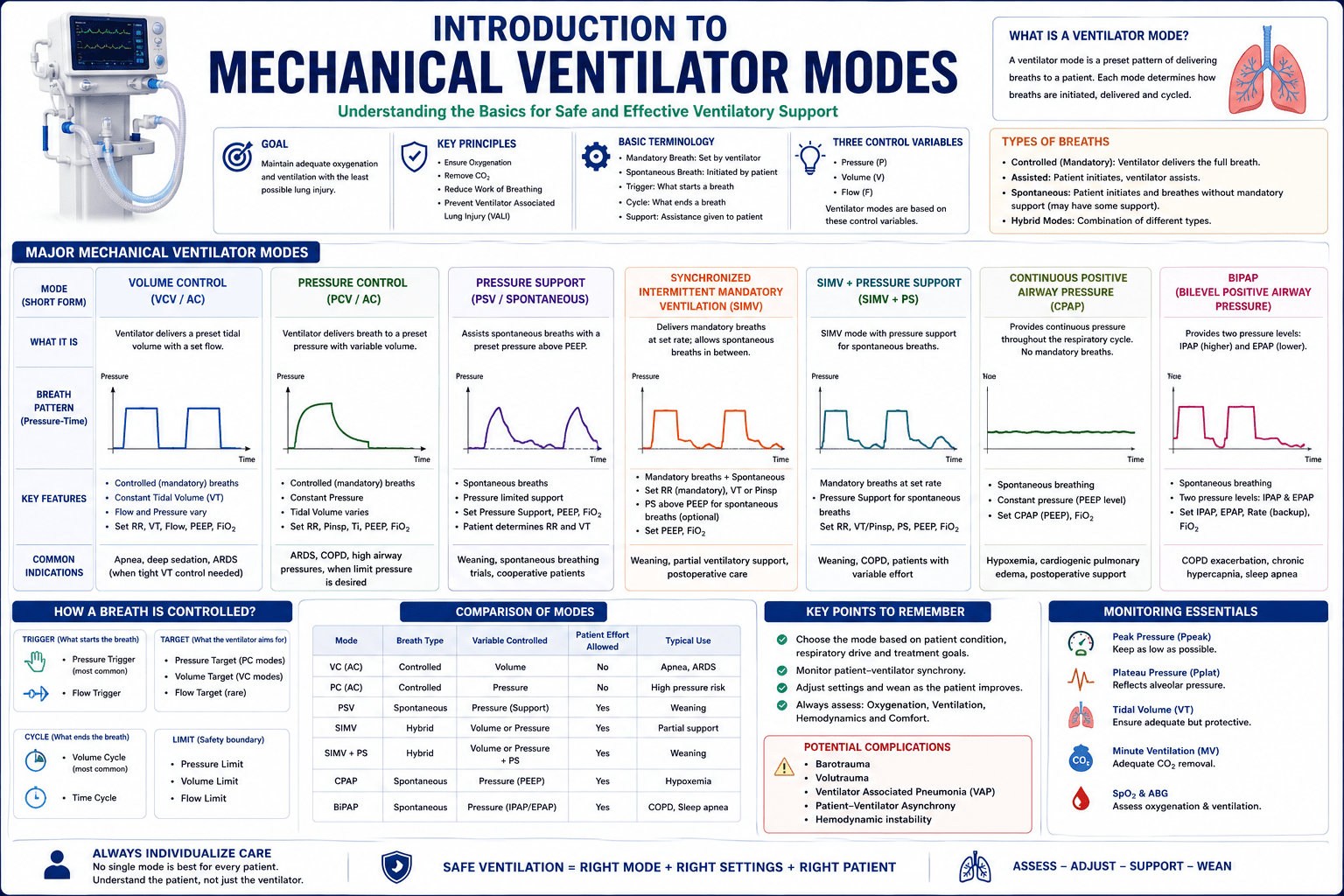
Introduction
Mechanical ventilation is one of the most essential and life-saving interventions in modern medicine. It sustains patients who cannot breathe adequately on their own, supports failing lungs, and provides the critical time needed for healing and recovery. In intensive care units, emergency departments, and operating rooms around the world, ventilators are the machines that keep patients alive when their respiratory systems cannot.
Yet for many healthcare professionals, the ventilator remains a source of anxiety. The terminology is confusing. The modes seem endless. The settings appear to multiply without clear guidance. Where does one even begin?
The answer is simpler than it seems. Every ventilator mode is built on a few fundamental concepts: how the breath is triggered, what controls the delivery of gas, and how the breath ends. Understanding these building blocks makes the entire system logical and manageable.
The Introduction to Mechanical Ventilator Modes course is designed precisely for this purpose. It provides a clear, structured introduction to the most common ventilator modes, their clinical applications, and the principles that govern their use.
This guide provides a comprehensive overview of mechanical ventilator modes, covering what they are, how they work, when to use each mode, and how to build your expertise in this critical area of patient care.
What Is a Mechanical Ventilator Mode?
A mechanical ventilation mode is a predetermined pattern of interaction between the patient and the ventilator. It defines how the ventilator delivers breaths, how it responds to the patient’s respiratory efforts, and how it cycles between inspiration and expiration. There are 624 trade names for these modes, corresponding to 74 different mechanical ventilators.
Despite this proliferation of names, all modes are built on a few fundamental principles. Understanding these principles is the key to mastering mechanical ventilation.
The Three Components of Every Ventilator Mode
Every ventilator mode can be understood in terms of three components:
- The Control Variable: What does the ventilator control during inspiration? The two primary control variables are pressure and volume.
- The Breath Sequence: How are breaths delivered? Breaths can be mandatory (ventilator-initiated), assisted (patient-initiated with ventilator support), or spontaneous (patient-initiated and patient-cycled).
- The Targeting Scheme: How does the ventilator adjust its output to achieve the desired goal? This can be a simple set point or a more complex adaptive algorithm.
Classifying Ventilator Modes
Ventilator modes are typically classified into two main categories: volume-controlled modes and pressure-controlled modes. This classification is based on what the ventilator controls during inspiration.
Volume-Controlled Ventilation (VCV)
In volume-controlled modes, the ventilator delivers a preset tidal volume with each breath. The pressure is variable and depends on the patient’s lung compliance and airway resistance.
Key Characteristics:
- Tidal volume is guaranteed
- Peak pressure varies with lung mechanics
- Flow is typically constant (square waveform)
- Suitable for patients with stable lung mechanics
Clinical Applications:
- Patients with normal or stable lung compliance
- When consistent minute ventilation is required
- During the initial phase of mechanical ventilation
Pressure-Controlled Ventilation (PCV)
In pressure-controlled modes, the ventilator delivers gas until a preset inspiratory pressure is reached. The volume is variable and depends on the patient’s lung compliance and airway resistance.
Key Characteristics:
- Pressure is limited and controlled
- Tidal volume varies with lung mechanics
- Flow is decelerating
- May be more comfortable for spontaneously breathing patients
Clinical Applications:
- Acute Respiratory Distress Syndrome (ARDS)
- When limiting peak airway pressures is a priority
- Patients with variable lung mechanics
Dual-Control Modes
Some modern ventilators offer dual-control modes that can automatically switch between pressure control and volume control during a single breath. These modes aim to provide the benefits of both approaches.
Common Ventilator Modes
Controlled Mechanical Ventilation (CMV)
CMV is a mode in which the ventilator delivers a preset number of breaths at a preset rate, regardless of the patient’s respiratory efforts. The patient cannot initiate additional breaths.
When to Use: Patients who are apnoeic, heavily sedated, or paralysed. CMV is rarely used as a primary mode in modern practice due to the risk of patient-ventilator asynchrony.
Assist-Control Ventilation (AC)
AC is one of the most commonly used modes in intensive care. In AC, the ventilator delivers a preset tidal volume or pressure with every breath, whether the breath is triggered by the patient or by the ventilator’s time cycle.
Key Features:
- Every breath is fully supported
- Patient can trigger additional breaths
- The set tidal volume or pressure is delivered with each breath
- Minute ventilation is guaranteed
When to Use:
- Patients who require full ventilatory support
- Initial stabilisation of critically ill patients
- Patients with respiratory muscle fatigue
Advantages:
- Ensures consistent minute ventilation
- Reduces patient work of breathing
- Simple to set up and manage
Disadvantages:
- Can cause hyperventilation if the patient triggers frequently
- May lead to patient-ventilator asynchrony
- Not ideal for weaning
Synchronized Intermittent Mandatory Ventilation (SIMV)
SIMV delivers a preset number of mandatory breaths that are synchronized with the patient’s inspiratory efforts. Between mandatory breaths, the patient can breathe spontaneously.
Key Features:
- Mandatory breaths are synchronized with patient effort
- Spontaneous breaths are allowed between mandatory breaths
- The number of mandatory breaths can be gradually reduced for weaning
When to Use:
- Weaning patients from mechanical ventilation
- Patients with some respiratory effort
- Transitioning from full support to spontaneous breathing
Advantages:
- Maintains respiratory muscle strength
- Facilitates weaning
- Reduces the risk of hyperventilation
Disadvantages:
- Can increase patient work of breathing
- May not be suitable for patients with severe respiratory failure
Pressure Support Ventilation (PSV)
PSV is a spontaneous breathing mode in which the ventilator provides a preset level of pressure support to augment the patient’s own inspiratory effort. The patient initiates and terminates each breath.
Key Features:
- Patient-triggered and patient-cycled
- Preset pressure support level
- Tidal volume varies with patient effort
- No mandatory breaths
When to Use:
- Weaning patients from mechanical ventilation
- Patients with stable respiratory drive
- As a standalone mode for patients who can breathe spontaneously
Advantages:
- Comfortable for patients
- Maintains respiratory muscle strength
- Excellent for weaning
Disadvantages:
- Requires patient respiratory effort
- Not suitable for apnoeic patients
- Tidal volume is not guaranteed
Biphasic Positive Airway Pressure (BIPAP)
BIPAP is a mode that allows spontaneous breathing during both inspiration and expiration. It provides two levels of positive airway pressure, with the patient able to breathe spontaneously at either level.
When to Use: Patients with hypoxemic respiratory failure who can breathe spontaneously.
Triggering, Cycling, and Limiting: The Building Blocks of Modes
Understanding how ventilator modes work requires understanding three key concepts: triggering, cycling, and limiting.
Triggering
Triggering determines how a breath is initiated. Breaths can be:
- Time-Triggered: The ventilator initiates the breath at a preset interval
- Patient-Triggered: The patient initiates the breath by creating a pressure or flow change
- Flow-Triggered: The ventilator detects a change in flow
Cycling
Cycling determines when inspiration ends and expiration begins. Breaths can be:
- Volume-Cycled: Inspiration ends when the preset volume is delivered
- Pressure-Cycled: Inspiration ends when the preset pressure is reached
- Flow-Cycled: Inspiration ends when flow drops to a preset level
- Time-Cycled: Inspiration ends after a preset time
Limiting
Limiting determines the maximum value of a parameter during inspiration. Common limits include:
- Pressure Limiting: The maximum airway pressure allowed
- Flow Limiting: The maximum flow rate allowed
- Volume Limiting: The maximum volume allowed
Choosing the Right Ventilator Mode
The selection of a ventilator mode is generally based on clinician familiarity and institutional preferences. However, certain principles can guide the choice.
Initial Ventilator Settings
When initiating mechanical ventilation, the goal is to provide adequate oxygenation and ventilation while minimising the risk of lung injury. Common initial settings include:
- Mode: AC or SIMV
- Tidal Volume: 6-8 mL/kg of ideal body weight
- Respiratory Rate: 12-20 breaths per minute
- FiO2: 100% initially, then titrated to SpO2 > 92%
- PEEP: 5-10 cm H2O
Mode Selection by Clinical Scenario
| Clinical Scenario | Recommended Mode | Rationale |
|---|---|---|
| Initial stabilisation | AC (volume or pressure control) | Full support, guaranteed minute ventilation |
| ARDS | Pressure control or lung-protective volume control | Limits peak pressures, protects lungs |
| Obstructive lung disease (COPD, asthma) | Low rate SIMV or pressure support | Allows adequate expiratory time |
| Weaning | SIMV, pressure support, or spontaneous breathing trials | Gradually reduces support |
| Neuromuscular disease | AC or SIMV | Provides consistent support |
What You Will Learn in a Comprehensive Ventilator Modes Course
The Introduction to Mechanical Ventilator Modes course provides a clear, structured introduction to the most important ventilator modes and their clinical applications.
Course Overview
| Feature | Detail |
|---|---|
| Category | Mechanical Ventilation |
| Focus | Introduction to Ventilator Modes |
| Target Audience | Medical students, residents, ICU nurses, respiratory therapists, healthcare professionals |
| Prerequisites | None required |
What You Will Learn
Understanding Ventilator Modes
- Definition and classification of ventilator modes
- The three components of every mode: control variable, breath sequence, and targeting scheme
- The difference between volume-controlled and pressure-controlled modes
Common Ventilator Modes
- Controlled Mechanical Ventilation (CMV)
- Assist-Control Ventilation (AC)
- Synchronized Intermittent Mandatory Ventilation (SIMV)
- Pressure Support Ventilation (PSV)
- Clinical applications for each mode
Setting Up the Ventilator
- Initial ventilator settings
- Adjusting settings based on patient response
- Troubleshooting common problems
Clinical Applications
- Choosing the right mode for different clinical scenarios
- Weaning patients from mechanical ventilation
- Managing complications
Enrol in Introduction to Mechanical Ventilator Modes Now
Who Should Take This Course
Medical Students and Residents
Students and residents who will encounter ventilated patients during their clinical rotations need a solid foundation in ventilator modes. This course provides the essential knowledge without overwhelming detail.
ICU Nurses
Nurses who care for ventilated patients daily will benefit from understanding how different modes work and what settings to monitor.
Respiratory Therapists
Respiratory therapists who manage ventilators will deepen their understanding of mode selection and clinical applications.
Critical Care Physicians
Physicians who manage ventilated patients will gain a clear framework for understanding and selecting ventilator modes.
Healthcare Professionals New to Mechanical Ventilation
Anyone who encounters ventilated patients and wants to understand the basics of ventilator management will find this course accessible and practical.
Frequently Asked Questions
What is the difference between volume control and pressure control?
In volume control, the ventilator delivers a preset tidal volume. The pressure is variable. In pressure control, the ventilator delivers gas until a preset pressure is reached. The volume is variable.
What is Assist-Control ventilation?
AC is a mode in which every breath is fully supported by the ventilator. Breaths can be triggered by the patient or by the ventilator’s time cycle. Each breath delivers the preset tidal volume or pressure.
What is SIMV?
SIMV delivers a preset number of mandatory breaths that are synchronized with the patient’s inspiratory efforts. Between mandatory breaths, the patient can breathe spontaneously.
What is Pressure Support?
Pressure support is a spontaneous breathing mode in which the ventilator provides a preset level of pressure support to augment the patient’s own inspiratory effort. The patient initiates and terminates each breath.
How do I choose the right ventilator mode?
Mode selection is generally based on clinician familiarity and institutional preferences. Key considerations include the patient’s underlying condition, respiratory effort, and the goal of ventilation (full support vs. weaning).
What are the most common ventilator modes?
The most common modes include Assist-Control (AC), Synchronized Intermittent Mandatory Ventilation (SIMV), and Pressure Support Ventilation (PSV).
Which course should I choose for learning ventilator modes?
A course that provides a clear, structured introduction to the most common modes and their clinical applications is ideal. The Introduction to Mechanical Ventilator Modes course provides exactly this foundation.
Mastering Ventilator Modes: Your Next Step
Understanding mechanical ventilator modes is essential for any healthcare professional who cares for critically ill patients. The ventilator is a powerful tool, but like any tool, it must be used with skill and understanding.
The Introduction to Mechanical Ventilator Modes course provides the clear, structured introduction you need to build your confidence and competence in ventilator management.
The course covers:
- The fundamental principles of mechanical ventilation
- The most common ventilator modes and their clinical applications
- How to set up and adjust the ventilator
- Choosing the right mode for different clinical scenarios
Start your journey to mastering ventilator modes today.
Enrol in Introduction to Mechanical Ventilator Modes Now
Recommended Related Courses
To build a comprehensive understanding of mechanical ventilation and critical care, consider these additional courses:
Mechanical Ventilation – Thinking Simple using Waveforms! – Master mechanical ventilation through simple waveform interpretation. Understand patient-ventilator synchrony, PEEP optimisation, and blood gas interpretation.
Introduction to Mechanical Ventilator Modes – A focused introduction to the different ventilator modes and their applications.
Mechanical Ventilation – Thinking Simple using Waveforms! – Build on your knowledge of modes with advanced waveform interpretation and clinical problem-solving.
Data Center Essentials: Mechanical and Cooling – Apply mechanical principles to data center cooling systems.
Thermodynamics for Mechanical Engineering – Build foundational knowledge in thermodynamics relevant to respiratory physiology.
Final Thoughts
Mechanical ventilation is one of the most powerful tools in critical care. It sustains life, supports recovery, and gives patients time to heal. But like any powerful tool, it must be used with skill and understanding.
The key to mastering mechanical ventilation is not memorising every mode or setting. It is understanding the fundamental principles that underlie all ventilator modes: how breaths are triggered, controlled, and cycled. Once you understand these principles, the rest falls into place.
The Introduction to Mechanical Ventilator Modes course provides the structured, accessible introduction you need to build your confidence and competence in ventilator management.
Start your journey to mastering mechanical ventilation today.
Enrol in Introduction to Mechanical Ventilator Modes
About the Author