

 Edu_Admin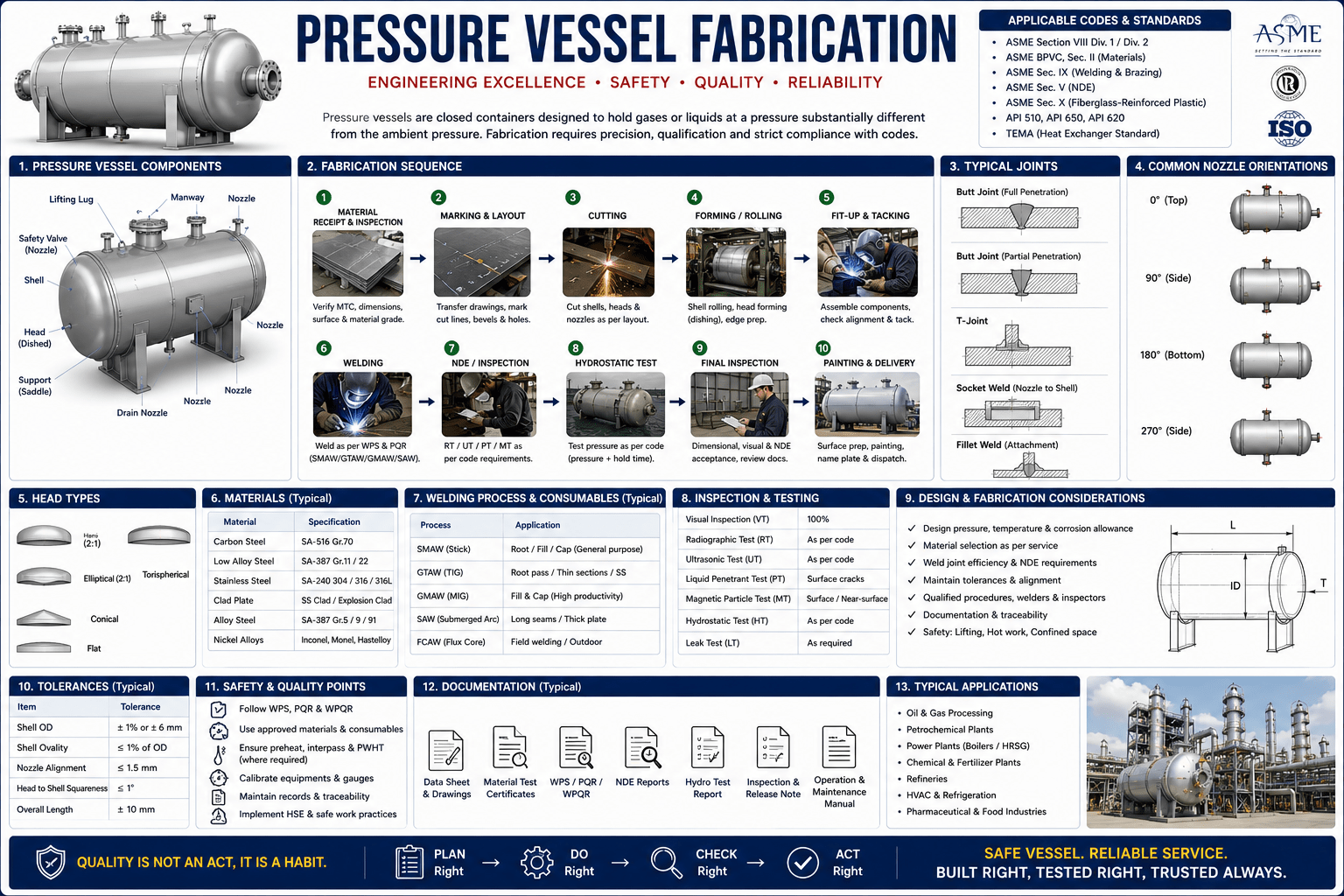
Introduction
Pressure vessels are the unsung heroes of the oil and gas industry. They are the drums, columns, reactors, and filters that process hydrocarbons under extreme conditions of temperature and pressure. They are the static equipment that enables refineries to produce fuel, chemical plants to manufacture products, and power plants to generate electricity. Without pressure vessels, modern industry as we know it would simply not exist.
Yet for many mechanical engineers and industry professionals, the world of pressure vessel fabrication remains unfamiliar. The terminology is specialised. The standards are exacting. The range of processes—from material selection to welding to non-destructive testing—is broad and interconnected.
The stakes could not be higher. A failure in a pressure vessel can have catastrophic consequences. That is why the fabrication process is governed by rigorous standards, particularly the ASME Boiler and Pressure Vessel Code (BPVC), which ensures that vessels are safe to operate in the extreme conditions they may encounter. ASME certified welders are typically employed to carry out the steps outlined in the pressure vessel drawings.
This guide provides a comprehensive introduction to pressure vessel fabrication mechanical engineering and oil and gas professionals. It covers what pressure vessels are, why they matter, the key fabrication processes, the standards that govern them, and how you can build expertise in this critical field.
What Is a Pressure Vessel?
A pressure vessel is a container designed to hold gases or liquids at a pressure substantially different from the ambient pressure. The majority of mechanical equipment found in oil and gas facilities belongs to the static equipment group, which comprises pressure vessels (drums, columns, reactors, filters) and heat exchangers.
Common Types of Pressure Vessels
- Storage Vessels: Tanks for storing liquids or gases under pressure
- Process Vessels: Reactors, columns, and drums used in chemical processing
- Heat Exchangers: Shell and tube, plate and frame, and air coolers
- Boilers: Vessels that generate steam under pressure
- Filters and Separators: Equipment for separating fluids and solids
Key Components
Pressure vessels are typically composed of several key parts, including the shell, closure, support, flanges, and nozzles. Each component must be carefully designed and fabricated to withstand the operating conditions.
Operating Conditions
Pressure vessels in the oil and gas industry operate at high temperatures and pressures to physically and chemically process hydrocarbons. The vessels must withstand internal or external pressures exceeding 15 psig.
Why Pressure Vessel Fabrication Matters for Mechanical Engineers
Critical Industry Application
Pressure vessels are fundamental to the oil and gas, chemical, petrochemical, and power generation industries. Mechanical engineers who understand pressure vessel fabrication are essential to these sectors.
Career Opportunities
Expertise in pressure vessel fabrication opens doors to roles including:
- Pressure Vessel Engineer
- Mechanical Design Engineer
- Quality Control Inspector
- Welding Engineer
- Manufacturing Engineer
- Project Engineer
Standards and Compliance
Pressure vessel fabrication is governed by rigorous standards, particularly the ASME Boiler and Pressure Vessel Code (BPVC). Understanding these standards is essential for ensuring safety and regulatory compliance.
Safety and Quality
Pressure vessel failures can have catastrophic consequences. Proper fabrication ensures the safety of personnel, protection of the environment, and reliability of industrial operations.
The Pressure Vessel Fabrication Process
The fabrication of pressure vessels involves a series of precise, controlled steps. From initial design to final testing, each stage requires careful attention to detail and adherence to standards.
1. Design and Engineering
The fabrication process begins with design. Engineers must determine the vessel’s dimensions, material requirements, and operating parameters. Key design considerations include:
- Pressure and Temperature: The vessel must withstand the maximum operating conditions
- Material Selection: Choosing appropriate materials for the application
- Corrosion Allowance: Accounting for material loss over time
- Nozzle and Support Design: Ensuring proper connections and structural integrity
ASME Section VIII provides rules for the design, fabrication, and inspection of pressure vessels. The code provides rules that permit the use of materials and alternative methods of construction that are not covered by existing BPVC rules.
2. Material Selection
The selection of materials for pressure vessels is a critical decision. Materials must withstand mechanical stress and temperature fluctuations while resisting corrosion and degradation.
Common Materials:
- Carbon Steel: Widely used for its strength and cost-effectiveness
- Low Alloy Steels: Chromium-molybdenum steels for high-temperature applications
- Stainless Steel: AISI 304 offers an excellent balance of structural integrity and resistance to environmental degradation
- Nickel Alloys: For extreme corrosion resistance
Price factors, ease of processing, and reliability of the material are important considerations. Errors in material selection and treatment are a main causal factor in industrial accidents.
3. Cutting and Forming
Raw materials must be cut and formed into the shapes required for vessel construction. This involves:
- Cutting: Precision cutting of plates to the required dimensions
- Forming: Bending and shaping plates into cylindrical or spherical sections
- Roll Forming: Creating cylindrical shells from flat plates
Forming processes include brake forming, roll forming, and three-dimensional forming. Tolerances must be carefully controlled to ensure proper fit-up.
4. Welding and Assembly
Welding is the most critical step in pressure vessel fabrication. The integrity of the vessel depends on the quality of its welds.
Key Welding Considerations:
- Weld Preparation: Proper joint preparation is essential for sound welds
- Welder Qualification: ASME certified welders must perform the work
- Welding Procedures: Procedures must be qualified in accordance with ASME Section IX
- Preheating and Interpass Temperature: Controlled to prevent cracking
- Post-Weld Heat Treatment (PWHT): Relieves residual stresses
The welding procedure for pressure vessels typically covers design checks, material selection, welder qualifications, joint preparation, the actual welding steps, and final inspections.
5. Non-Destructive Testing (NDT)
NDT is essential for ensuring the quality and integrity of pressure vessels. It is conducted at different stages of fabrication to detect defects without damaging the vessel.
Common NDT Methods:
- Visual Inspection: Checking for surface cracks, undercut, incomplete fusion, or other surface flaws
- Radiographic Testing (RT): Using X-rays or gamma rays to detect internal defects
- Ultrasonic Testing (UT): Sending high-frequency sound waves through the material to detect flaws
- Magnetic Particle Testing (MT): Detecting surface and near-surface defects in ferromagnetic materials
- Liquid Penetrant Testing (PT): Detecting surface-breaking defects
NDT plays a vital role during fabrication to ensure product quality without causing any damage. ASME Section V contains requirements and methods for nondestructive examination.
6. Pressure Testing
Before a pressure vessel can be put into service, it must be tested to verify its integrity. Hydrostatic testing is the most common method, in which the vessel is filled with water and pressurised to a level above its design pressure. This test confirms that the vessel can safely contain its contents under operating conditions.
7. Finishing and Coating
After testing, vessels may receive surface treatments to protect against corrosion. This can include painting, coating, or other protective measures.
8. Transportation and Installation
Large pressure vessels must be carefully transported to their final location. Transportation considerations are an important part of the fabrication process.
ASME Standards and Certification
The ASME Boiler and Pressure Vessel Code (BPVC) is the primary standard governing pressure vessel fabrication. It provides the single largest source of technical data used in the manufacturing, construction, and operation of boilers and pressure vessels.
ASME Section VIII
Section VIII, Rules for Construction of Pressure Vessels, provides requirements applicable to the design, fabrication, inspection, testing, and certification of pressure vessels operating at either internal or external pressures exceeding 15 psig.
The section is divided into:
- Division 1: General requirements for pressure vessel construction
- Division 2: Alternative rules with higher allowable stresses and more rigorous design criteria
ASME Section IX
Section IX, Welding and Brazing Qualifications, establishes standards for welding procedures, welder qualifications, and inspection processes, ensuring that all pressure vessels meet strict safety and quality requirements.
ASME Section V
Section V, Nondestructive Examination, contains requirements and methods for nondestructive examination.
Certification and Authorized Inspection
An ASME Authorized Inspector must perform regular checks, including radiographic, ultrasonic, hydrostatic, or visual tests. Pressure vessel fabrication activities are monitored and regulated by the ASME and the American Petroleum Institute (API).
Career Opportunities in Pressure Vessel Fabrication
Pressure Vessel Engineer
Designs and analyses pressure vessels to ensure they meet code requirements and operating conditions.
Quality Control Inspector
Conducts inspections and NDT to verify that vessels meet quality standards. ASME Authorized Inspectors are specially qualified for this role.
Welding Engineer
Develops and qualifies welding procedures, certifies welders, and ensures weld quality.
Manufacturing Engineer
Oversees the fabrication process, from material preparation to final testing.
Project Engineer
Manages pressure vessel projects, coordinating design, fabrication, and installation.
Industries That Need Pressure Vessel Professionals
- Oil and Gas: Refineries, upstream production, and pipelines
- Chemical Processing: Chemical plants and petrochemical facilities
- Power Generation: Thermal and nuclear power plants
- Pharmaceutical: Bioreactors and processing equipment
- Food and Beverage: Processing and storage vessels
Mastering Pressure Vessel Fabrication: Your Next Step
Pressure vessel fabrication is a critical discipline within mechanical engineering. It combines design, materials science, welding, quality control, and regulatory compliance into a single, integrated process. Mastering this field requires both theoretical knowledge and practical understanding.
The Pressure Vessel Fabrication – Mechanical Engineering, Oil & Gas course provides comprehensive training in this essential discipline. The course covers:
- Design and engineering principles for pressure vessels
- Material selection for oil and gas applications
- Welding procedures and quality control
- ASME and API code requirements
- Fabrication processes and inspection techniques
- Practical knowledge for real-world applications
Enrol in Pressure Vessel Fabrication – Mechanical Engineering, Oil & Gas Now
Recommended Related Courses
To build a comprehensive understanding of pressure vessel engineering and oil and gas equipment, consider these additional courses:
Mechanical Aspects of Shell and Tube Heat Exchangers – Build foundational knowledge of heat exchangers, a critical component in oil and gas processing.
Piping Fabrication with Isometrics – Oil & Gas, Mechanical – Learn piping fabrication techniques for the oil and gas industry.
Mechanical Engineers-Your Role in EPC of Process Plants – Understand the role of mechanical engineers in engineering, procurement, and construction projects.
Drilling – Mechanical & Wellbore Geometry Sticking – Understand drilling operations in the oil and gas industry.
Thermodynamics for Mechanical Engineering – Build foundational knowledge in thermodynamics for understanding pressure vessel applications.
Basics of Mechanical Design Engineering (2022) – Build fundamental mechanical design skills applicable to pressure vessel engineering.
ANSYS mechanical APDL for Finite Element Simulation – Learn FEA simulation for analysing pressure vessel designs.
Frequently Asked Questions
What is a pressure vessel in the oil and gas industry?
A pressure vessel is a container designed to hold gases or liquids at pressures substantially different from ambient pressure. In oil and gas, they include drums, columns, reactors, and filters used to process hydrocarbons under high temperatures and pressures.
What standards govern pressure vessel fabrication?
The primary standard is the ASME Boiler and Pressure Vessel Code (BPVC), particularly Section VIII for construction, Section IX for welding, and Section V for nondestructive examination. API also regulates fabrication activities.
What materials are used for pressure vessels?
Common materials include carbon steel, low alloy steels (chromium-molybdenum), stainless steel (AISI 304), and nickel alloys. Material selection depends on operating conditions and corrosion resistance requirements.
What is the ASME BPVC?
The ASME Boiler and Pressure Vessel Code provides rules for the design, fabrication, and inspection of boilers and pressure vessels. It is the single largest source of technical data used in the manufacturing, construction, and operation of pressure vessels.
Why is welding critical in pressure vessel fabrication?
Welding determines the integrity of the vessel. ASME certified welders are typically employed to carry out the steps outlined in pressure vessel drawings. Welding procedures must be qualified in accordance with ASME Section IX.
What is NDT and why is it important?
Non-Destructive Testing (NDT) is used to detect defects without damaging the vessel. It includes methods such as visual inspection, radiographic testing, and ultrasonic testing. NDT ensures product quality at different stages of fabrication.
Which course should I choose for learning pressure vessel fabrication?
A comprehensive course covering design, materials, welding, inspection, and standards is ideal. The Pressure Vessel Fabrication – Mechanical Engineering, Oil & Gas course provides exactly this comprehensive training.
Final Thoughts
Pressure vessel fabrication is a cornerstone of the oil and gas industry. These vessels are essential for processing hydrocarbons under extreme conditions, and their safe operation depends on rigorous design, careful material selection, precise welding, and thorough inspection.
The ASME Boiler and Pressure Vessel Code provides the framework for ensuring that pressure vessels are safe to operate. Understanding this framework is essential for mechanical engineers, quality inspectors, and manufacturing professionals working in the oil and gas industry.
The Pressure Vessel Fabrication – Mechanical Engineering, Oil & Gas course provides the comprehensive training you need to master this critical discipline. Start your journey today.
Enrol in Pressure Vessel Fabrication – Mechanical Engineering, Oil & Gas
About the Author