
 Edu_Admin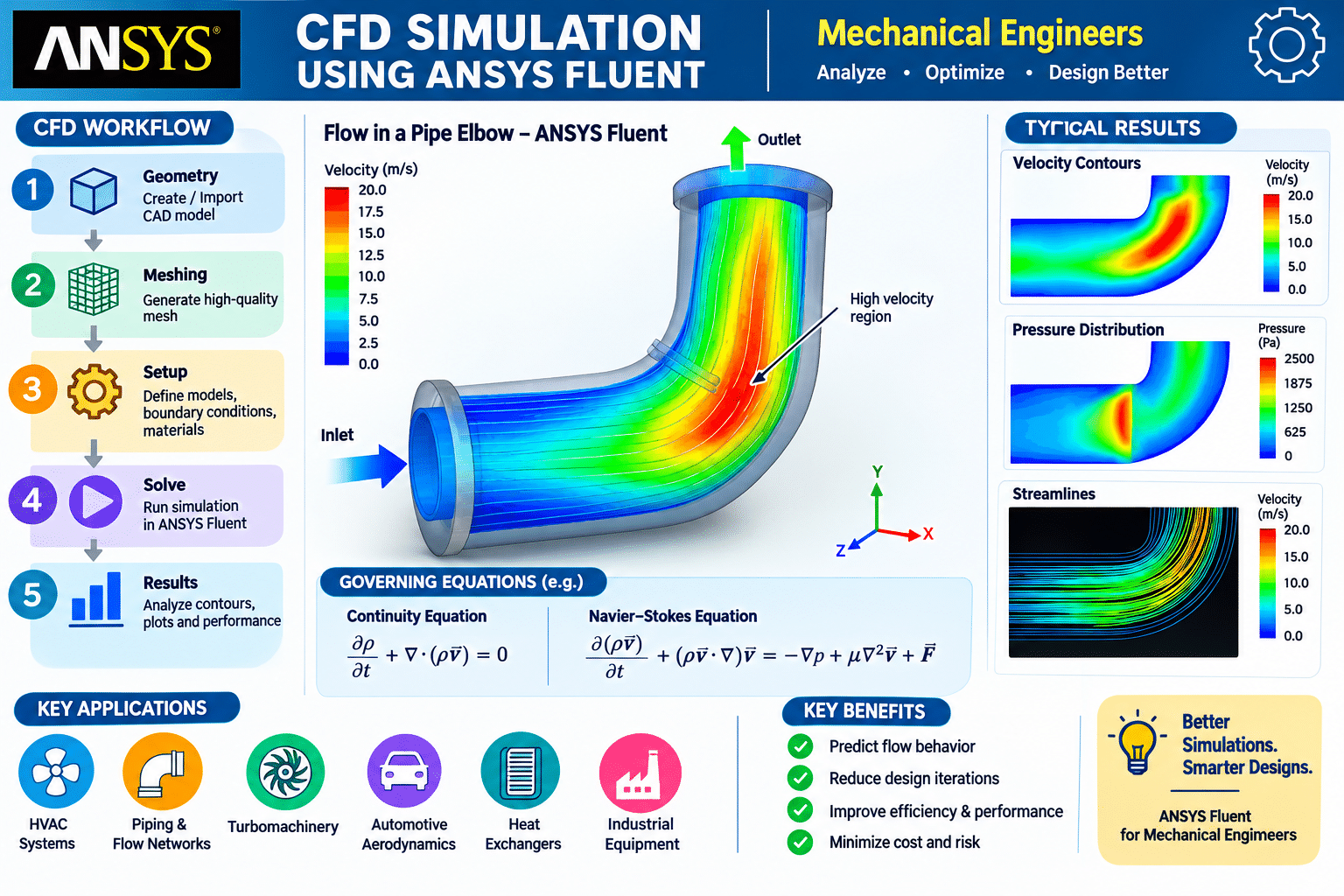
Fluid flow surrounds us everywhere. The air flowing over an aircraft wing, the coolant circulating through an engine block, the ventilation system maintaining indoor air quality, the combustion processes inside a gas turbine—all involve complex fluid dynamics that determine performance, efficiency, and safety. Understanding these flows is essential for designing better products, but the complexity of fluid behaviour makes analytical solutions impossible for most real-world problems.
This is where Computational Fluid Dynamics (CFD) becomes indispensable. CFD uses numerical methods to solve the equations governing fluid flow, enabling engineers to simulate and analyse complex flow phenomena that would otherwise be impossible to predict. It has become a standard tool across industries—from automotive and aerospace to energy and HVAC—and proficiency in CFD is one of the most valuable skills a mechanical engineer can develop.
At the forefront of CFD software stands ANSYS Fluent, the industry-standard tool used by engineers worldwide to simulate fluid flow, heat transfer, and chemical reactions. Its powerful solver, comprehensive physical models, and user-friendly interface make it accessible to beginners while providing advanced capabilities that professional analysts depend on.
The CFD Simulation Course, ANSYS Fluent for Mechanical Engineers is designed to help mechanical engineers master this essential tool. It provides practical, hands-on training in CFD simulation using ANSYS Fluent, covering everything from geometry creation and meshing to turbulence modelling and heat transfer analysis.
This guide provides a comprehensive overview of what CFD simulation is, why it matters, what the course covers, and how you can begin your journey toward becoming a proficient CFD analyst.
What Is Computational Fluid Dynamics (CFD)?
Computational Fluid Dynamics is the branch of fluid mechanics that uses numerical methods and algorithms to solve and analyse problems involving fluid flows. It is the numerical simulation of fluid motion and heat transfer.
The Core Concept
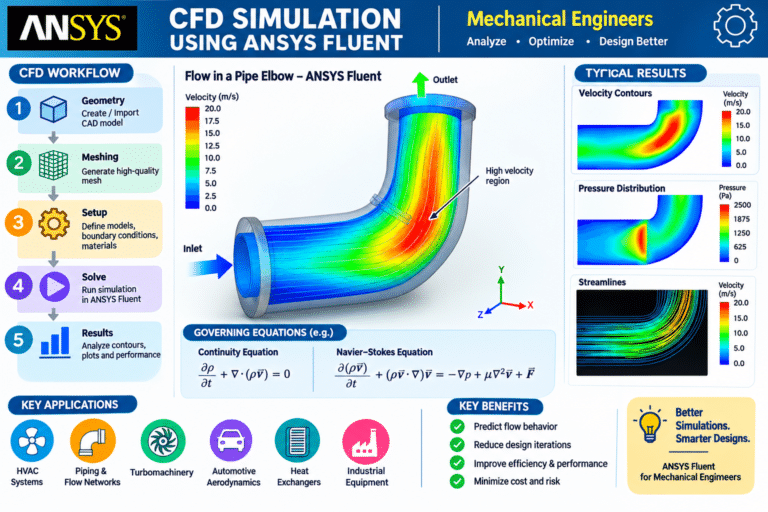
At its heart, CFD involves solving the governing equations of fluid flow—the Navier-Stokes equations—on a computational mesh. These equations describe how the velocity, pressure, temperature, and density of a moving fluid are related. Because these equations are highly non-linear and cannot be solved analytically for most real-world geometries, numerical methods are used to obtain approximate solutions.
The CFD Workflow
A typical CFD simulation follows a structured workflow:
1. Geometry Creation
The first step is creating the geometry of the region where fluid flows. This is done using CAD software or dedicated geometry tools like ANSYS DesignModeler.
2. Meshing
The geometry is divided into small cells or elements that form a computational mesh. The quality of the mesh significantly affects the accuracy and convergence of the simulation.
3. Physics Definition
Boundary conditions, material properties, and physical models (such as turbulence models) are specified.
4. Solution
The governing equations are solved iteratively until convergence is achieved.
5. Post-Processing
Results are visualised and analysed to extract meaningful information such as velocity fields, pressure distributions, and temperature contours.
Why CFD Matters for Mechanical Engineers
Design Optimisation
CFD enables engineers to test multiple design variations virtually, identifying optimal configurations before any physical prototype is built.
Cost Reduction
Physical testing is expensive. CFD reduces the number of physical tests needed by providing detailed insight into fluid behaviour.
Understanding Complex Phenomena
CFD provides detailed insight into flow phenomena that cannot be easily measured experimentally, such as flow separation, turbulence, and thermal mixing.
Performance Prediction
Engineers can predict how products will perform under various operating conditions, from the aerodynamics of a vehicle to the cooling of electronic components.
Regulatory Compliance
Many industries require CFD analysis to demonstrate compliance with safety and environmental standards.
What Is ANSYS Fluent?
ANSYS Fluent is the most widely used commercial CFD software in the world. It is used across industries including aerospace, automotive, energy, chemical processing, and HVAC.
Key Capabilities of ANSYS Fluent
Comprehensive Physical Models
ANSYS Fluent includes a wide range of physical models for:
- Laminar and turbulent flow
- Heat transfer (conduction, convection, radiation)
- Multiphase flows
- Chemical reactions and combustion
- Acoustics
- Dynamic mesh and moving zones
Advanced Turbulence Modelling
Fluent offers a comprehensive suite of turbulence models including:
- k-epsilon models (standard, RNG, realizable)
- k-omega models (standard, SST)
- Reynolds Stress Model (RSM)
- Detached Eddy Simulation (DES)
- Large Eddy Simulation (LES)
Powerful Solvers
Fluent provides both pressure-based and density-based solvers, along with a comprehensive range of numerical schemes.
User-Friendly Interface
Fluent operates within the ANSYS Workbench environment, which provides a graphical interface for setting up, organising, and connecting simulation modules.
Integration with ANSYS Ecosystem
Fluent integrates with other ANSYS tools including DesignModeler for geometry, ANSYS Meshing for mesh generation, and CFD-Post for post-processing.
Why ANSYS Fluent for Mechanical Engineers
Industry Standard
ANSYS Fluent is the industry standard for CFD simulation. Proficiency in Fluent is a skill that employers actively seek and value.
Career Opportunities
CFD skills open doors to roles including:
- CFD Analyst
- Simulation Engineer
- Thermal Engineer
- Aerodynamics Engineer
- Design Engineer
- R&D Engineer
Broad Applications
CFD simulation is used across industries:
- Automotive: Aerodynamics, engine cooling, HVAC systems
- Aerospace: Airfoil design, combustion, heat management
- Energy: Turbine design, wind energy, nuclear cooling
- HVAC: Building ventilation, air distribution, thermal comfort
- Electronics: Component cooling, thermal management
- Chemical Processing: Mixing, reactions, separation
What the Course Covers
The CFD Simulation Course, ANSYS Fluent for Mechanical Engineers provides comprehensive, practical training in CFD simulation using ANSYS Fluent.
Course Overview
| Feature | Detail |
|---|---|
| Category | CFD Simulation |
| Focus | ANSYS Fluent for Mechanical Engineers |
| Target Audience | Mechanical engineers, students, design engineers |
| Software | ANSYS Fluent, DesignModeler, ANSYS Meshing |
| Prerequisites | Basic knowledge of fluid mechanics |
What You Will Learn
Geometry Creation with DesignModeler
You will learn to create and prepare geometry for CFD simulation using ANSYS DesignModeler. This includes:
- Creating 2D and 3D geometries
- Importing CAD models
- Preparing geometry for meshing
- Handling complex geometries
Mesh Generation
You will learn to create high-quality computational meshes using ANSYS Meshing. This includes:
- Understanding mesh types and their applications
- Creating structured and unstructured meshes
- Mesh refinement techniques
- Assessing mesh quality
- Mesh independence studies
Setting Up CFD Simulations in Fluent
You will learn to set up CFD simulations from start to finish. This includes:
- Defining boundary conditions
- Selecting appropriate solver settings
- Choosing turbulence models
- Setting up material properties
- Configuring solution controls
Laminar and Turbulent Flow Simulation
You will learn to simulate both laminar and turbulent flows. This includes:
- Understanding flow regimes
- Applying appropriate turbulence models
- Interpreting turbulence results
Heat Transfer Simulation
You will learn to simulate heat transfer problems. This includes:
- Conjugate heat transfer
- Convection and conduction
- Radiation modelling
- Thermal comfort analysis
Post-Processing and Results Interpretation
You will learn to visualise and analyse simulation results. This includes:
- Creating contour plots and vector plots
- Generating streamlines and pathlines
- Extracting quantitative data
- Creating animations
Practical Applications
You will work through real-world examples and case studies, developing practical skills that can be applied immediately.
Enrol in CFD Simulation Course, ANSYS Fluent for Mechanical Engineers Now
Why CFD Skills Matter for Mechanical Engineers
Foundation of Modern Engineering
CFD is no longer a niche specialisation—it is a core competency for mechanical engineers working in industries where fluid flow and heat transfer are critical. Understanding CFD enables engineers to analyse and optimise designs in ways that were previously impossible.
Career Advancement
CFD skills are highly valued in the job market. Engineers who can perform CFD simulations command premium salaries and have access to more challenging and rewarding positions.
Design Innovation
CFD enables engineers to explore design alternatives quickly and efficiently. Instead of building multiple physical prototypes, you can test hundreds of design variations virtually.
Interdisciplinary Applications
CFD is used across industries and disciplines, from aerospace to biomedical engineering. Proficiency in CFD opens doors to diverse career opportunities.
Problem-Solving Capability
Many engineering problems involve fluid flow and heat transfer. CFD provides the tools to solve these problems systematically and accurately.
Who Should Take This Course
Mechanical Engineering Students
Students who want to build practical CFD skills will find this course an excellent foundation. It bridges the gap between academic theory and industry practice.
Design Engineers
Design engineers who want to validate their designs through simulation will gain the skills needed to perform CFD analysis independently.
Simulation Engineers
Professionals who want to deepen their understanding of CFD and expand their capabilities.
Thermal Engineers
Engineers working on thermal management, HVAC, or heat exchanger design will benefit from the heat transfer simulation training.
Aerospace and Automotive Engineers
Engineers in these industries will find CFD essential for aerodynamics, cooling, and combustion analysis.
Researchers and Academics
University faculty and researchers who want to incorporate CFD into their teaching or research.
Anyone Interested in CFD
Anyone with an interest in computational fluid dynamics and engineering simulation will find this course accessible and comprehensive.
Requirements
The course has specific requirements:
- Basic knowledge of fluid mechanics – Understanding of fundamental fluid mechanics concepts is recommended
- ANSYS software installed – Access to ANSYS Fluent for practice
- Basic computer skills – Familiarity with Windows or Linux environments
- Willingness to learn – A drive to develop practical CFD skills
No advanced CFD experience is required. The course starts from the fundamentals.
Frequently Asked Questions
What is CFD?
Computational Fluid Dynamics (CFD) is the branch of fluid mechanics that uses numerical methods and algorithms to solve and analyse problems involving fluid flows.
What is ANSYS Fluent?
ANSYS Fluent is the most widely used commercial CFD software in the world. It is used across industries to simulate fluid flow, heat transfer, and chemical reactions.
Do I need prior CFD experience to take this course?
No. The course starts from the fundamentals. Basic knowledge of fluid mechanics is recommended.
How long is the course?
The course duration varies. Please check the course page for the most up-to-date information.
What software do I need?
You will need ANSYS Fluent, ANSYS DesignModeler, and ANSYS Meshing. These are typically available through ANSYS student or commercial licenses.
What topics are covered in this course?
The course covers geometry creation with DesignModeler, mesh generation, setting up CFD simulations, laminar and turbulent flow, heat transfer simulation, and post-processing results.
Will I receive a certificate upon completion?
Yes. Udemy provides a certificate of completion for this course.
What career opportunities does this course prepare me for?
This course prepares you for roles including CFD Analyst, Simulation Engineer, Thermal Engineer, Aerodynamics Engineer, Design Engineer, and R&D Engineer.
What industries use CFD simulation?
CFD is used across industries including automotive, aerospace, energy, HVAC, electronics, chemical processing, and biomedical engineering.
Mastering CFD Simulation: Your Next Step
Computational Fluid Dynamics is one of the most powerful tools available to mechanical engineers. It enables you to understand and optimise fluid flow and heat transfer in ways that were previously impossible. Proficiency in ANSYS Fluent is a skill that opens doors to rewarding career opportunities.
The CFD Simulation Course, ANSYS Fluent for Mechanical Engineers provides the comprehensive, practical training you need. You will develop the skills to:
- Create and prepare geometry for CFD simulation
- Generate high-quality computational meshes
- Set up and run CFD simulations in ANSYS Fluent
- Simulate laminar and turbulent flows
- Perform heat transfer analysis
- Interpret and visualise simulation results
The course starts from the fundamentals and builds your skills systematically.
Enrol in CFD Simulation Course, ANSYS Fluent for Mechanical Engineers Now
Recommended Related Courses
To build a comprehensive simulation and analysis skillset, consider these additional courses:
ANSYS mechanical APDL for Finite Element Simulation – Master ANSYS Mechanical APDL for finite element simulation from basics to advanced.
FEA & CFD with ANSYS Mechanical & ANSYS Fluent – For Beginner – Comprehensive introduction to engineering simulations with ANSYS.
Ansys Mechanical Fluent CFD Using Projects Beginner to Adv. – Project-based learning for ANSYS Fluent and Mechanical.
Ansys Mechanical Intro – Full Anlatım – Comprehensive introduction to ANSYS Mechanical.
Thermodynamics for Mechanical Engineering – Build foundational knowledge in thermodynamics for understanding thermal-fluid systems.
Mechanical concept design : Stress simulation in Fusion 360 – Learn stress simulation to complement your CFD skills.
Data Center Essentials: Mechanical and Cooling – Apply CFD principles to data center cooling systems.
Mechanical Aspects of Shell and Tube Heat Exchangers – Understand heat exchanger design for CFD applications.
Final Thoughts
Computational Fluid Dynamics is transforming the way products are designed and optimised. From the aerodynamics of vehicles to the cooling of electronics, from the efficiency of turbines to the comfort of buildings, CFD provides the insight needed to create better, more efficient, and safer products.
For mechanical engineers, CFD skills are not optional—they are essential. The ability to simulate fluid flow and heat transfer is a core competency that employers actively seek and value.
The CFD Simulation Course, ANSYS Fluent for Mechanical Engineers provides the comprehensive, practical training you need to master this essential engineering discipline.
Start your CFD journey today.
Enrol in CFD Simulation Course, ANSYS Fluent for Mechanical Engineers
About the Author