


 Edu_Admin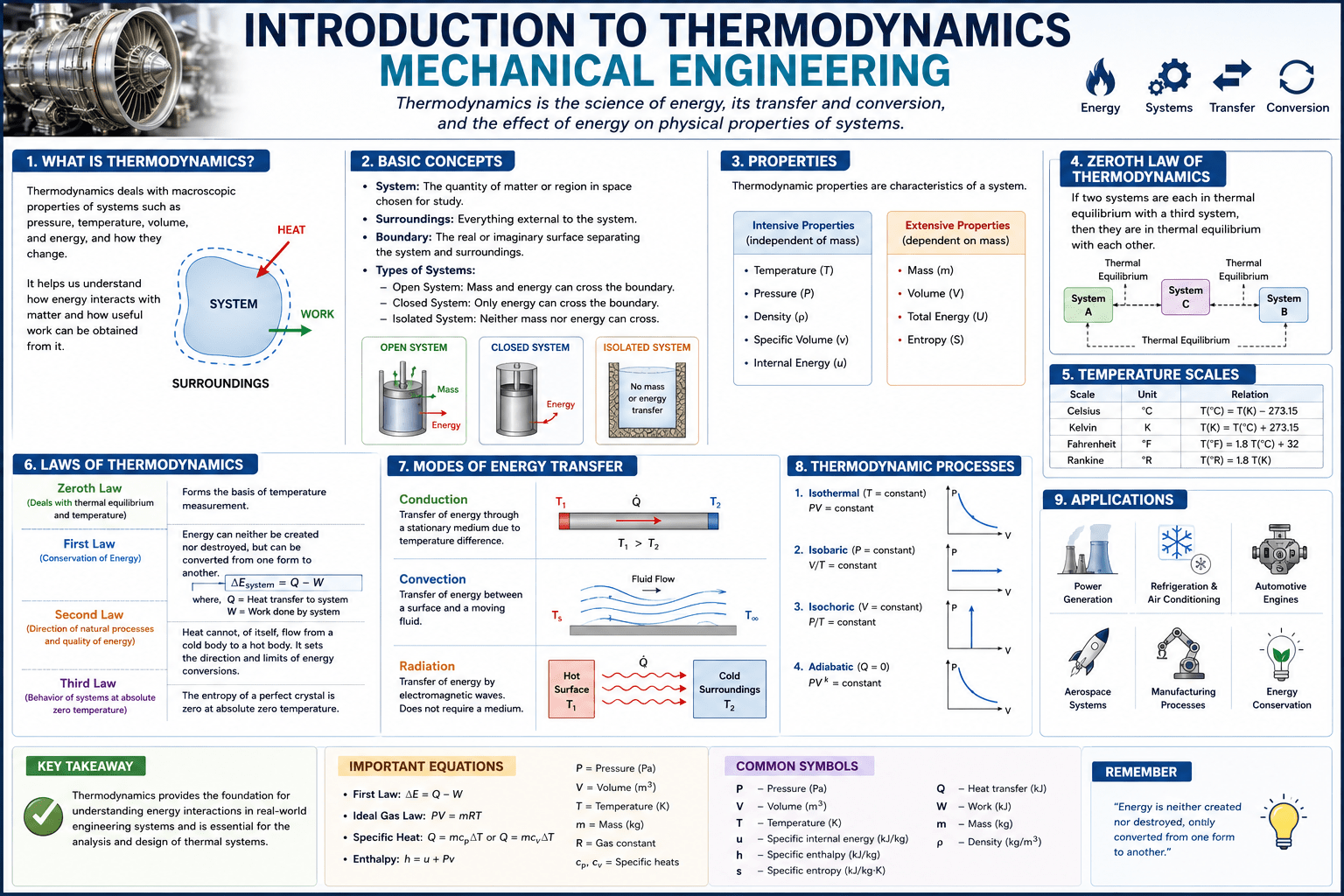
Introduction
Thermodynamics is the science of energy. It is the branch of physics that deals with heat, work, and temperature, and their relation to energy, radiation, and the physical properties of matter. For mechanical engineers, thermodynamics is not merely an academic subject—it is the foundation upon which entire industries are built.
Every mechanical system that involves energy conversion relies on thermodynamic principles. The engines that power cars, the turbines that generate electricity, the refrigeration systems that preserve food, the air conditioning that keeps buildings comfortable—all are applications of thermodynamics in action. The discipline provides the framework for understanding how energy is transformed from one form to another and how these transformations can be harnessed for practical purposes.
Yet for many students, thermodynamics can seem abstract and intimidating. The terminology is unfamiliar. The equations appear complex. The connection between theory and practice is not always clear. This perception is understandable, but it is also misleading. Thermodynamics is actually a remarkably logical and intuitive subject. Once the fundamental concepts are understood, the entire discipline falls into place.
This guide provides a comprehensive introduction to thermodynamics mechanical engineering. It covers the basic concepts, the laws of thermodynamics, key applications, and the knowledge required to master this essential engineering discipline.
What Is Thermodynamics?
Thermodynamics is a foundational branch of physics and an integral part of mechanical engineering. It encompasses the study of energy transformations and the relationships between various physical quantities such as temperature, volume, pressure, and internal energy.
The Scope of Thermodynamics
Thermodynamics can be understood at two levels:
Classical Thermodynamics focuses on the macroscopic behaviour of systems. It deals with observable properties such as temperature, pressure, and volume, without considering the molecular structure of matter. This is the thermodynamics that mechanical engineers use most frequently.
Statistical Thermodynamics considers the microscopic behaviour of atoms and molecules and relates these to macroscopic properties. While important for advanced study, it is not typically the focus of introductory mechanical engineering courses.
Why Thermodynamics Matters for Mechanical Engineers
Mechanical engineers apply thermodynamic principles to design and analyse a wide range of systems and processes. These applications include:
- Power Generation: Designing and optimising power plants, from steam turbines in thermal power plants to nuclear and renewable energy systems
- Engine Design: Developing internal combustion engines, gas turbines, and jet engines
- Refrigeration and Air Conditioning: Designing cooling systems for buildings, vehicles, and industrial processes
- Heat Transfer Equipment: Designing heat exchangers, boilers, and condensers
- Energy Efficiency: Optimising industrial processes to reduce energy consumption
Fundamental Concepts in Thermodynamics
Before exploring the laws of thermodynamics, it is essential to understand the basic concepts and terminology that underpin the discipline.
Systems, Surroundings, and Boundaries
A thermodynamic system is the specific quantity of matter or region of space under consideration. Everything outside the system is the surroundings. The boundary separates the system from its surroundings and can be fixed, moving, or imaginary.
Systems are classified into three types:
- Closed System (Control Mass): No mass crosses the boundary. Only energy can be transferred.
- Open System (Control Volume): Both mass and energy can cross the boundary.
- Isolated System: Neither mass nor energy crosses the boundary.
Properties, State, and Equilibrium
Properties are characteristics of a system that can be measured, such as temperature, pressure, volume, and internal energy. The state of a system is defined by its properties.
A system is in thermodynamic equilibrium when its properties are uniform throughout and do not change with time. This requires:
- Thermal Equilibrium: No temperature difference within the system or with the surroundings
- Mechanical Equilibrium: No pressure difference, no unbalanced forces
- Chemical Equilibrium: No chemical reactions occurring
Processes and Cycles
A process is a change from one state to another. Common thermodynamic processes include:
- Isochoric (Constant Volume)
- Isobaric (Constant Pressure)
- Isothermal (Constant Temperature)
- Isentropic (Constant Entropy)
- Polytropic
A cycle is a series of processes that returns a system to its initial state. Thermodynamic cycles are the foundation of engines, refrigeration systems, and power plants.
The Laws of Thermodynamics
The four laws of thermodynamics form the foundation of the discipline. They describe how energy behaves in physical systems.
Zeroth Law of Thermodynamics
If two systems are in thermal equilibrium with a third system, they are in thermal equilibrium with each other.
This law establishes the concept of temperature and provides the basis for temperature measurement. It allows us to define temperature scales and build thermometers. Without the Zeroth Law, temperature would be meaningless as a measurable quantity.
First Law of Thermodynamics (Conservation of Energy)
Energy cannot be created or destroyed, only transformed from one form to another.
The First Law states that the total energy of an isolated system is constant. Energy can be transferred between a system and its surroundings through:
- Heat (Q): Energy transfer due to a temperature difference
- Work (W): Energy transfer due to a force acting through a distance
Mathematically, for a closed system:
text
ΔU = Q - W
where ΔU is the change in internal energy, Q is heat added to the system, and W is work done by the system.
Second Law of Thermodynamics
The entropy of an isolated system always increases over time, or remains constant in idealised reversible processes.
The Second Law introduces the concept of entropy—a measure of the disorder or randomness in a system. It explains why certain processes occur spontaneously while others do not.
Key implications of the Second Law:
- Heat cannot spontaneously flow from a colder body to a hotter body
- No heat engine can be 100% efficient
- Perpetual motion machines of the second kind are impossible
- The quality of energy degrades over time
Third Law of Thermodynamics
The entropy of a perfect crystal at absolute zero temperature is exactly zero.
The Third Law establishes an absolute reference point for entropy measurements. It implies that absolute zero (-273.15°C or 0 K) is unattainable in practice.
Key Thermodynamic Properties
Temperature
Temperature is a measure of the average kinetic energy of the particles in a substance. It determines the direction of heat flow—heat always flows from higher temperature to lower temperature.
Pressure
Pressure is force per unit area. It is a fundamental property in thermodynamics, particularly for gases and liquids.
Internal Energy
Internal energy (U) is the total energy contained within a system. It includes the kinetic and potential energies of the molecules. Changes in internal energy are central to the First Law of Thermodynamics.
Enthalpy
Enthalpy (H) is defined as:
text
H = U + PV
where P is pressure and V is volume. Enthalpy is particularly useful for analysing open systems and flow processes.
Entropy
Entropy (S) is a measure of the disorder or randomness in a system. It is central to the Second Law of Thermodynamics. Entropy quantifies the amount of energy in a system that is no longer available to do useful work.
Applications of Thermodynamics in Mechanical Engineering
Thermodynamics finds application across virtually every sector of mechanical engineering. Understanding these applications helps connect theory to practice.
Power Generation
Thermodynamics is fundamental to designing and optimising power plants. Steam turbines in thermal power plants convert heat from combustion or nuclear reactions into mechanical work, which is then converted to electricity. The Rankine cycle describes this process.
Internal Combustion Engines
The Otto cycle describes spark-ignition engines (petrol engines), while the Diesel cycle describes compression-ignition engines. Both are applications of thermodynamic principles to convert chemical energy into mechanical work.
Gas Turbines and Jet Engines
The Brayton cycle describes gas turbine engines, used in power generation and aircraft propulsion. Thermodynamics governs the compression, combustion, and expansion processes that generate thrust.
Refrigeration and Air Conditioning
The vapour-compression refrigeration cycle is a direct application of thermodynamics. It uses work input to move heat from a cold space to a hot space. Air conditioning systems, refrigerators, and heat pumps all operate on this principle.
Heat Exchangers
Heat exchangers transfer heat between fluids without mixing them. Thermodynamics governs the effectiveness and efficiency of these devices, which are used in power plants, HVAC systems, chemical processing, and countless other applications.
Turbines and Compressors
Turbines convert the energy of a working fluid into mechanical energy. Compressors do the reverse—they add energy to a fluid to increase its pressure. Both are governed by thermodynamic principles.
Nozzles and Diffusers
Nozzles accelerate flow by reducing cross-sectional area, while diffusers decelerate flow by increasing cross-sectional area. These devices are widely used in engineering systems, from rocket engines to ventilation systems.
Heating, Ventilation, and Air Conditioning (HVAC)
HVAC systems rely on thermodynamic principles for heating, cooling, and humidity control. Understanding thermodynamics is essential for designing energy-efficient building systems.
What You Will Learn in a Comprehensive Thermodynamics Course
A well-structured introductory thermodynamics course covers the essential concepts and applications required for mechanical engineering.
Core Topics
Introduction and Basic Concepts
- Applications of thermodynamics
- Terminology and definitions
- Systems, boundaries, and surroundings
- Properties, state, and equilibrium
- Processes and cycles
Properties of Substances
- Pure substances and phase change
- Property tables and charts
- Ideal gases and real gases
- Equations of state
First Law of Thermodynamics
- Conservation of energy
- Work and heat transfer
- Energy analysis of closed systems
- Energy analysis of open systems (steady-flow devices)
- Applications to turbines, compressors, nozzles, and heat exchangers
Second Law of Thermodynamics
- Entropy and its significance
- Reversibility and irreversibility
- Carnot cycle and Carnot efficiency
- Heat engines and refrigerators
Thermodynamic Cycles
- Power cycles (Rankine, Otto, Diesel, Brayton)
- Refrigeration cycles (vapour-compression, absorption)
- Cycle analysis and efficiency
Course Outcomes
Upon completing a thermodynamics course, students should be able to:
- Understand and apply thermodynamic terminology and concepts
- Apply the First and Second Laws to closed and open systems
- Analyse power generation and refrigeration systems
- Use thermodynamic property data from tables and charts
- Design and optimise simple thermodynamic systems
Why This Course Is Different
The Thermodynamics – Introduction to Mechanical Engineering course is designed specifically for students and professionals who want to understand thermodynamics from the ground up.
The course covers the fundamental concepts and laws of thermodynamics, providing a solid foundation for further study. Key features include:
- Clear, systematic explanations of thermodynamic concepts
- Practical examples connecting theory to real-world applications
- Step-by-step problem-solving approaches
- Foundation for advanced study in mechanical engineering
- Certificate of completion for professional development
Enrol in Thermodynamics – Introduction to Mechanical Engineering Now
Recommended Related Courses
To build a comprehensive understanding of thermodynamics and mechanical engineering, consider these additional courses:
Thermodynamics for Mechanical Engineering – A more comprehensive thermodynamics course covering both fundamentals and advanced applications.
Thermodynamics & Python for Process and Mechanical Engineers – Combine thermodynamics principles with Python programming for modern engineering analysis.
Mechanical Aspects of Shell and Tube Heat Exchangers – Apply thermodynamic principles to heat exchanger design.
Heat and Mass Transfer HMT for Mechanical Engineering – Build on thermodynamics knowledge with heat and mass transfer principles.
Data Center Essentials: Mechanical and Cooling – Apply thermodynamic principles to data center cooling systems.
The Complete Mechanical Engineering Course – 12 Courses in 1 – Comprehensive coverage of all mechanical engineering disciplines.
Frequently Asked Questions
What is thermodynamics in mechanical engineering?
Thermodynamics is the science of energy transformations and the relationships between physical quantities such as temperature, pressure, volume, and internal energy. Mechanical engineers apply thermodynamic principles to design and analyse energy systems, engines, power plants, refrigeration systems, and HVAC systems.
What are the four laws of thermodynamics?
The Zeroth Law establishes temperature measurement. The First Law states that energy is conserved. The Second Law states that entropy increases over time. The Third Law states that absolute zero is unattainable.
Why is thermodynamics important for mechanical engineers?
Thermodynamics is fundamental to understanding how energy systems work. It is essential for designing engines, power plants, refrigeration systems, and HVAC systems. Without thermodynamics, mechanical engineering would be limited to purely mechanical systems without considering energy conversion.
Is thermodynamics difficult to learn?
Thermodynamics can seem challenging due to unfamiliar terminology and abstract concepts. However, with clear explanations and practical examples, the subject becomes intuitive. Many students find that once they understand the fundamental concepts, the rest of the discipline falls into place.
What are the main applications of thermodynamics?
Thermodynamics is applied in power generation (steam turbines, gas turbines), internal combustion engines, refrigeration and air conditioning, heat exchangers, compressors, turbines, and HVAC systems.
What is the difference between heat and work?
Heat is energy transfer due to a temperature difference. Work is energy transfer due to a force acting through a distance. Both are forms of energy transfer across the boundary of a system.
Do I need prior knowledge to take an introductory thermodynamics course?
No. Introductory thermodynamics courses start from the basics. The Thermodynamics – Introduction to Mechanical Engineering course is designed for beginners with no prior thermodynamics knowledge.
Mastering Thermodynamics: Your Next Step
Thermodynamics is the foundation of mechanical engineering. It provides the framework for understanding how energy is transformed and harnessed for practical purposes. From the engines that power transportation to the power plants that generate electricity to the HVAC systems that maintain comfortable environments, thermodynamics is everywhere.
Learning thermodynamics presents a choice. You can struggle through confusing textbooks and fragmented online resources. Alternatively, you can take a structured course that explains concepts clearly with practical examples.
The Thermodynamics – Introduction to Mechanical Engineering course provides exactly this structured approach. The course covers:
- Fundamental concepts and definitions
- The laws of thermodynamics and their applications
- Properties of pure substances and ideal gases
- Energy analysis of closed and open systems
- Applications to engines, power plants, and refrigeration systems
The course starts from the very basics. No prior thermodynamics knowledge is required.
Enrol in Thermodynamics – Introduction to Mechanical Engineering Now
Final Thoughts
Thermodynamics is not a subject to be feared. It is the science of how energy works—and energy is everywhere. Once you understand thermodynamics, you will see the world differently. You will understand why engines work, how power is generated, and what makes refrigeration possible.
For mechanical engineers, thermodynamics is not optional. It is essential. It is the foundation upon which careers are built and innovations are created.
Start your thermodynamics journey today with the right course and approach.
Enrol in Thermodynamics – Introduction to Mechanical Engineering
About the Author