

 Edu_Admin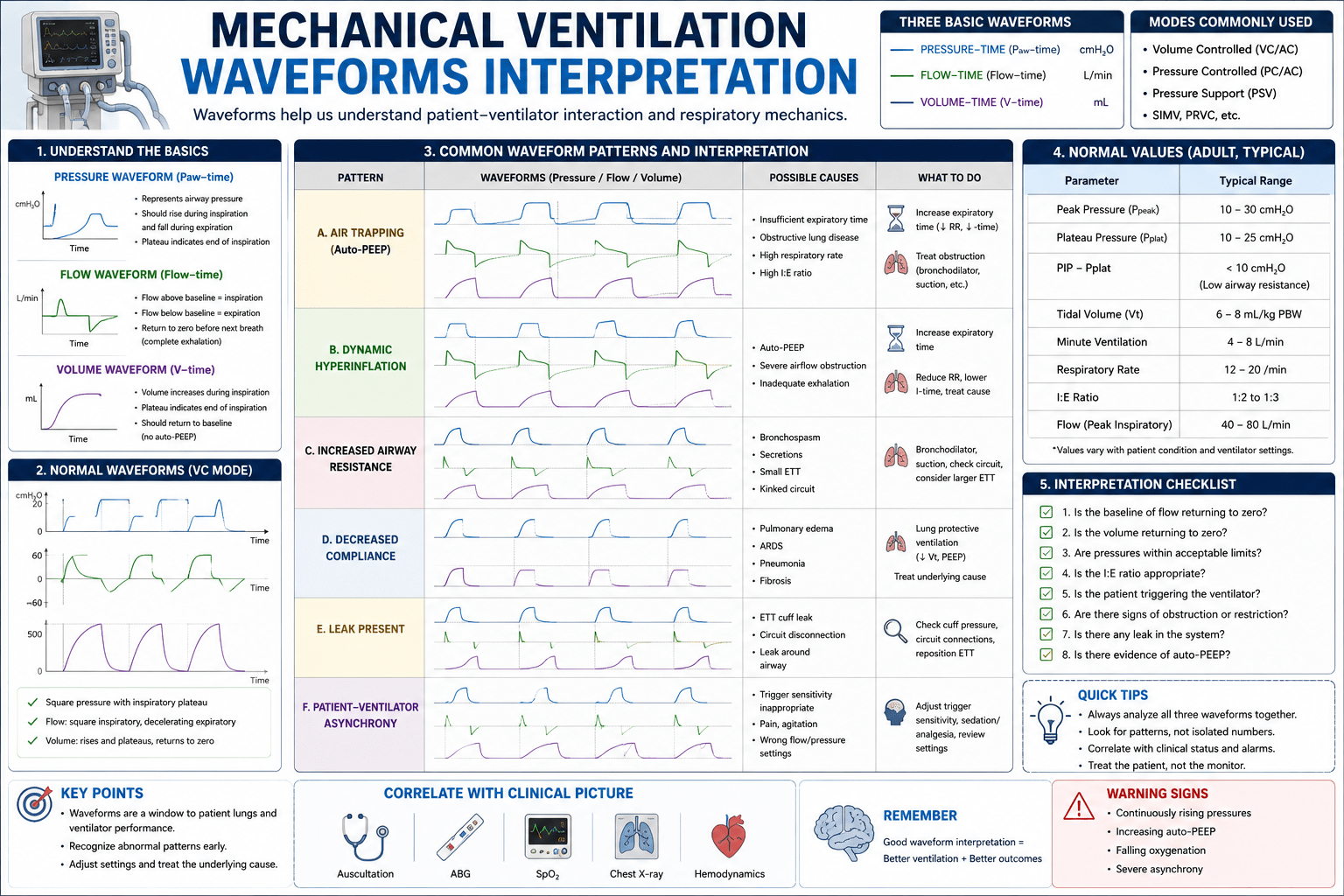
Introduction
mechanical ventilation waveforms interpretation is one of the most critical interventions in modern medicine. It sustains life when patients cannot breathe on their own. It supports failing lungs. It buys time for healing. Yet for many clinicians, the ventilator remains a source of anxiety—a complex machine with confusing modes, cryptic waveforms, and settings that seem to multiply endlessly.
The numbers tell a compelling story. During the COVID-19 pandemic, clinicians who had never touched a ventilator were suddenly asked to manage critically ill patients on life support. The need for clear, simple, and actionable ventilator education became urgent. Even today, in ICUs around the world, patient-ventilator dyssynchrony affects as many as 25% of patients within 24 hours of initiating mechanical ventilation. These are not minor issues—they are matters of life and death.
The problem is not that mechanical ventilation is inherently difficult. The problem is that it is often taught poorly. Complex physics, intimidating terminology, and abstract concepts obscure what is actually a remarkably logical and intuitive process.
This guide changes that. It approaches mechanical ventilation through a simple principle: if you cannot explain something simply, you do not truly understand it. By breaking ventilation down to its fundamental building blocks—the breaths—this guide provides a clear, practical framework for understanding how ventilators work, how to interpret waveforms, and how to optimise patient care.
What Is Mechanical Ventilation?
Mechanical ventilation is the process of using a machine to assist or replace spontaneous breathing. When a patient’s respiratory system cannot maintain adequate gas exchange, a mechanical ventilator delivers breaths to support oxygenation and carbon dioxide removal.
Who Needs Mechanical Ventilation?
Mechanical ventilation is indicated for patients with:
- Respiratory Failure: Inadequate oxygenation or ventilation
- Acute Respiratory Distress Syndrome (ARDS): Severe lung inflammation and fluid accumulation
- Neuromuscular Disorders: Conditions affecting the muscles of breathing
- Sedation and Anaesthesia: During surgical procedures
- Trauma: Chest injuries affecting breathing mechanics
- Sepsis: Systemic infection causing respiratory compromise
The Goal of Mechanical Ventilation
The primary goals are:
- Maintain adequate oxygenation and ventilation
- Minimise ventilator-induced lung injury
- Optimise patient-ventilator synchrony
- Facilitate weaning and recovery
- Improve survival outcomes
The Core Principle: Understanding the Breath
At its essence, mechanical ventilation is about delivering breaths. And here is the key insight: there are really only two and a half breaths that exist in mechanical ventilation. Everything else—all the modes, all the settings, all the complexity—is just a variation on these fundamental breath types.
The Pressure Breath
In a pressure breath, the ventilator delivers gas until a preset pressure is reached. The pressure is controlled; the volume is variable.
Characteristics:
- Pressure is the controlled variable
- Volume varies based on lung compliance and resistance
- Flow is decelerating
- May be more comfortable for spontaneously breathing patients
Clinical Application:
Pressure-controlled ventilation is often used in patients with ARDS or when limiting peak airway pressures is a priority. It can reduce the risk of barotrauma but may result in variable tidal volumes.
The Volume Breath
In a volume breath, the ventilator delivers a preset volume of gas. The volume is controlled; the pressure is variable.
Characteristics:
- Volume is the controlled variable
- Pressure varies based on lung compliance and resistance
- Flow is typically constant (square waveform)
- Guarantees minute ventilation
Clinical Application:
Volume-controlled ventilation is the traditional approach and remains widely used. It ensures consistent tidal volumes but may result in high airway pressures if compliance decreases.
The 0.5 Breath (Spontaneous Breath)
The half breath represents patient-triggered, patient-cycled spontaneous breathing. The patient initiates the breath and the ventilator supports it.
Characteristics:
- Patient initiates the breath
- Ventilator provides support (pressure support)
- Patient determines the timing and flow
- Requires patient effort
Clinical Application:
Spontaneous breathing modes are used during weaning and for patients who can initiate breaths but need ventilatory support.
Ventilator Waveforms: The Language of the Ventilator
Waveforms are graphic representations of changes in pressure, flow, and volume within the ventilator circuit. They are the ventilator’s way of telling you what is happening with the patient’s lungs. Learning to read them is like learning a new language—one that reveals the patient-ventilator interaction in real time.
Scalars: Pressure, Flow, and Volume over Time
Scalars plot pressure, flow, or volume on the vertical axis against time on the horizontal axis. The three primary scalars are:
Pressure-Time Scalar
- Shows airway pressure changes over the breathing cycle
- Identifies peak inspiratory pressure (PIP) and positive end-expiratory pressure (PEEP)
- Reveals auto-PEEP and inspiratory effort
- Essential for assessing lung mechanics
Flow-Time Scalar
- Shows inspiratory and expiratory flow rates
- Identifies air trapping and flow limitation
- Detects patient-ventilator asynchrony
- Crucial for assessing expiratory dynamics
Volume-Time Scalar
- Shows tidal volume delivery over time
- Identifies volume delivery and leaks
- Essential for ensuring adequate ventilation
- Detects leaks in the circuit
Loops: Pressure-Volume and Flow-Volume
Loops plot one parameter against another, providing additional information about lung mechanics.
Pressure-Volume Loop
- Shows the relationship between pressure and volume
- Identifies lung compliance changes
- Reveals airway resistance
- Essential for ARDS management
Flow-Volume Loop
- Shows the relationship between flow and volume
- Identifies airway obstruction
- Detects flow limitation
- Useful for assessing upper airway issues
The Four Phases of a Mechanical Breath
Every mechanical breath consists of four phases. Understanding these phases is essential for interpreting waveforms and optimising settings.
Phase 1: The Trigger
The trigger phase determines how the breath is initiated. Breaths can be:
- Time-Triggered: The ventilator initiates the breath at a preset interval
- Patient-Triggered: The patient initiates the breath by creating a pressure or flow change
Waveform Significance: A patient-triggered breath shows a negative deflection on the pressure scalar before inspiration begins. A missed trigger suggests the patient is not triggering the ventilator effectively.
Phase 2: The Inspiration
During inspiration, gas is delivered to the patient. The characteristics of this phase depend on the mode and settings.
Waveform Significance: The shape of the pressure and flow scalars during inspiration reveals the mode (pressure vs volume control) and the adequacy of settings.
Phase 3: The Cycle
The cycle phase determines when inspiration ends and expiration begins. Breaths can be:
- Volume-Cycled: Inspiration ends when the preset volume is delivered
- Pressure-Cycled: Inspiration ends when the preset pressure is reached
- Flow-Cycled: Inspiration ends when flow drops to a preset level
- Time-Cycled: Inspiration ends after a preset time
Waveform Significance: The cycling mechanism is visible in the waveform shape. Dyssynchrony often occurs when the patient wants to exhale but the ventilator continues to deliver gas.
Phase 4: The Expiration
Expiration is passive, driven by the elastic recoil of the lungs and chest wall.
Waveform Significance: The expiratory flow scalar reveals whether the patient has adequate time to exhale. A flow curve that does not return to zero before the next breath suggests air trapping or auto-PEEP.
Patient-Ventilator Dyssynchrony: Identifying and Correcting Problems
Patient-ventilator dyssynchrony occurs when the patient’s respiratory efforts are not matched by the ventilator’s support. It is common, affecting up to 25% of patients within 24 hours, and is associated with worse outcomes.
Common Types of Dyssynchrony
Ineffective Triggering
- What It Looks Like: The patient attempts to breathe, but the ventilator does not respond
- Waveform: A negative deflection on the pressure scalar without a subsequent breath
- Causes: Excessive PEEP, low trigger sensitivity, patient weakness
- Solutions: Reduce PEEP, adjust trigger sensitivity, consider neuromuscular support
Double Triggering
- What It Looks Like: Two breaths are delivered for one patient effort
- Waveform: Two consecutive pressure or flow waveforms with a short expiratory time between them
- Causes: Short inspiratory time, high flow rates, patient demand for more volume
- Solutions: Increase inspiratory time, adjust flow, consider pressure support
Flow Starvation
- What It Looks Like: The patient wants more flow than the ventilator is providing
- Waveform: A scooping appearance on the pressure scalar during inspiration
- Causes: Inadequate flow settings, patient distress
- Solutions: Increase flow, consider pressure control mode
Auto-PEEP
- What It Looks Like: Incomplete expiration before the next breath
- Waveform: Expiratory flow does not return to zero; pressure scalar shows elevated end-expiratory pressure
- Causes: Inadequate expiratory time, high respiratory rate, airway obstruction
- Solutions: Increase expiratory time, reduce respiratory rate, treat airway obstruction
Optimising PEEP: The Key to Better Outcomes
Positive End-Expiratory Pressure (PEEP) is the pressure remaining in the lungs at the end of expiration. Optimising PEEP is one of the most important interventions in mechanical ventilation.
Why PEEP Matters
- Prevents alveolar collapse
- Improves oxygenation
- Reduces ventilator-induced lung injury
- Improves survival in ARDS
How to Optimise PEEP
The optimal PEEP challenge involves systematically adjusting PEEP while monitoring:
- Oxygenation (PaO2, SpO2)
- Lung compliance
- Hemodynamics
- Waveform changes
The PEEP Challenge:
- Increase PEEP incrementally
- Assess oxygenation and compliance
- Monitor for adverse effects (hypotension, barotrauma)
- Identify the PEEP level that maximises benefit
Waveform Indicators of Optimal PEEP:
- Improved compliance (pressure-volume loop shifts)
- Better oxygenation
- Stable hemodynamics
- Reduced dyssynchrony
What You Will Learn in a Comprehensive Mechanical Ventilation Course
A well-designed mechanical ventilation course should provide practical, actionable knowledge that can be applied at the bedside immediately.
The Mechanical Ventilation – Thinking Simple using Waveforms! course embodies this approach.
Course Overview
What You Will Learn
Chapter 1: Introduction and Foundation
- Understanding how mechanical ventilation delivers breaths to patients
- The philosophy of simplifying complex concepts
- Setting the framework for ventilator management
Chapter 2: The Breath
- The Pressure Breath explained simply
- The Volume Breath and its applications
- Understanding the two-and-a-half breaths concept
Chapter 3: Ventilator Modes
- Combining breaths into ventilator modes
- Understanding how the ventilator and patient interact
- Practical mode selection and application
Chapter 4: Advanced Concepts
- Optimal PEEP settings and the PEEP challenge
- Identifying and correcting ventilator dyssynchrony
- Airway pressure release ventilation (APRV)
- Blood gas interpretation
What Makes This Course Different
- Simplicity First: The course is built on the principle that if you cannot explain something simply, you do not understand it
- Practical Focus: Designed for bedside application, not academic theory
- COVID-Era Proven: Originally created to teach non-ICU clinicians during the pandemic
- Hospital-Endorsed: Now taught at a quaternary care hospital as part of the standard lecture series for critical care physicians, trainees, anesthesiology residents, and respiratory therapists
- Beginner-Friendly: No prerequisites required
Enrol in Mechanical Ventilation – Thinking Simple using Waveforms! Now
Who Should Take This Course
Intensive Care Physicians
ICU physicians who manage ventilated patients daily will benefit from a simpler, more intuitive framework for ventilator management.
Anesthesiologists
Anesthesiologists who manage ventilation during and after surgery will gain deeper insight into patient-ventilator interaction.
Respiratory Therapists
RTs who are the frontline clinicians managing ventilators will enhance their waveform interpretation and troubleshooting skills.
Critical Care Nurses
Nurses who care for ventilated patients will develop the skills to identify problems and communicate effectively with the care team.
Clinicians-in-Training
Residents, fellows, and students will build a strong foundation in mechanical ventilation that will serve them throughout their careers.
Advanced Practice Providers
NPs and PAs working in critical care will gain confidence in managing ventilated patients.
Non-ICU Clinicians
Clinicians who may encounter ventilated patients in emergency or pandemic situations will learn the essentials quickly and effectively.
Frequently Asked Questions
What is the most important skill in mechanical ventilation?
Waveform interpretation is arguably the most important skill. Waveforms reveal patient-ventilator interaction, lung mechanics, and problems in real time.
How long does it take to learn mechanical ventilation basics?
With a focused course like this one, the fundamentals can be learned in approximately 2.5 hours. Mastery requires practice and experience.
What are the most common ventilator waveform problems?
Common issues include auto-PEEP, ineffective triggering, double triggering, and flow starvation. Each has characteristic waveform patterns.
Why is PEEP optimisation important?
Optimising PEEP improves oxygenation, prevents alveolar collapse, and reduces ventilator-induced lung injury. It has been shown to improve survival in ARDS.
What is the “two and a half breaths” concept?
This is the insight that there are really only two and a half fundamental breath types in mechanical ventilation: the pressure breath, the volume breath, and the spontaneous (half) breath. All modes are variations on these.
Do I need prior experience to take this course?
No. This is a beginner-level course with no prerequisites. A basic understanding of physiology is helpful but not required.
How was this course developed?
The course was originally created during COVID-19 to teach non-ICU clinicians how to ventilate patients safely and simply. It is now taught at a quaternary care hospital as part of the standard curriculum.
Mastering Mechanical Ventilation: Your Next Step
Mechanical ventilation is not a skill to be feared. It is a skill to be mastered. With the right approach—one that focuses on simple, fundamental principles rather than overwhelming complexity—any clinician can become confident and competent in ventilator management.
The Mechanical Ventilation – Thinking Simple using Waveforms! course provides exactly this approach. With 2.5 hours of focused instruction across 10 lectures, you will develop the skills to:
- Understand how mechanical ventilation delivers breaths to patients
- Set a ventilator and adjust settings based on lung physiology
- Identify all types of ventilator dyssynchrony and correct them
- Optimise PEEP to improve outcomes, including survival
- Interpret blood gases and manage APRV
The course starts from the very basics. No prior experience is required.
Enrol in Mechanical Ventilation – Thinking Simple using Waveforms! Now
Recommended Related Courses
To build a comprehensive critical care and respiratory skillset, consider these additional courses:
Introduction to Mechanical Ventilator Modes – A focused introduction to the different ventilator modes and their applications.
Data Center Essentials: Mechanical and Cooling – Apply mechanical principles to data center cooling systems.
Thermodynamics for Mechanical Engineering – Build foundational knowledge in thermodynamics relevant to respiratory physiology.
Final Thoughts
Mechanical ventilation is one of the most powerful tools in critical care. It sustains life, supports recovery, and gives patients time to heal. But like any powerful tool, it must be used with skill and understanding.
The key to mastering mechanical ventilation is not memorising modes or settings. It is understanding the breath—the fundamental unit of ventilation. Once you understand the breath, everything else falls into place. The waveforms make sense. The modes become logical. The patient-ventilator interaction becomes visible.
This is the approach that has been proven in the ICU, taught in hospitals, and trusted by clinicians. It is the approach that can transform your practice and improve patient outcomes.
Start your journey to ventilator mastery today.
Enrol in Mechanical Ventilation – Thinking Simple using Waveforms!
About the Author