

 Edu_Admin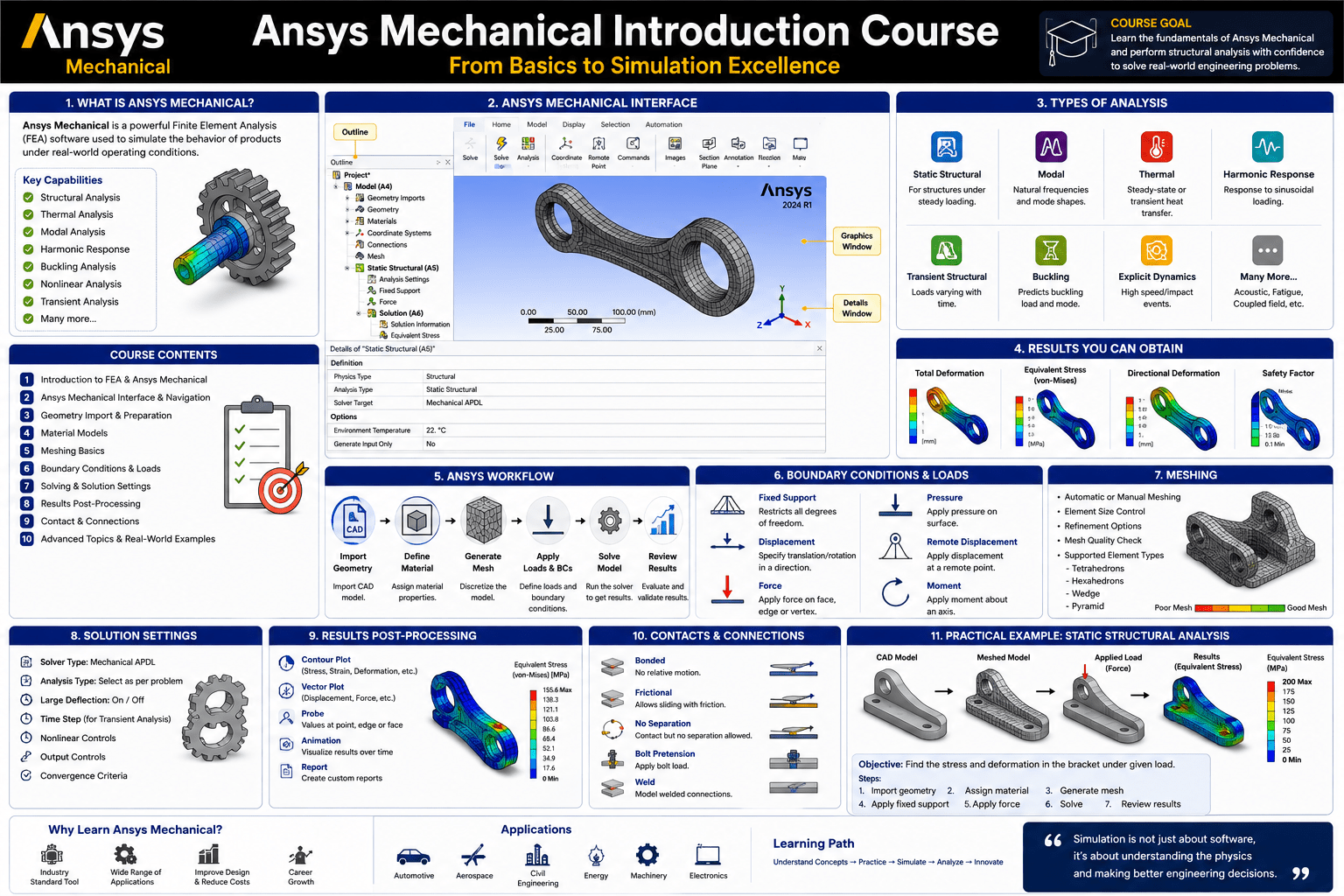
Introduction
Engineering simulation has transformed the way products are designed, tested, and optimised. Gone are the days when engineers had to build multiple physical prototypes to validate their designs. Today, powerful simulation software allows engineers to test thousands of scenarios virtually, identifying potential failures and optimising performance before a single physical part is manufactured.
At the forefront of this revolution stands Ansys Mechanical, one of the most powerful and widely used finite element analysis (FEA) tools in the world. From automotive and aerospace to energy and medical devices, engineers across industries rely on Ansys Mechanical to solve complex structural and thermal problems with confidence.
Yet for many engineering students and professionals, the journey into FEA can seem intimidating. The software is powerful, but that power comes with complexity. The terminology is unfamiliar. The workflow appears intricate. Where does one even begin?
The answer is simple: start with a structured, comprehensive introduction.
The Ansys Mechanical introduction course course is designed precisely for this purpose. Whether you are a complete beginner or have some exposure to FEA, this Turkish-language course provides the complete foundation you need to become confident and competent in Ansys Mechanical. With 9.5 hours of comprehensive video content, it guides you through every aspect of the software, from the Workbench interface to advanced analysis techniques.
This guide provides a comprehensive overview of what Ansys Mechanical is, why it matters, what the course covers, and how you can begin your journey toward mastering engineering simulation.
What Is Ansys Mechanical?
Ansys Mechanical is a best-in-class finite element analysis (FEA) software that enables engineers to solve complex structural and thermal problems. It is part of the broader Ansys ecosystem, which includes tools for computational fluid dynamics, electromagnetics, and multiphysics simulation.
Core Capabilities
Ansys Mechanical provides a dynamic environment with a complete range of analysis tools, from preparing geometry for analysis to connecting additional physics for even greater fidelity. The software includes comprehensive capabilities for:
Structural Analysis
- Linear and nonlinear static analysis
- Modal analysis (natural frequencies and mode shapes)
- Harmonic analysis (steady-state response to sinusoidal loading)
- Transient dynamic analysis (time-dependent response)
- Spectrum response and random vibration analysis
Thermal Analysis
- Steady-state and transient heat transfer
- Conduction, convection, and radiation
- Thermal-stress coupling
Advanced Features
- Contact modelling
- Material nonlinearities
- Geometric nonlinearities
- Parameterisation and design optimisation
- Multiphysics coupling
Ansys Workbench Integration
Ansys Mechanical operates within the Ansys Workbench environment, which serves as a graphical front end to set up, organise, and connect simulation modules. Workbench provides powerful methods for interacting with the Ansys family of solvers and offers unique integration with CAD systems.
This integration allows engineers to:
- Import CAD models directly
- Manage simulation projects efficiently
- Connect different physics simulations
- Automate workflows
- Collaborate across teams
Why Ansys Mechanical Matters
Industry Standard
Ansys is one of the most trusted and widely adopted simulation software packages in the world. Companies across automotive, aerospace, defence, energy, medical devices, and countless other sectors rely on Ansys for their engineering simulation needs.
Career Advancement
Proficiency in Ansys Mechanical is a highly valued skill in the job market. Engineers who can perform FEA simulations are in high demand and command premium salaries. The ability to validate designs virtually, identify potential failures, and optimise performance is essential in modern engineering practice.
Design Optimisation
Ansys Mechanical enables engineers to explore design alternatives quickly and efficiently. Instead of building multiple physical prototypes, you can test hundreds of design variations virtually, identifying the optimal solution before committing to manufacturing.
Risk Reduction
By identifying potential failures early in the design process, Ansys Mechanical helps reduce the risk of costly product failures, recalls, and liability issues. Simulation provides confidence that designs will perform as intended under real-world conditions.
Innovation Enablement
With the ability to simulate complex physics, engineers can push the boundaries of what is possible. Ansys Mechanical enables innovation by allowing engineers to explore designs that would be too expensive or time-consuming to test physically.
What the Course Covers
The Ansys Mechanical Intro – Full Anlatım course is a comprehensive, Turkish-language introduction to Ansys Mechanical. It is designed to take you from complete beginner to confident user, covering both theory and practical application.
Course Overview
| Feature | Detail |
|---|---|
| Total Duration | 9.5 hours |
| Instructors | Ahmet Okudan, İbrahim YOZGATLI |
| Language | Turkish |
| Platform | Udemy |
| Level | Beginner to intermediate |
| Certificate | Course completion certificate |
What You Will Learn
Introduction to Ansys Workbench
- Understanding the Workbench interface
- Project management and organisation
- Setting up simulation projects
- Connecting analysis systems
Ansys Mechanical Interface
- Navigating the Mechanical interface
- Understanding the workflow
- Essential tools and commands
- Tips for productivity
Geometry Preparation
- Importing CAD models
- Geometry simplification
- Defeaturing for analysis
- Using DesignModeler
Material Definition
- Engineering material properties
- Creating and assigning materials
- Understanding material behaviour
- Engineering Data interface
Meshing
- Finite element mesh generation
- Mesh quality and convergence
- Element types and their applications
- Mesh controls and refinement
Boundary Conditions
- Applying loads and supports
- Understanding load types
- Constraints and boundary conditions
- Load combinations
Solution and Post-Processing
- Running analyses
- Interpreting results
- Stress, strain, and deformation visualisation
- Result extraction and reporting
Practical Applications
- Structural analysis examples
- Thermal analysis examples
- Real-world engineering problems
- Hands-on exercises
Enrol in Ansys Mechanical Intro – Full Anlatım Now
Who Should Take This Course
Engineering Students
Mechanical, civil, aerospace, and other engineering students who want to build practical simulation skills will find this course invaluable. It bridges the gap between academic theory and industry practice.
Design Engineers
Engineers who want to validate their designs through simulation will gain the skills needed to perform FEA independently.
Simulation Engineers
Professionals who want to deepen their understanding of Ansys Mechanical and expand their capabilities.
Academics and Researchers
University faculty and researchers who want to incorporate simulation into their teaching or research.
Career Changers
Professionals transitioning into engineering roles who need to build simulation skills quickly.
Anyone Interested in FEA
Anyone with an interest in finite element analysis and engineering simulation will find this course accessible and comprehensive.
Why This Course Is Different
Comprehensive Yet Accessible
With 9.5 hours of content, this course provides depth without overwhelming the beginner. The material is structured to be digestible and engaging.
Taught by Experienced Instructors
The course is taught by Ahmet Okudan and İbrahim YOZGATLI, experienced professionals who understand both the software and the needs of learners.
Turkish Language Instruction
For Turkish-speaking engineers and students, this course removes the language barrier that can make learning complex software difficult. Instruction in your native language accelerates understanding and retention.
Practical Focus
The course emphasises hands-on learning through practical examples and exercises. You learn by doing, not just by watching.
Foundation for Advanced Study
This course provides the foundation you need for more advanced study in Ansys Mechanical, whether you want to pursue structural, thermal, or multiphysics analysis.
Frequently Asked Questions
What is finite element analysis (FEA)?
Finite element analysis is a numerical method for solving complex engineering problems. It divides a structure into smaller, simpler elements and analyses their behaviour under loads. FEA is used to predict stress, deformation, temperature distribution, and other physical phenomena.
What is the difference between Ansys Workbench and Ansys Mechanical?
Ansys Workbench is the project management platform that connects different Ansys simulation tools. Ansys Mechanical is the specific module within Workbench used for structural and thermal analysis.
Do I need prior experience to take this course?
No. This course is designed for beginners. It starts with the fundamentals and progresses systematically.
What version of Ansys does the course cover?
The course covers Ansys Mechanical, with instruction applicable to recent versions.
How long is the course?
The course includes 9.5 hours of video content.
What language is the course taught in?
The course is taught in Turkish.
Will I receive a certificate upon completion?
Yes. Udemy provides a certificate of completion for this course.
What career opportunities does this course prepare me for?
This course prepares you for roles including Simulation Engineer, Design Engineer, FEA Analyst, Structural Engineer, and R&D Engineer across industries such as automotive, aerospace, energy, and manufacturing.
Mastering Ansys Mechanical: Your Next Step
Finite element analysis is an essential skill for modern engineers. Ansys Mechanical is one of the most powerful tools available for performing this analysis. But like any powerful tool, it requires proper training to use effectively.
The Ansys Mechanical Intro – Full Anlatım course provides the comprehensive, structured introduction you need. With 9.5 hours of expert instruction, practical examples, and hands-on exercises, it is the ideal starting point for anyone serious about mastering engineering simulation.
The course covers:
- Complete introduction to Ansys Workbench and Mechanical
- Structural and thermal analysis fundamentals
- Geometry preparation, meshing, and material definition
- Boundary conditions and solution techniques
- Result interpretation and post-processing
- Practical applications and real-world examples
Start your journey to becoming a simulation expert today.
Enrol in Ansys Mechanical Intro – Full Anlatım Now
Recommended Related Courses
To build a comprehensive simulation and analysis skillset, consider these additional courses:
ANSYS mechanical APDL for Finite Element Simulation – Master Ansys Mechanical APDL for finite element simulation from basics to advanced.
FEA & CFD with ANSYS Mechanical & ANSYS Fluent – For Beginner – Comprehensive introduction to engineering simulations with Ansys Mechanical and Fluent.
Ansys Mechanical Fluent CFD Using Projects Beginner to Adv. – Project-based learning for Ansys Fluent and Mechanical.
CFD Simulation Course, ANSYS Fluent for Mechanical Engineers – Computational fluid dynamics training for mechanical engineers.
Thermodynamics for Mechanical Engineering – Strengthen your thermodynamics knowledge, essential for thermal analysis.
Mechanical concept design : Stress simulation in Fusion 360 – Stress simulation for mechanical concept design.
Final Thoughts
Ansys Mechanical is one of the most powerful tools available to engineers. It enables you to validate designs, optimise performance, and reduce risk before manufacturing. In today’s competitive engineering environment, simulation skills are not optional—they are essential.
The journey to mastering Ansys Mechanical starts with a single step: a comprehensive, structured introduction that builds your skills systematically. The Ansys Mechanical Intro – Full Anlatım course provides that introduction, guiding you from complete beginner to confident user with 9.5 hours of expert instruction.
Whether you are a student preparing for your career, a professional seeking to upskill, or an engineer looking to add simulation to your toolkit, this course is the ideal starting point.
Start your simulation journey today.
Enrol in Ansys Mechanical Intro – Full Anlatım
About the Author