
 Edu_Admin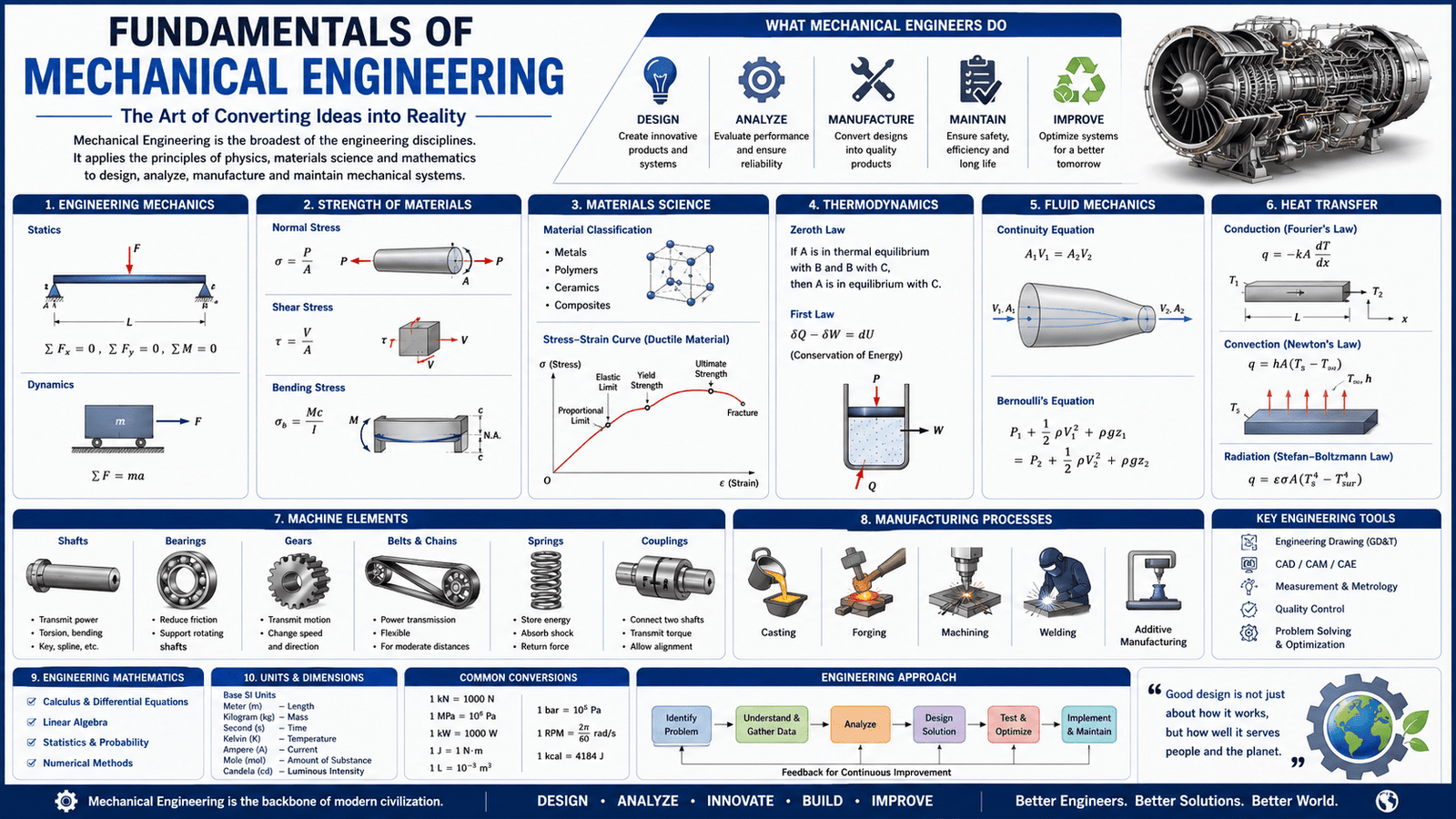
Introduction
Mechanical engineering is everywhere. Look around you—the car you drive, the elevator you take, the manufacturing plant that produces your food, the aircraft that carries you across the world. All of these systems and countless more are the result of mechanical engineering. It is the branch of engineering that deals with moving machines, tools, and their components.
Yet for many people, mechanical engineering can seem intimidating. The field is vast. The terminology is unfamiliar. The path from student to professional engineer appears long and uncertain. Where does one even begin?
The answer is simple: start with the fundamentals.
Every successful mechanical engineer began by understanding the basic tools, machines, and components that form the foundation of the discipline. Before designing complex systems, they learned about hand tools and workshop practices. Before optimising industrial processes, they understood how pumps, motors, and gearboxes work. Before innovating new solutions, they grasped the principles of bearings, seals, and power transmission.
This is the knowledge that separates those who merely have an interest in engineering from those who can actually practice it. It is the foundation upon which careers are built.
The Learn the Fundamentals of Mechanical Engineering course is designed specifically for those who want to build this foundation. Created by an experienced engineer with over a decade of industry experience, this course provides the necessary ground knowledge to start or enhance your engineering knowledge in preparation for entering the industry.
This guide provides a comprehensive overview of what mechanical engineering fundamentals entail, why these skills matter for your career, what the course covers, and how you can begin your journey today.
What Are the Fundamentals of Mechanical Engineering?
The fundamentals of mechanical engineering encompass the core concepts, principles, and practices that are essential for understanding and solving mechanical engineering problems. They provide a solid groundwork for students to build their knowledge and skills in more specialised areas of mechanical engineering.
The Core Disciplines
Mechanical engineering fundamentals draw upon several core disciplines:
Classical Mechanics
This is the foundation of mechanical engineering. It includes statics (the study of forces on stationary objects), dynamics (the study of forces on moving objects), and strength of materials (the study of how materials behave under stress).
Thermodynamics
The study of energy, heat, and work. Mechanical engineers must understand how energy is transferred from one form to another to suit a specific demand. This is essential for designing engines, power plants, and refrigeration systems.
Fluid Mechanics
The study of fluids (liquids and gases) in motion and at rest. This is essential for understanding pumps, compressors, piping systems, and hydraulic equipment.
Materials Science
The study of material properties and how they behave under different conditions. Mechanical engineers must select appropriate materials for their designs, considering factors such as strength, durability, and cost.
Machine Design
The application of engineering principles to design mechanical components and systems. This includes understanding gears, bearings, shafts, and other machine elements.
Practical Knowledge
Beyond theoretical principles, mechanical engineering fundamentals also include practical knowledge:
- Workshop tools and their applications
- Hand tools and workshop practices
- Valves, connectors, and piping components
- Pumps, motors, and gearboxes
- Bearings, seals, sprockets, and chains
- Conveyor belts, pulleys, hoists, and lubrication
Why Mechanical Engineering Fundamentals Matter
Foundation for Advanced Study
Understanding the fundamentals is essential for advanced study in mechanical engineering. Without a solid grounding in basic principles, more complex topics become difficult or impossible to grasp. As one course description notes, this course provides a solid groundwork for students to build their knowledge and skills in more specialised areas of mechanical engineering.
Career Preparation
The fundamentals of mechanical engineering are what employers expect entry-level engineers to know. Whether you are applying for an internship, a graduate position, or your first full-time role, you will be expected to demonstrate knowledge of basic engineering principles, tools, and practices.
Practical Application
Unlike some academic subjects that remain theoretical, mechanical engineering fundamentals have direct practical application. Understanding how tools work, how machines operate, and how components function is essential for anyone working in or around engineering environments.
Career Versatility
A strong foundation in mechanical engineering fundamentals opens doors across multiple industries. Mechanical engineers work in automotive, aerospace, manufacturing, energy, consumer products, medical devices, and countless other sectors. The fundamentals are transferable across all of them.
Confidence Building
For students and early-career professionals, understanding the fundamentals builds confidence. When you know the basics, you can engage in engineering discussions, ask informed questions, and contribute meaningfully to projects.
What You Will Learn in This Course
The Learn the Fundamentals of Mechanical Engineering course is designed to give you the necessary ground knowledge to start or enhance your engineering knowledge in preparation for entering the industry.
Course Overview
| Feature | Detail |
|---|---|
| Total Duration | 3 hours 22 minutes |
| Number of Lectures | 35 lectures |
| Number of Chapters | 7 chapters |
| Language | English |
| Instructor | Shahed – Entrepreneur, Engineer, and Corporate Trainer |
| Instructor Experience | Over a decade in mechanical engineering, FMCG, and aviation industries |
| Student Enrollment | 3,106+ students |
| Instructor Rating | 4.4 |
What You Will Master
Hand Tools and Workshop Tools
You will learn about the tools used in mechanical engineering workshops. This includes understanding the purpose, application, and proper use of various hand tools and workshop equipment. This knowledge is essential for anyone working in or around engineering environments.
Valves and Connectors
You will understand the different types of valves and connectors used in mechanical systems. This includes their functions, applications, and selection criteria. Valves and connectors are fundamental components in piping systems, hydraulic systems, and pneumatic systems.
Pumps, Motors, and Gearboxes
You will learn about the principles, types, and applications of pumps, motors, and gearboxes. These are the core components that convert energy into motion and are found in virtually every mechanical system.
Bearings, Seals, Sprockets, and Chains
You will understand the function and selection of bearings, seals, sprockets, and chains. These components are essential for power transmission and motion control in mechanical systems.
Conveyor Belts, Chains, Pulleys, Hoists, and Lubrication
You will learn about material handling equipment and lubrication principles. Conveyor systems, hoists, and pulleys are fundamental to manufacturing and industrial operations.
The Engineering Industry
You will gain insight into the mechanical engineering industry, its applications, and career opportunities. This includes understanding the role of mechanical engineers in improving efficiency across a wide range of industries.
Course Structure
Chapter 1: Introduction
Chapters 2-7: Core Content
- Hand Tools and Workshop Tools
- Valves and Connectors
- Pumps, Motors, and Gearboxes
- Bearings, Seals, Sprockets, and Chains
- Conveyor Belts, Chains, Pulleys, Hoists, and Lubrication
- Practical applications and industry insights
Enrol in Learn the Fundamentals of Mechanical Engineering Now
Who Should Take This Course
High School Students
Students completing their senior year of high school who are considering a career in engineering will find this course an invaluable introduction. It provides a clear, accessible overview of what mechanical engineering actually involves.
Technical College Students
Students enrolled in technical colleges who want to build a strong foundation in mechanical engineering principles will benefit from this practical, industry-focused training.
Entry-Level Professionals
Individuals who are joining the engineering industry at an entry level will gain the knowledge they need to succeed in their roles. This course bridges the gap between academic knowledge and practical industry requirements.
Career Changers
Anyone who wishes to advance their knowledge in the engineering industry or transition into a mechanical engineering career will find this course an ideal starting point.
Engineering Enthusiasts
Anyone with an interest in how machines work, how tools are used, and how mechanical systems function will enjoy this accessible, practical course.
Why This Course Is Different
Designed for Beginners
This course is specifically designed to be easily comprehensible and not just an overview. It is not a theoretical lecture series—it is a practical introduction to the tools, machines, and components that mechanical engineers actually use.
Taught by an Experienced Industry Professional
The instructor, Shahed, is an entrepreneur, engineer, and corporate trainer with over a decade of working experience in the mechanical engineering, Fast Manufacturing Consumer Goods, and Aviation Industries. He has worked for some of the largest blue-chip companies in the world where engineering is the core basis of their operational outputs. This real-world experience informs every lecture.
Practical, Not Just Theoretical
The course goes over an array of engineering concepts and provides explanations for you, the learner, to become proficient in your engineering journey. It is designed to give you practical knowledge that you can apply immediately.
Comprehensive Yet Accessible
With 35 lectures across 7 chapters, the course covers the essential topics without overwhelming you. The material is structured to be digestible and engaging.
Career-Focused
The course is designed to prepare you for entering the industry or succeeding in your employed or future employment position. It is not just about learning—it is about building a career.
Requirements
The course has modest and accessible requirements:
- General knowledge of the world around you
- High School-level math and physics
- An underlying understanding of the industry and what are the applications of it into the everyday way of life
No prior engineering experience is required. This course is designed for complete beginners.
Frequently Asked Questions
What are the fundamentals of mechanical engineering?
The fundamentals encompass the core concepts, principles, and practices essential for understanding and solving mechanical engineering problems. This includes classical mechanics, thermodynamics, fluid mechanics, materials science, machine design, and practical knowledge of tools, machines, and components.
Do I need prior engineering experience to take this course?
No. This course is designed for complete beginners. High school-level math and physics are the only prerequisites.
How long is the course?
The course includes 3 hours 22 minutes of video content across 35 lectures and 7 chapters.
Who is the instructor?
The course is taught by Shahed, an entrepreneur, engineer, and corporate trainer with over a decade of experience in mechanical engineering, FMCG, and aviation industries.
Will I receive a certificate upon completion?
Yes. Udemy provides a certificate of completion for this course.
What will I be able to do after completing this course?
You will understand the basis of the tools, machinery, and components used in the engineering industry. You will be prepared to enter the industry or advance in your current engineering role.
Is this course suitable for high school students?
Yes. The course is specifically designed for students completing their senior year of high school who are considering a career in engineering.
Building Your Career in Mechanical Engineering
The Engineering Career Pathway
Student → Fundamentals → Specialisation → Professional
Every mechanical engineer follows this pathway. The journey starts with understanding the fundamentals. From there, you can specialise in areas such as design, manufacturing, thermal systems, robotics, or any of the many sub-disciplines within mechanical engineering.
Industries That Need Mechanical Engineers
- Automotive: Designing vehicles and their components
- Aerospace: Developing aircraft and spacecraft systems
- Manufacturing: Optimising production processes and equipment
- Energy: Designing power generation and distribution systems
- Consumer Products: Developing everyday products
- Medical Devices: Creating life-saving equipment
- Robotics: Designing automated systems
Skills Employers Look For
Based on industry requirements, employers typically seek mechanical engineers who understand:
- Basic engineering principles and their practical application
- Tools, machinery, and components used in the industry
- How to approach and solve engineering problems
- The ability to work in teams and share expertise
- Advanced technical skills and strong theoretical knowledge
Mastering Mechanical Engineering Fundamentals: Your Next Step
Learning the fundamentals of mechanical engineering presents a choice. You can struggle through confusing textbooks and fragmented online resources. Or you can take a structured, practical course designed by an experienced industry professional.
The Learn the Fundamentals of Mechanical Engineering course provides exactly this structured approach. With 3.5 hours of focused instruction across 35 lectures, you will develop the skills to:
- Understand the basis of tools, machinery, and components used in the engineering industry
- Identify and apply workshop tools and hand tools
- Understand valves, connectors, pumps, motors, and gearboxes
- Select and apply bearings, seals, sprockets, and chains
- Understand conveyor systems, pulleys, hoists, and lubrication principles
- Build a strong foundation for further study or career entry
The course starts from the very basics. No prior engineering experience is required.
Enrol in Learn the Fundamentals of Mechanical Engineering Now
Recommended Related Courses
To build a comprehensive mechanical engineering skillset, consider these additional courses:
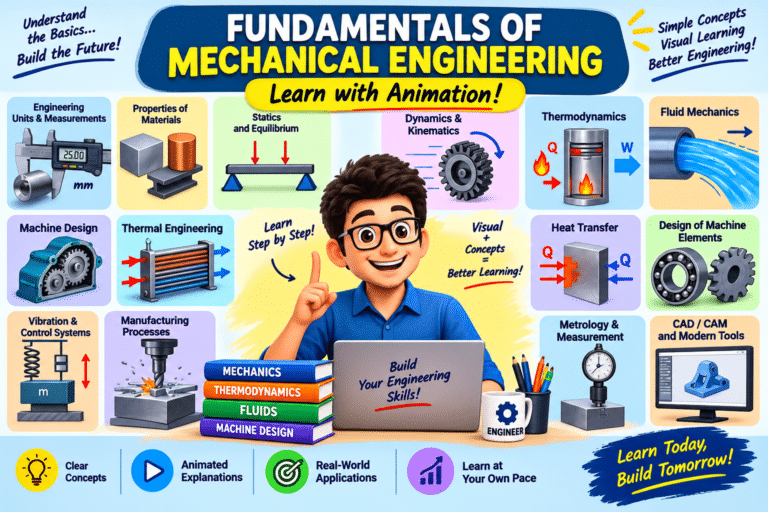
Fundamentals of Mechanical Engineering: Learn with Animation – A visual, animation-based introduction to mechanical engineering fundamentals, making complex concepts easier to understand.
Thermodynamics for Mechanical Engineering – Build foundational knowledge in thermodynamics, a core discipline of mechanical engineering.
Basics of Mechanical Design Engineering (2022) – Understand the fundamentals of mechanical design engineering and industry-required skills.
Mechanical Engineering-Machine Designing-1 – Learn to design and model machine components including gears, shafts, and springs.
TOP 50 MECHANICAL ENGINEERING INTERVIEW QUESTIONS – Prepare for mechanical engineering interviews with comprehensive question banks and practice tests.
Career Kickstart: Mechanical Engineers Job Ready – Complete career preparation for mechanical engineers entering the job market.
The Complete Mechanical Engineering Course – 12 Courses in 1 – Comprehensive coverage of all mechanical engineering disciplines.
Final Thoughts
Mechanical engineering is one of the most versatile and rewarding careers available. It is a profession that touches every aspect of modern life, from the vehicles we drive to the energy that powers our homes to the medical devices that save lives. But like any profession, it starts with a foundation.
The fundamentals of mechanical engineering—understanding tools, machines, components, and basic principles—are the building blocks of a successful career. They are what enable you to progress from student to professional, from novice to expert.
The Learn the Fundamentals of Mechanical Engineering course provides the structured, practical introduction you need to start your journey. With 3.5 hours of expert instruction, 35 lectures, and practical industry knowledge, it is the ideal starting point for anyone interested in mechanical engineering.
Start your engineering journey today.
Enrol in Learn the Fundamentals of Mechanical Engineering
About the Author