

 Edu_Admin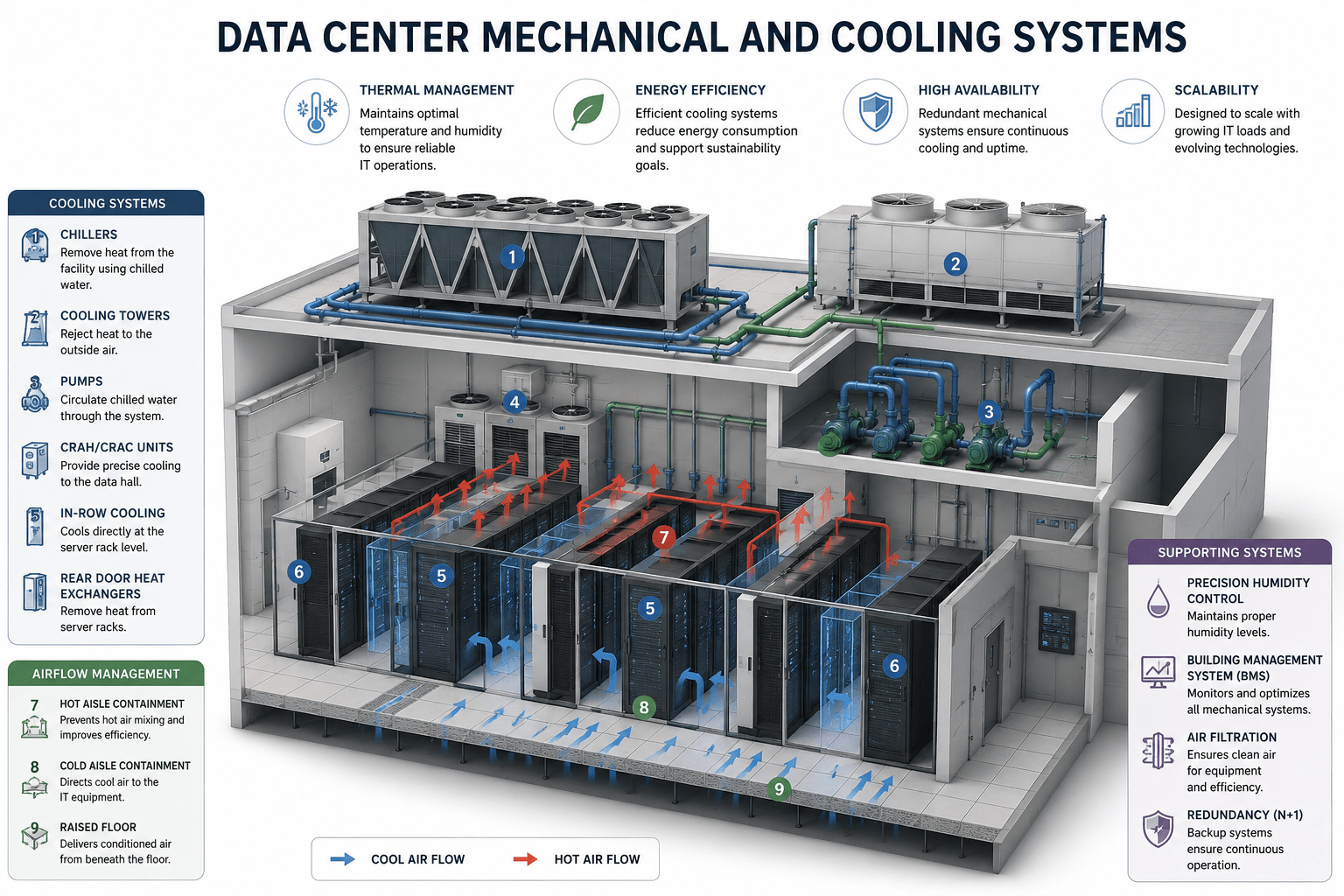
Introduction
Data centers are the physical backbone of the digital economy. Every cloud computation, streaming video, financial transaction, and artificial intelligence model runs on servers housed in these facilities. Yet the most critical component of a data center is often invisible to the end user: the mechanical and cooling infrastructure that keeps everything operational.
Consider the scale of the challenge. Modern data centers commonly require cooling capacity of 35 to 70 watts per square foot, while newer high-density installations can reach 200 to 300 watts per square foot or higher. A 100-kilowatt IT load requires approximately 100 kilowatts of cooling capacity before ancillary loads are included. As digital infrastructure becomes more powerful, more compact, and more essential to everyday business operations, data center cooling has become one of the most important disciplines in facility engineering.
What was once treated as a supporting mechanical service is now a primary determinant of uptime, operating cost, and scalability. In high-density environments, thermal management is no longer a background issue but a core design problem that influences room layout, equipment selection, airflow control, and long-term reliability.
This guide provides a comprehensive introduction to data center mechanical and cooling systems. It covers the fundamental principles, the main cooling architectures, key components, efficiency metrics, and the essential knowledge required for professionals working in this critical field.
What Is a Data Center Cooling System?
A data center cooling system includes the mechanical, thermal, and fluid-based infrastructure that removes heat generated by IT equipment. Servers, networking gear, and storage devices convert electrical power into heat at high rates. Cooling systems capture that heat, move it away from sensitive components, and reject it safely to the environment or to heat reuse systems.
The core objectives of data center cooling include:
- Heat capture at the rack or chip level
- Heat transport through cooling infrastructure
- Heat rejection to ambient systems or reuse loops
Successful data center thermal management balances performance, efficiency, and operational resilience. Modern cooling systems support higher rack densities while controlling energy consumption and risk.
The Foundation: Understanding Heat Load
The foundation of any data center cooling strategy is heat load. Electrical energy consumed by IT equipment is ultimately released as heat, which means every watt drawn by servers, storage, networking devices, and support systems must be removed from the space.
This simple relationship becomes more complex once supporting infrastructure is added. Uninterruptible power supply losses, power distribution losses, lighting, ventilation, and occasional occupant loads all contribute to the total thermal burden.
For this reason, cooling cannot be sized from floor area alone. A 5,000-square-foot server hall operating at 50 watts per square foot requires roughly 250 kilowatts of cooling for IT load alone. At 150 watts per square foot, the same room requires about 750 kilowatts.
In modern facilities, rack density is often a more important design driver than room size. As equipment becomes more compact and power density rises, the problem becomes increasingly localised. The thermal challenge shifts from cooling a room to cooling specific rows, racks, and inlets.
Types of Data Center Cooling Systems
Air-Based Cooling Systems
Air cooling remains common across enterprise and colocation environments. These systems rely on computer room air conditioners or handlers, airflow management, and containment strategies.
Computer Room Air Conditioning (CRAC)
CRAC units were the foundation of early data center cooling. They draw in warm return air, cool it with direct expansion systems, and redistribute the chilled air back to the room. The approach is simple and efficient for lower density deployments.
The drawback is inefficiency at higher loads. As rack power density climbs beyond 5 to 10 kilowatts, CRAC units often struggle to maintain even temperature setpoints across the room without overcooling or driving up energy expenditure.
Computer Room Air Handlers (CRAH)
By using chilled water from external chillers, CRAH systems decouple cooling from mechanical refrigeration, resulting in greater efficiency for medium to large facilities. CRAHs integrate into building chilled water loops, enabling precise control of the facility environment.
These systems are limited by the investment cost of facility systems integration and the climate of the region.
Liquid Cooling Systems
Liquid cooling systems use water or water-based coolants to remove heat more efficiently than air. Liquids carry significantly more thermal energy, which enables precise and scalable data center thermal management.
The appeal of liquid cooling is straightforward: liquids transfer heat far more efficiently than air, allowing direct-to-chip systems to remove heat at the source and stabilise temperatures under extreme loads. Water provides far higher thermal conductivity than air, which can reduce reliance on large air-handling systems and enable higher rack densities within a smaller footprint.
Common liquid cooling approaches include:
- Direct-to-chip liquid cooling that targets CPUs, GPUs, and peripherals
- Rear-door heat exchangers that cool exhaust air at the rack
- Coolant distribution units that transfer heat from liquid-cooled servers to the facility water system
Liquid cooling supports higher rack power, improved energy efficiency, and greater design flexibility. Many modern facilities adopt liquid cooling to prepare for future workloads while maintaining operational stability.
As AI workloads surge, engineers are facing a critical challenge: how to cool increasingly dense, high-performance data centres efficiently. Traditional air cooling systems can support up to 50 kilowatts per rack, but newer GPU-driven workloads are pushing far beyond this limit. Direct-to-chip cooling is emerging as a key solution, with specially designed cold plates that can remove up to 80 percent of the heat generated at source.
Immersion Cooling Systems
Immersion cooling submerges IT hardware directly into dielectric fluid. This approach delivers excellent heat transfer and enables extreme power density. For very high densities, up to 1 megawatt per rack, more advanced methods such as two-phase cooling and full immersion are being deployed.
Immersion cooling systems require specialised hardware, maintenance processes, and facility integration. These requirements shape adoption primarily within specialised or experimental environments.
Hybrid Cooling Architectures
Direct-to-chip liquid cooling, immersion systems, and hybrid architectures are becoming core elements of modern mechanical design. Hybrid environments where air- and liquid-cooled racks operate simultaneously require careful engineering to balance flow velocities, account for variable loads, and manage the interactions between different cooling approaches.
Key Mechanical Components
Chillers
Chillers are the heart of many data center cooling systems. They remove heat from chilled water loops and reject it to the environment through cooling towers or dry coolers. Modern high-efficiency centrifugal chillers are designed to support both liquid- and air-cooled IT loads.
Economizers
Economizers enable free cooling by using outside air or water when ambient conditions are favourable. This reduces or eliminates the need for mechanical compression, significantly improving energy efficiency. With advanced systems, data centres can operate in economizer mode for much of the year, cooling without mechanical compression.
Coolant Distribution Units (CDUs)
CDUs regulate temperature and fluid quality to protect high-value equipment. They incorporate filtration, often down to 25 microns, and continuous monitoring of fluid properties. This precision is essential when dealing with infrastructure where individual servers can exceed $1 million in value. Modern CDU systems can support capacities up to 2.5 megawatts with expected lifespans of over 20 years.
Airflow Management
Cooling performance depends as much on airflow management as on refrigeration capacity. The most effective arrangement remains the hot aisle/cold aisle layout, in which rack fronts face cold aisles and rear exhausts face hot aisles. This configuration reduces recirculation, improves temperature uniformity, and helps ensure that conditioned air reaches server intakes before it is reheated by nearby equipment.
This principle becomes even more important as rack loads rise from the historical range of 4 to 5 kilowatts toward 12-kilowatt average racks and beyond. Once density increases, poor airflow organisation quickly undermines performance.
Good cooling is not just about producing cold air but about controlling where that air goes, how it moves through the racks, and how it returns to the system.
Temperature and Humidity Control
Temperature control alone is not enough. Humidity control is equally critical because both excessive moisture and overly dry air can damage electronic equipment. Too much humidity can lead to condensation on components, while too little humidity can increase the risk of electrostatic discharge. In a high-value digital environment, either condition can create costly downtime.
Efficiency Metrics
Power Usage Effectiveness (PUE)
PUE is the most widely used metric for data center efficiency. It is calculated as the ratio of total facility energy consumption to IT equipment energy consumption. A PUE of 1.0 represents perfect efficiency, where all energy goes to IT equipment.
By operating at higher water temperatures, data centres can reduce PUE to as low as 1.1, compared to around 1.5 for traditional systems. Integrated liquid-cooled facilities can achieve PUE values near 1.10, compared to approximately 1.4 to 1.6 for traditional designs.
Water Usage Effectiveness (WUE)
WUE measures water consumption relative to IT energy use. This metric is becoming increasingly important as water scarcity concerns grow and as liquid cooling adoption increases.
Carbon Usage Effectiveness (CUE)
CUE measures carbon emissions relative to IT energy use, reflecting the environmental impact of data center operations.
Mechanical Design Considerations for Modern Data Centers
Liquid Cooling Integration
The shift to liquid cooling introduces new complexities that go well beyond thermal performance. Mechanical design choices, fluid chemistry, and materials compatibility now play a decisive role in long-term reliability, commissioning success, and sustainability outcomes.
High-efficiency thermal management solutions rely on narrow channels, precision manifolds, and tight tolerances. These features improve heat transfer but increase sensitivity to fouling, corrosion, and flow imbalance, making materials selection a key step in the design process.
Mixed-metal systems introduce galvanic corrosion potential that can be managed through considered design and water chemistry control. Copper, aluminium, stainless steel, and various alloys can coexist successfully, but their interactions should be anticipated from the outset.
Fluid Chemistry
In liquid-cooled systems, water quality is not a background consideration; it directly influences system performance and longevity. Parameters such as pH, alkalinity, conductivity, hardness, and dissolved oxygen affect corrosion rates and material stability. Suspended solids and microbial growth can obstruct cold plates and reduce effective heat transfer long before alarms are triggered.
Unlike traditional cooling towers, where some variability can be tolerated, direct-to-chip systems typically demand tighter control and more consistent monitoring. Effective mechanical design may involve incorporating filtration, sampling points, and online monitoring into the system layout from the earliest design phases.
Commissioning and System Preparation
Disciplined design assumptions, consistent water quality from the start, and pre-operational system preparation are essential for reliable operation. Many issues that arise in liquid-cooled environments are mechanical or chemical in nature rather than purely thermal, which means early engineering decisions can significantly influence system reliability.
Data Center Mechanical and Cooling Course: Your Next Step
Understanding data center mechanical and cooling systems requires specialised knowledge that is rarely covered adequately in university curricula or general engineering training. This is where targeted professional education becomes invaluable.
The Data Center Essentials: Mechanical and Cooling course provides the essential knowledge required for professionals working in this critical field. The course covers:
- Concepts, definitions, and operating conditions – typical mechanical terms, cooling operations, and redundancy levels
- The fundamentals of data center cooling systems
- Mechanical plant equipment and heat rejection systems
- Air and liquid cooling implementations
- Efficiency metrics including PUE, WUE, and CUE
- ASHRAE standards and environmental criteria
- Practical knowledge for data center design and operation
Enrol in Data Center Essentials: Mechanical and Cooling Now
Recommended Related Courses
To build a comprehensive understanding of data center infrastructure and mechanical systems, consider these additional courses:
Data Center Cooling: The Thermal Backbone of Digital Infrastructure – A detailed industry article on modern cooling challenges and solutions.
Mechanical Aspects of Shell and Tube Heat Exchangers – Understand heat exchanger principles critical for data center cooling systems.
Thermodynamics for Mechanical Engineering – Build foundational knowledge in thermodynamics for understanding cooling system performance.
Chiller and Cooling Plant Mechanical on Autodesk Revit – Learn to design chiller and cooling plants using Revit MEP.
Revit MEP – Mechanical / HVAC Systems – Develop HVAC system design skills for data center applications.
CFD Simulation Course, ANSYS Fluent for Mechanical Engineers – Learn computational fluid dynamics for airflow analysis in data centers.
Final Thoughts
Data center cooling has evolved from a supporting mechanical service to a primary determinant of uptime, operating cost, and scalability. As rack densities continue to rise and AI workloads push thermal management to new limits, the demand for professionals who understand data center mechanical and cooling systems will only grow.
The shift from air to liquid cooling introduces new complexities in materials selection, fluid chemistry, and system design. Engineers who master these disciplines will be well-positioned for career advancement in one of the most critical infrastructure sectors of the digital economy.
Start building your expertise today with the right training and take the next step in your professional development.
Enrol in Data Center Essentials: Mechanical and Cooling
About the Author