

 Edu_Admin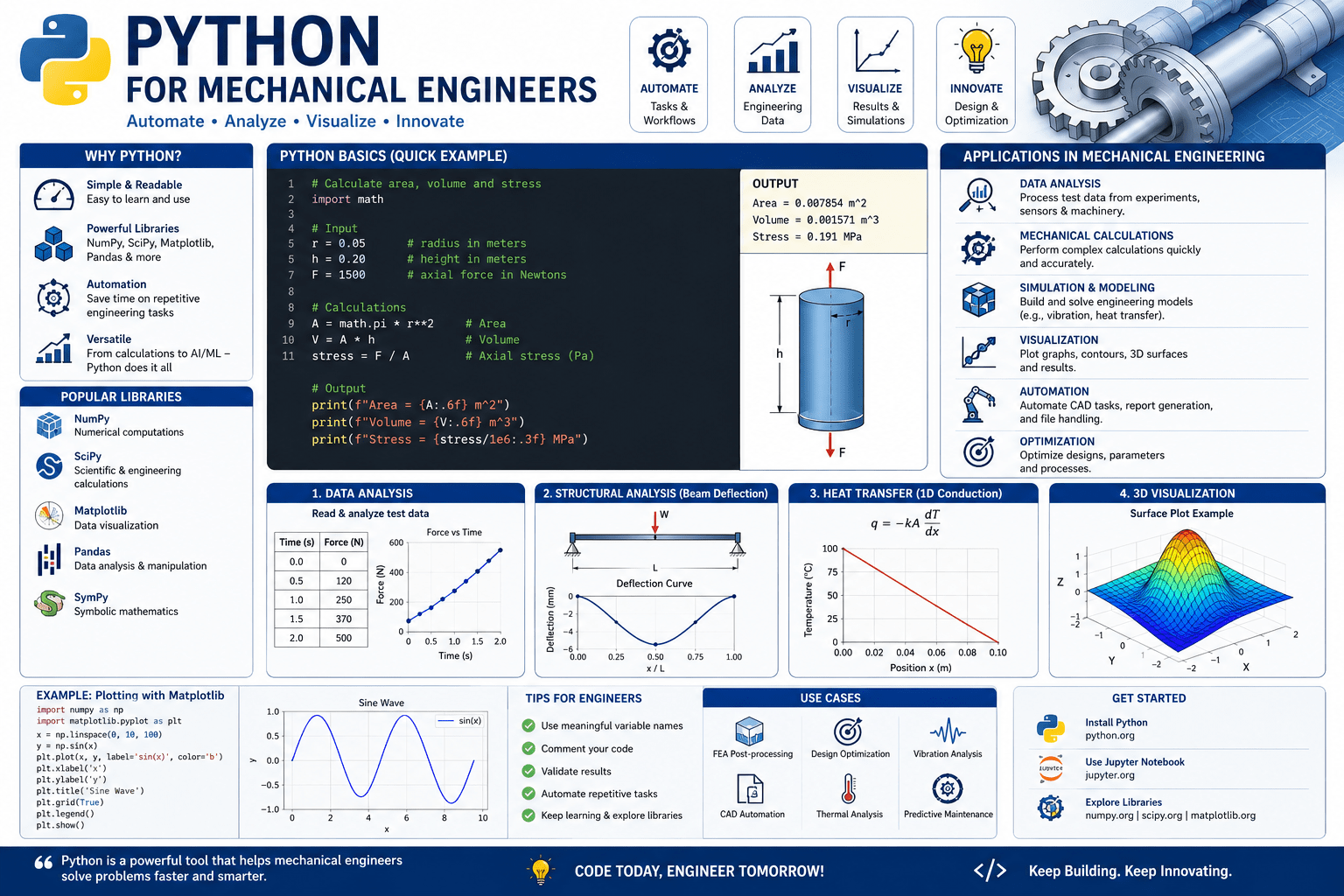
Introduction
The landscape of mechanical engineering is undergoing a fundamental transformation. The days when a mechanical engineer could rely solely on traditional design skills and manual calculations are over. Modern mechanical engineering demands computational proficiency.
Python for Mechanical Engineers has emerged as the programming language of choice for engineers across disciplines. Its simplicity, versatility, and powerful libraries make it indispensable for solving complex engineering problems. From analysing mechanical vibrations to automating finite element simulations, Python is reshaping how mechanical engineers work.
Consider the numbers. Over 6,900 students have already enrolled in Python courses designed specifically for mechanical engineers. Universities are integrating Python into their mechanical engineering curricula, with courses teaching students to develop algorithms for dynamic systems, solve differential equations numerically, and work with numeric and graphic libraries. Leading institutions like Purdue now offer data science courses for sophomore mechanical engineers using Python and Jupyter notebooks.
Yet many mechanical engineers remain hesitant to learn programming. Some believe it is too difficult. Others think it is irrelevant to their work. These assumptions are incorrect and increasingly costly.
This guide explains why Python matters for mechanical engineers, what you can achieve with it, and how to start your programming journey.
Why Python Matters for Mechanical Engineers
Industry Demand
Employers are actively seeking mechanical engineers with Python skills. Job descriptions increasingly list Python proficiency as a requirement or strong preference. Engineers who can code have a significant advantage in the job market.
Python is used across the engineering industry for:
- Automating repetitive design and analysis tasks
- Processing and visualising engineering data
- Developing custom simulation and analysis tools
- Integrating with engineering software like Ansys and Abaqus
Efficiency and Productivity
Python enables engineers to automate tasks that would otherwise consume hours of manual work. What takes minutes in Python might take hours in spreadsheets or manual calculations.
For example, Ansys provides PyMechanical, a Python interface for automating finite element analysis workflows. Engineers can script the entire simulation process from geometry import to meshing to post-processing in plain Python. This automation dramatically reduces analysis time and minimises human error.
Problem-Solving Capability
Python excels at solving the types of numerical problems that mechanical engineers encounter daily:
- Solving systems of differential equations
- Performing numerical integration and optimisation
- Analysing vibration and dynamic systems
- Simulating heat transfer and fluid flow
- Processing experimental data
Career Advancement
Mechanical engineers who know Python command higher salaries and have access to more interesting roles. They can transition into data science, machine learning, and computational engineering positions that are closed to non-programmers.
Key Python Libraries for Mechanical Engineers
Python’s power for engineering comes from its ecosystem of specialised libraries. These libraries provide pre-built functions for scientific computing, data analysis, and visualisation.
NumPy
NumPy is the foundation of scientific computing in Python. It provides support for large, multi-dimensional arrays and matrices, along with a collection of mathematical functions to operate on these arrays. NumPy is essential for any engineering computation.
SciPy
SciPy builds on NumPy and provides advanced scientific functions including optimisation, integration, interpolation, eigenvalue problems, and differential equation solvers. It is the go-to library for engineering analysis.
Matplotlib
Matplotlib is the primary plotting library for Python. It enables engineers to create publication-quality visualisations of engineering data, including line plots, scatter plots, contour plots, and 3D visualisations. Visualising data is essential for understanding engineering problems and communicating results.
SymPy
SymPy provides symbolic mathematics capabilities, allowing engineers to perform algebraic manipulations, solve equations symbolically, and derive analytical expressions.
Pandas
Pandas provides powerful data structures for data analysis and manipulation. It is essential for working with experimental data, time series, and large datasets.
Specialised Engineering Libraries
Beyond the core libraries, Python offers specialised libraries for mechanical engineering applications:
- PyMechanical: Python interface for Ansys Mechanical, enabling automation of FEA workflows
- PyNiteFEA: Finite element analysis library for structural engineering
- easyfea: User-friendly Python library for finite element analysis
- anastruct: Specialised Python library for analysing planar trusses and structures
- VIBRANT: Tool based on Python and Abaqus for analysing complex mechanical systems
Applications of Python in Mechanical Engineering
Mechanical Vibrations and Dynamics
Python is exceptionally well-suited for analysing mechanical vibrations and dynamic systems. Engineers can write Python programs to solve differential equations of motion, analyse frequency response, and simulate system behaviour.
The course Python For Mechanical Vibrations and Dynamics provides hands-on experience with these applications, including 17 practical examples.
Finite Element Analysis (FEA)
Python enables automation and customisation of FEA workflows. Engineers can use Python to:
- Automate pre-processing and post-processing tasks
- Parametrically study design variations
- Integrate FEA with optimisation algorithms
- Create custom analysis scripts
Ansys provides PyMechanical for automating simulations, with two modes: embedding (Mechanical runs inside your Python process) and remote session (Mechanical runs as a separate server).
Heat Transfer and Fluid Mechanics
Python can solve heat transfer and fluid mechanics problems using numerical methods. Libraries like SciPy provide solvers for differential equations, while visualisation tools help interpret results.
Data Analysis and Visualisation
Mechanical engineers frequently work with experimental data. Python provides tools to:
- Load and clean data from various sources
- Perform statistical analysis
- Create professional visualisations
- Generate reports automatically
Optimisation
Python is excellent for engineering optimisation problems. Engineers can use Python to:
- Optimise design parameters
- Perform sensitivity analysis
- Solve constrained optimisation problems
- Implement machine learning for predictive modelling
Automation of Engineering Software
Python scripts can automate commercial engineering software including:
- Ansys Mechanical and Fluent
- Abaqus/CAE
- Revit (through Dynamo)
This automation saves significant time and reduces errors.
What a Comprehensive Python for Mechanical Engineers Course Should Cover
A well-designed Python course for mechanical engineers should include:
Python Fundamentals
- Installation of Python and integrated development environments
- Basic syntax, variables, and data types
- Control structures (loops and conditionals)
- Functions and modules
- File input and output
Scientific Computing Libraries
- NumPy for numerical computing
- SciPy for advanced scientific functions
- Matplotlib for data visualisation
- SymPy for symbolic mathematics
Engineering Applications
- Solving mechanics problems
- Machine design calculations
- Fluid mechanics and thermal science
- Heat transfer analysis
- Vibrations and dynamics
Visualisation Techniques
- Line plots and scatter plots
- 2D and 3D contour plots
- Animation of dynamic systems
- Interactive visualisation
Frequently Asked Questions
Do I need prior programming experience to learn Python for mechanical engineering?
No. Many Python courses for mechanical engineers start from the basics. The Python for Mechanical Engineers course assumes no prior programming knowledge.
How long does it take to learn Python for engineering applications?
With focused study, you can gain proficiency in 4-6 weeks. The fundamentals can be learned in a few days, while mastering engineering applications takes longer.
Which Python libraries are most important for mechanical engineers?
NumPy, SciPy, and Matplotlib are essential. Depending on your specialisation, you may also need Pandas, SymPy, or specialised libraries for FEA and CFD.
Can Python replace MATLAB for mechanical engineering?
Python can replace MATLAB for most engineering applications. Python is free, open-source, and has a larger ecosystem of libraries. Many universities are transitioning from MATLAB to Python.
Is Python used in industry for mechanical engineering?
Yes. Python is widely used in industry for automation, data analysis, simulation, and integration with engineering software. Companies across aerospace, automotive, energy, and manufacturing sectors use Python.
Which course should I choose for learning Python as a mechanical engineer?
A course specifically designed for mechanical engineers is ideal. The Python for Mechanical Engineers course covers mechanics, machine design, fluid mechanics, thermal science, heat transfer, vibrations, and optimisation with practical Python programs.
Mastering Python: Your Next Step
Learning Python presents a choice. You can struggle through general programming tutorials that lack engineering context. Alternatively, you can take a course specifically designed for mechanical engineers that teaches Python through engineering problems.
The Python for Mechanical Engineers course provides exactly this focused approach. The course includes:
- Python programs covering mechanics, machine design, fluid mechanics, thermal science, heat transfer, vibrations, and optimisation
- Various types of plots including line plots and 2D and 3D contour plots for visualising engineering data
- Practical, hands-on programming experience
- Applications relevant to mechanical engineering practice
The course starts from the basics. No prior programming experience is required.
Enrol in Python for Mechanical Engineers Now
Recommended Related Courses
To build a comprehensive Python and computational engineering skillset, consider these additional courses:
Python For Mechanical Vibrations and Dynamics + 17 Examples – Specialised course for analysing mechanical vibrations and dynamic systems using Python.
AI Driven Python for Mechanical Engineers – Learn Python with AI assistance for mechanical engineering applications.
Thermodynamics & Python for Process and Mechanical Engineers – Combine thermodynamics principles with Python programming.
Generative AI for Mechanical Engineers – Explore AI applications in mechanical engineering.
No-Code AI for Mechanical Engineers – Introduction to AI without extensive coding requirements.
ANSYS mechanical APDL for Finite Element Simulation – Learn FEA simulation with Ansys.
CFD Simulation Course, ANSYS Fluent for Mechanical Engineers – Computational fluid dynamics training for mechanical engineers.
FEA & CFD with ANSYS Mechanical & ANSYS Fluent – For Beginner – Comprehensive introduction to engineering simulation.
Final Thoughts
Python is no longer optional for mechanical engineers. It is an essential tool that enables automation, analysis, and innovation. Engineers who embrace Python position themselves for career advancement and access to more interesting work.
The programming language is accessible to beginners and powerful enough for advanced applications. With the right training, any mechanical engineer can become proficient in Python and apply it to real engineering problems.
Start your Python journey today with the right course and approach.
Enrol in Python for Mechanical Engineers
About the Author